Our recommendations in three classes
The overview summarises six models from entry level to the premium tier with number of compartments, material and editorial rating. The ratings are editorial assessments based on the documented features, not the result of measurements of our own. The details on each model follow below in the individual boxes.
| Model | Compartments | Material | Price range | Rating |
|---|---|---|---|---|
| Heisse & Söhne Executive 10 | 10 | Wood and aluminium | Premium | 4.4/5 |
| Friedrich|23 Cubano 8 | 8 (+1) | Genuine leather | Mid-range | 4.3/5 |
| Rothenschild RS-1100-20BU | 20 | Wood, bubinga look | Mid-range | 4.1/5 |
| Songmics watch box with 12 compartments | 12 | PU cover | Entry level | 4.0/5 |
| ProCase watch box, 2 levels | 8 | Espresso finish | Entry level | 4.0/5 |
| VLANDO watch box, lockable | 6 | Leather according to the manufacturer | Entry level to mid-range | 3.9/5 |

Songmics watch box with 12 compartments
- Twelve compartments with a viewing lid and velvet cushions for the price of two polishing cloths
- The pragmatic organising solution for starter collections and quartz watches
- The faux leather feel and cushion size do not reach the wood class; the manufacturer does not state exact compartment dimensions

ProCase watch box with 8 compartments, 2 levels
- Eight watches on top and a second level below for jewellery, straps or cufflinks, which tidies two problems at once
- The glass lid shows off the collection and keeps dust out, without having to open the box to choose
- The watch cushions are removable, so individual compartments can be cleared for wider straps or small items
- The manufacturer does not state compartment dimensions or maximum case diameter for this variant; measure large divers beforehand
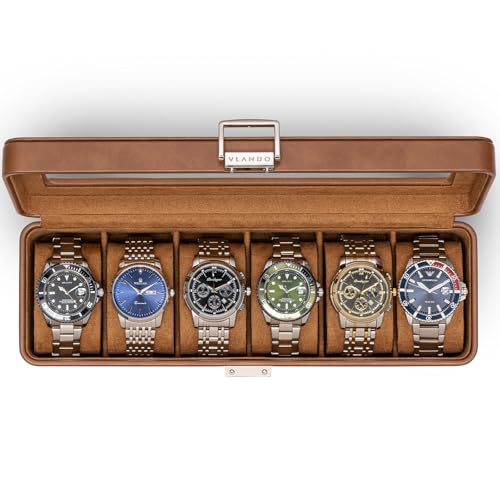
VLANDO watch box for 6 watches, lockable
- Six slots behind a glass lid that shows the collection and protects it from dust at the same time
- The lockable lid keeps children's hands and curious guests away, a sensible everyday access safeguard
- Leather on the outside according to the manufacturer, plus PU watch cushions that adapt to different wrist circumferences
- The manufacturer states dials up to 48 millimetres, beyond that it gets tight, and the lock remains an access safeguard, not theft protection

Friedrich|23 Cubano 8
- Roughened, lively genuine leather that develops a patina over the years
- Eight cushions plus a central compartment for tools, straps or papers
- Series partly with soft-close and cable port, practical for a smartwatch too
- Leather commands a premium over functionally equivalent wooden boxes

Heisse & Söhne Executive 10
- The clasp system wraps gently around straps and presents watches upright rather than squeezed
- Material mix of high-gloss wood and aluminium with a velour interior
- Developed and made in Germany, with the corresponding spare-parts prospects
- Check clasp width and strap circumference against very narrow straps before buying

Rothenschild RS-1100-20BU watch display cabinet
- Twenty compartments with room for cases up to around 53 millimetres, even large divers fit
- Lockable glass door as protection against dust and tarnishing, mounted either with a stand or as a wall cabinet
- Compact 32 by 44.5 centimetres at 5.4 kilograms, matt sealed wooden surface in a bubinga look
- Display cabinet rather than cushion box: no individual cushion holding as in classic watch boxes, straps lie more openly
What a watch box is for, and what it is not
The watch box is the basic equipment of every collection: it keeps dust out, prevents the scratches watches inflict on each other in a drawer, and protects dials and straps from fading light. It also brings order to the ritual, because if you see your watches, you wear them. For most collections, a good box is therefore more sensible than any other accessory.
Just as important is the honest limit: a watch box is not a security product. Even lockable lids only stop curious hands, not a burglary, and when it comes to a claim, no insurer cares about the lock on a little box. Once a collection reaches a relevant value, a certified watch safe belongs in the plan; our article on safe security grades explains the basics.
The designs at a glance
The market sorts itself into four designs. The classic box with a glass lid is the all-rounder for shelf and chest of drawers: watches visible, dust kept out. The watch case with a sturdy frame and a carry-handle character suits anyone who moves their watches now and then. The flat slim case for two to four watches lives in a drawer or safe. And the display cabinet class with drawers and add-ons becomes a piece of furniture, often combined with winder modules, and then we are in the territory of the watch winder guide.
The buying criteria that boxes fail on
1. Compartment size: the most common bad buy
The standard compartments of many boxes are cut for cases up to about 42 millimetres; modern divers, chronographs and Panerai formats of 44 to 47 millimetres jam or rest on the bezel. Reputable manufacturers state documented maximum dimensions: Rothenschild, for example, gives case diameters of up to 53, in some cases 55 millimetres for its common boxes. Measure your largest watch and buy by that figure, not by the number of compartments. How to measure cases correctly is shown by the watch size guide on our sister site.
2. Cushion and holder
The cushion decides whether the watch is presented or squashed: soft, removable cushions of moderate circumference fit most wrist sizes, while very plump cushions overstretch small leather straps. A clever alternative is clasp systems such as on the Heisse & Söhne Executive 10, which enclose straps gently. For ladies' watches and vintage pieces with narrow straps, it is worth looking for explicitly small cushion circumferences.
3. Material, smell and inner lining
Whether wood, leather or faux leather is initially a matter of taste; functionally, what counts is the interior: soft lining without hard seams on contact surfaces, cleanly finished dividers, no sharp edges. An underrated warning sign is a chemical smell: strongly outgassing varnishes and glues in very cheap boxes do not belong permanently next to dials and leather straps. If in doubt, let the new box air out open for a few days. You can read more about the characteristics of solid wood in our in-depth article on the wooden watch box.
4. Lid and lock
A glass lid makes the collection visible and still keeps dust away, which is the right choice for most people. Locks are access protection against children's hands and curious visitors, nothing more, but as such quite sensible. If you keep the box open in the bedroom or office, you also benefit from a low-UV spot, because sunlight bleaches every dial in the long run.
Storing correctly: the short rules
The best place for the box is dry, stable in temperature and free of direct sun, so rather a chest of drawers than a windowsill, rather a living space than a cellar. Leather straps appreciate air circulation, so do not keep the box hermetically sealed, and let worn watches air out first. Automatic watches can safely stay still in the box: why standing still does no harm, and when a winder is worthwhile instead, is explained in our article Does my watch need a watch winder?. And for travel, the travel case takes over.
Conclusion
The watch box is the most sensible accessory of the whole collection, if it fits the watches: choose compartments by the largest watch, cushions by the smallest strap, material by taste and nose. Songmics, ProCase and VLANDO organise the entry level, Rothenschild and Friedrich|23 carry the mid-range, Heisse & Söhne the premium tier. What remains is the question of security, and only the watch safe answers that honestly.
This page was translated with AI from the German original. The German original was written with an AI language model and editorially reviewed and approved before publication by Seydhan Cakmak, who holds editorial responsibility. The translation itself has not been reviewed again by a human.
The product images shown are not AI images but manufacturer and retailer photos from the Amazon catalogue, which we embed unchanged. One limitation we disclose: Amazon and the sellers there now use generative tools in their listings themselves. Whether an individual catalogue image is affected is something we cannot check from the outside, so we make no claim either way. As soon as an image demonstrably comes from a generative model, we label it visibly on the image as an AI image. More on this on our AI transparency page.