The recommendations at a glance
| Model | TPD range | Power | Strength | Price range | Rating |
|---|---|---|---|---|---|
| Barrington Single Watch Winder | 650 to 1,950 | Mains or battery | Safe-suitable, stackable | Mid-range | 4.2/5 |
| Modalo Inspiration MV4 | 900 to 1,700 | Mains or battery | Solid wood, holder technology | upper mid-range | 4.2/5 |
| botta Cube | 600 to 1,800 | USB or battery | Very quiet, modular and stackable | upper mid-range | 4.2/5 |
| Klarstein St. Gallen II | 650 to 1,500 | Mains | Value for money | Entry level | 4.1/5 |
| CHIYODA Single | 12 modes | Mains or battery | Budget function | Entry level | 3.9/5 |
| MOZSLY Single Winder | 12 modes | Mains or battery (seller claim) | Leather look on a budget | Entry level | 3.9/5 |
| Heisse & Söhne Watch Winder Moon | 950 and 2,150 | Battery (2x LR14) | Compact for safe and drawer | upper mid-range | 4.2/5 |
| MODALO Saturn Style MV4 | 900 to 1,700 | Mains, battery optional | Holds up to 60 mm and 400 g | upper mid-range | 4.2/5 |
| Designhütte San Diego 1 | 650 to 1,000 | Mains | Rotary knob instead of electronics | Mid-range | 4.1/5 |
| Designhütte Piccolo 2.0 | 650 / 900 / 1.200 / 1.500 | Mains via induction | smallest case in the field | Mid-range | 4.0/5 |
The devices in detail
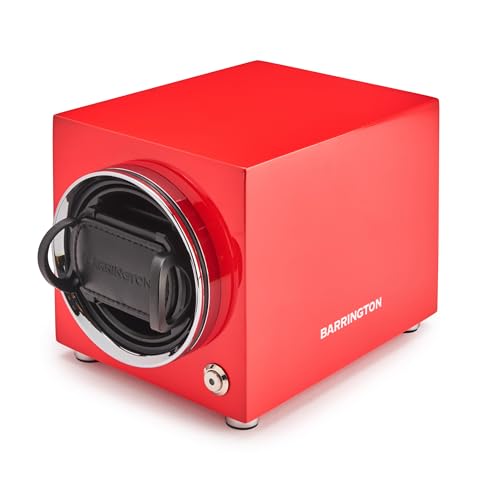
Barrington Single Watch Winder
- Five fixed rotation levels and all three rotation directions, clearly documented
- Battery operation for weeks: the pragmatic solution for a safe or cabinet without power
- Stackable, expandable as your collection grows, watches up to 50 millimetres and over 300 grams
- Marketplace prices vary considerably by colour, so compare before buying

Modalo Inspiration MV4
- New Zealand solid wood with piano lacquer and chrome-plated feet
- Clamp-technology holder securely takes even heavy watches up to 400 grams
- Rest phase in 12 o'clock position, operation via grippy dial
- Lowest TPD setting only starts at 900, less flexible for minimalist settings

botta Cube
- Almost inaudible direct drive in a sturdy aluminium housing; the roughly 14 decibels stated by the manufacturer correspond to a whisper
- Nine rotation programmes with all three rotation directions; battery operation with a runtime of around four months makes the module suitable for a safe
- Stackable rail system with central power supply: the single device can become a wall of nine when needed
- Expansion means buying further modules at the full module price, which adds up faster than a ready-made display case

Klarstein St. Gallen II
- Four speed programmes and three rotation directions fully cover standard calibres
- Touch panel, switchable LED light and acrylic glass viewing window
- Attachment for larger watches included
- Mains operation only and plastic housing, visually plainer than the wood class

CHIYODA Single Watch Winder
- Twelve combinations of direction and speed, selectable separately
- Quiet Japanese Mabuchi motor and optional battery operation
- Manufacturer claims on maximum speed seem exaggerated; we go by the lower modes
- Build quality and holder are plainer than with Beco or Modalo, not suitable for Seiko Kinetic

MOZSLY Single Watch Winder
- Twelve combinations of rotation direction and interval, selected with a rotary switch
- Leather-covered case looks considerably more premium than the price class suggests
- Mains or battery operation according to the seller, so it can also be used away from a socket
- Young Amazon brand: noise and TPD figures are manufacturer values, documented rotation steps are missing

Heisse & Söhne Watch Winder Moon
- At 11 by 11 by 16.5 centimetres and 0.9 kilograms, the model 70019-130 is expressly intended by the manufacturer for safes and drawers, that is, for places where a wide display case simply won't fit
- Two LR14 batteries last up to three months according to Heisse & Söhne, so you don't need a power feed-through, which would cost a safe its certification
- Alternating run to the left and right, operated via a slider on the back of the case. The 4 centimetre wide watch clasp with a soft, rubber-like surface covers circumferences from 16.5 to 19.5 centimetres; a smaller clasp for 14.5 to 16.5 centimetres is available as an option. According to the manufacturer, the device moves one watch and stores another
- Only two turn levels, and even the lower one at 950 is above the 650 that many Swiss three-hand movements need. If you want fine gradations, a device with four or more levels is better; in addition, the standard clasp with a minimum circumference of 16.5 centimetres is tight for very slim wrists or short straps

MODALO Saturn Style MV4 for 1 watch
- According to MODALO, the holder takes watches up to 60 millimetres in diameter, 400 grams in weight and 15 to 21 centimetres of strap length, making it the most generous on this page; it also swallows cases that smaller holders fail on
- The manufacturer lists five programmes for the MV4 series: 900 turns per day clockwise, 900 anticlockwise, 1,700 and 900 in both directions, plus a rest phase that stops in the 12 o'clock position
- Case made of New Zealand solid wood with fine interior material, red leather design with white decorative stitching on the outside; if desired, the device runs on batteries instead of the power adapter
- There is no intermediate level between 900 and 1,700 turns. If you want to set exactly 650, you won't find it here
With single winders, the holder matters as much as the rotation speed, and that is exactly where the two new additions sit at opposite ends of the scale. The Moon from Heisse & Söhne, at 11 by 11 by 16.5 centimetres, is the most compact battery-powered unit in this selection and so fits where no cable reaches, namely in a safe or a drawer. The MODALO Saturn Style MV4 goes the opposite way and, with a diameter of 60 millimetres and 400 grams, also takes heavy diver's and pilot's watches that narrower holders cannot cope with.

Designhütte San Diego 1 watch winder
- Four clearly labelled speed settings of 650, 750, 900 and 1,000 turns per day cover the range in which the vast majority of automatic movements fall
- It is operated with a single dial; there is no menu and no button combination to look up
- The high-gloss polished body of wood and MDF with velour interior and viewing window looks more upmarket than the price class suggests, and Designhütte gives a two-year warranty
- At 13.5 centimetres wide, 14 centimetres deep and 16.5 centimetres high, the unit fits on any bedside table
- Alternating rotation only: clockwise or anticlockwise cannot be selected separately, which makes the unit the second-best choice for chronographs of the 7750 type. There is no battery compartment, so it is ruled out for the safe

Designhütte Piccolo 2.0 Schwarz
- The lowest setting is 650 turns per day, which matches exactly the value that most current ETA and Sellita movements get by on. 900, 1,200 and 1,500 are available above that
- Clockwise, anticlockwise and alternating rotation can each be selected individually. This also allows a chronograph movement of the 7750 type, which only winds clockwise, to be served
- At 10 x 15 x 12.5 centimetres and 560 grams, the unit is the smallest on this page. The motor stops the watch at the 12 o'clock position, so the dial sits upright behind the acrylic window
- Designhütte deliberately ships without an adapter and without batteries. Power is transferred by induction; the matching power adapter is an accessory and belongs in the price comparison
- The wrist circumference is given as 17 to 21 centimetres. For a wide metal bracelet on a large diver's watch, that is tight
When a single winder is the right choice
A single winder is worthwhile in two situations: your only automatic watch regularly sits for several days but should be ready to go at any time, or you own exactly one complication watch with a calendar or moon phase alongside your daily-wear watches, and resetting it is a nuisance. If, on the other hand, you rotate two to four watches anyway, a multi-watch winder saves money and space compared with several single units.
And because honesty is our business model: if you wear your only automatic almost every day, you do not need a unit at all, as your wrist takes care of the winding. The detailed weighing-up, including the question of wear, is in the article Does my watch need a watch winder?. For everyone who is buying deliberately, the comparison follows now.
The luxury outlook: single winders as manufactory pieces
What really matters with a single winder
Three checkpoints decide the purchase. First, the winding technology: adjustable turns, all three directions of rotation and rest phases are mandatory, and the values for your calibre are provided by the TPD table. Second, the holder: it must clamp your watch securely, from a small ladies' case to a heavy diver, and the manufacturers' weight figures should be taken seriously here. Third, the place of use: a quiet motor for the bedroom, battery operation for the safe, a viewing window and material for the shelf.
Everything else is a matter of taste: whether piano lacquer or plastic, LED stage or understatement, it makes no difference to the winding. That is exactly why our rating range here runs from 3.9 to 4.3, because functionally the units are closer together than their price classes suggest. Buy the unit whose weaknesses affect you least.
Conclusion
The single winder is the simplest way to keep an automatic watch ready to go: Beco for the quiet bedside solution, Barrington for the safe and for flexibility, Modalo for looks, botta for the modular system that grows with you, Klarstein for entry level, and CHIYODA or MOZSLY for the tightest budget. If your collection grows, do not switch to several single units but go straight to the comparison of watch winders for 2 to 4 watches. And you will find a suitable first automatic on our sister site under the best watches under 500 euros.
This page was translated with AI from the German original. The German original was written with an AI language model and editorially reviewed and approved before publication by Seydhan Cakmak, who holds editorial responsibility. The translation itself has not been reviewed again by a human.
The product images shown are not AI images but manufacturer and retailer photos from the Amazon catalogue, which we embed unchanged. One limitation we disclose: Amazon and the sellers there now use generative tools in their listings themselves. Whether an individual catalogue image is affected is something we cannot check from the outside, so we make no claim either way. As soon as an image demonstrably comes from a generative model, we label it visibly on the image as an AI image. More on this on our AI transparency page.