A battery-powered watch winder solves one very specific problem: you want to keep your automatic watch moving even where there is no socket within reach. That applies exactly to the safe, the lockable cabinet and any trip where you do not want to carry a power adapter. Battery operation thus turns from a nice extra into the actual reason to buy.
The recommendations at a glance
| Model | Key feature | Positions / type | Price range | Rating |
|---|---|---|---|---|
| Barrington Single Watch Winder | 650 to 1,950 TPD, documented | 1 position, battery backup | Mid-range | 4,2/5 |
| MOZSLY watch winder green leather | 12 rotation modes, leather look | 1 position, battery or mains | Entry level | 4,0/5 |
| Los Gatos watch winder with USB-C | USB-C or battery | 1 slot | Entry level | 3,8/5 |
| Los Gatos watch winder 1 watch | Battery or power supply | 1 slot | Entry level | 3,7/5 |
| Safewinder SmoothX 4 CARBON | lockable design safe | 4 positions, 230V mains | Premium class | 4,0/5 |
| Safewinder SmoothX 8 CARBON | lockable design safe | 8 positions, 230V mains | Premium class | 4,0/5 |
| MODALO Twist | 900 TPD, mains or 2 type C batteries | 1 position, solid wood and leather | Mid-range | 4,1/5 |
| Mcbazel watch winder 1 watch | Battery operation or EU mains plug | 1 position, carbon look | Entry level | 3,8/5 |
The devices in detail
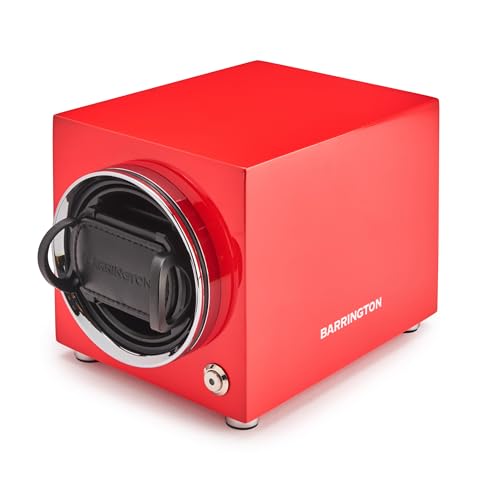
Barrington Single Watch Winder
- Five fixed TPD levels from 650 to 1,950 and all three directions of rotation, cleanly documented instead of vague mode descriptions
- Runs on two AA batteries as backup, so the watch keeps moving even in a safe without power or during a power cut
- Quiet Japanese Mabuchi motor with a 12-hour rest phase, stackable and expandable with your collection
- Battery operation is intended as a backup; for continuous running over months, the supplied power supply is the cheaper choice

MOZSLY watch winder green leather
- Twelve combinations of direction of rotation and interval, selected with a rotary switch, cover the common automatic calibres
- Can be powered either via the supplied mains adapter or by batteries, so it is also ready for use away from a socket
- Leather-covered housing in green looks homelier than the price class would suggest
- Young Amazon brand; runtime and TPD figures are manufacturer values without documented speed levels

Los Gatos watch winder with USB-C
- Single position with quiet motor, powered either by batteries or a USB-C cable
- USB-C makes the power supply flexible, so running it from a power bank on the go is conceivable
- Compact format fits in many safe compartments and equally on the bedside table
- Without fixed, documented TPD levels, fine adjustment is limited to the manufacturer's modes

Los Gatos watch winder 1 watch
- Simple single winder for one automatic watch, powered by batteries or a power supply
- Battery operation makes the unit a practical companion for a safe without a power feed-through
- Inexpensive entry for keeping a single automatic watch reliably moving in the first place
- Build quality and holder are kept simple; weigh heavy dive watches with steel bracelets beforehand
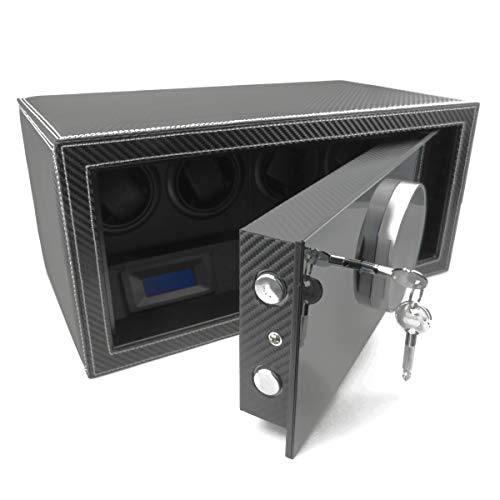
Safewinder SmoothX 4 CARBON
- Four programmable watch winders sit in a lockable housing with digital lock, key and two locking bolts
- Each position can be set individually to 650 to 1,950 turns and all three directions, with a 12-hour rest phase
- Carbon look and concealed hinges turn the watch winder into a showpiece suitable for the living room
- The unit runs on 230V mains, not on battery, and is a design safe, not a burglary-resistant safe certified to EN 1143-1

Safewinder SmoothX 8 CARBON
- Eight individually programmable positions in a lockable carbon housing, conveniently operated via a touch panel
- The same clean TPD logic from 650 to 1,950 turns as the smaller model, with sleep and wake phases
- Combines storage and winding for a medium-sized collection in one lockable place
- Like the four-slot version, tied to the mains and without EN 1143-1 certification, so more visual and access protection than burglary protection

MODALO Twist for 1 watch
- MODALO specifies the rotation output as 900 turns per day in alternating mode, which is a documented figure rather than a vague mode number
- It runs on either the included 5 V power adapter or two type C batteries, so the device also suits a cabinet without a power supply
- Solid wood and leather housing with a scratch-resistant surface; during the rest phase the watch stops in the 12 o'clock position
- 900 TPD is fixed, so if you want to set your calibre specifically to 650 or 1,200 turns, you need a device with selectable settings

Mcbazel watch winder 1 watch carbon look
- Runs on either batteries or the supplied EU plug, so the device covers both places of use
- Compact single housing in PU leather with a carbon look that runs straight after unpacking without any setup
- The cheapest battery device on this page and therefore an honest option if a single automatic watch needs to be bridged
- Mcbazel gives no specific turn figures for this model, so the exact TPD number remains unknown; if you want to supply your calibre specifically, you are better served by the MODALO Twist or the Barrington
On this page you will find eight devices that serve exactly this purpose, honestly classified by what they actually deliver. The range runs from the well-thought-out single winder with documented turn settings, through affordable leather and USB-C models, to lockable storage cases that combine winding and a safe look. Specific turn figures for your calibre are provided in our overview of turns per day.
An important note up front, because honesty is our business model: not every device that can be advertised with a battery is meant for continuous operation. And not every case that looks like a safe is a certified burglary safe. We classify both clearly here before you decide on a model in the watch winder buying guide.
What matters with battery-powered watch winders
The first thing to check is the power source itself. Look at whether a device only offers a battery backup for power cuts or whether it is meant to run on batteries permanently, because that determines runtime and ongoing costs. Models with two AA cells and rest phases last longest, because the motor only turns for about twelve hours a day.
The second point is the winding technology. Good devices state fixed turn settings in turns per day and handle all three directions of rotation, whereas cheap models often only talk about modes without documented values. For most modern automatic movements, 650 to 800 turns in both directions is entirely sufficient, and more is rarely needed.
The third point is the holder. It must grip your watch securely, from a light ladies' case to a heavy diver with a steel bracelet. Adjustable or spring-loaded cushions are clearly an advantage here, and you should take the manufacturers' weight specifications seriously so that the motor is not overloaded in the long run.
Battery operation in a safe: what a watch safe really delivers
The most common reason for a battery-powered watch winder is the safe. A simple rule applies here: only a device without a cable belongs in a certified safe, because a power lead-through drilled in afterwards destroys the burglary-protection certification and with it your insurance cover. How the security classes relate to each other is explained in our article on watch safe security levels.
Separate from these are devices that merely look like a safe. The lockable models in this comparison offer protection from view and access as well as attractive storage, but they are not burglary safes tested to EN 1143-1. For genuine burglary protection, you are better off combining a certified safe with a battery-powered winder, as we show on the page about watch safes with watch winder.
If you are thinking about secure storage anyway, you will find suitable models with classification in our overview of watch safes. A battery-powered watch winder is the link that keeps your automatic ready to go even behind a locked door. That saves you the annoying resetting of date and time after every safe break.
Which device suits whom
If you mainly want flexibility and clean technology, the Barrington Single is the obvious choice. It combines documented turn settings with a genuine battery backup and can later be stacked into a small winder wall. For a single watch that you also take along to the holiday home now and then, the affordable single devices from MOZSLY and Los Gatos are the pragmatic answer.
If lockable storage is the priority instead, the Safewinder models lead the field. They combine winding and a design safe in one housing, but they run on mains power and not on batteries. If you want to keep a single watch moving in an orderly way, you should also take a look at the single winder recommendations and the inexpensive alternatives on our page affordable watch winders.
Conclusion
A battery-powered watch winder is the right choice whenever there is no socket nearby: in the safe, in the cabinet or when travelling. Our clear recommendation is the Barrington Single, because it combines documented technology with a genuine battery backup. On a small budget, the single devices from MOZSLY and Los Gatos are enough, and if you are looking for a lockable design solution, go for Safewinder.
Before you buy, it is worth a look at our detailed data checks: the review section collects all the individual analyses, and the data check on the Barrington Single is particularly worth reading. That way you make your decision with documented facts instead of advertising promises, entirely without lab testing, but with an honest assessment.
The text of this page was created with an AI language model and was reviewed and approved editorially before publication. Editorial responsibility lies with Seydhan Cakmak. The product images shown are not AI images but manufacturer and retailer photos from the Amazon catalogue, which we embed unchanged.
A limitation we disclose: Amazon and the retailers selling there now use generative tools in their listings themselves. Whether an individual catalogue image is affected, we cannot check from the outside, so we claim it neither one way nor the other. As soon as an image demonstrably comes from a generative model, we label it visibly on the image with the label AI image. More on this on the AI transparency page.