The editorial team's recommendations
Here are the devices we recommend most often across all classes, from the single position for the first automatic watch to the eight-watch solution for the grown collection. We have deliberately included only one favourite per use case, so that you can see immediately which device suits your collection size and location. Covered are one position, two, four and eight positions, plus the entry price, the wooden case for the living room and the battery-powered single position for the closed safe. The detailed comparisons with all alternatives and the technical data follow in the linked subpages.

Beco Technic Boxy Carbon Single 1 Classic
- We name Beco Technic on several pages as a technical reference: the Boxy series works with a brushless motor and therefore without the typical gearbox whirr
- Designed to be modular: with further Boxy modules, the Single becomes a system that grows with the collection
- Carbon version in model year 2025, compact enough for a bedside table, desk or shelf compartment
- The brand premium is clearly noticeable, and an entry-level device also handles the basic function

ROTHWELL double watch winder
- Two positions with a quiet motor: the right size for an everyday watch and a dress watch side by side
- Several speed levels and selectable rotation settings cover the common automatic movements
- Black with red contrast, so considerably less inconspicuous than the usual faux leather boxes
- The manufacturer does not state turns per day as fixed TPD levels, you choose via the speed levels

DESIGNHÜTTE San Diego 4 LCD
- Four positions under one lid cover the typical rotating collection of everyday watch, dress watch and sports watch
- The LCD display makes the selected setting visible instead of hiding it behind blind switch positions
- Designhütte is one of the established brands on the winder shelf and is therefore better documented than marketplace goods
- For a single automatic watch, a four-watch device is oversized, and a single position is then enough

MODALO Ambiente MV4 for 1 watch
- Black Makassar wood design: a device that can stand openly in the living space instead of disappearing into a drawer
- MODALO is one of the established brands in the design class and provides clean manufacturer specifications instead of marketing platitudes
- One slot, simple operation, suited to the one watch with a calendar or moon phase that is annoying to reset
- Here you pay for material and appearance; functionally, much cheaper single devices do the same job
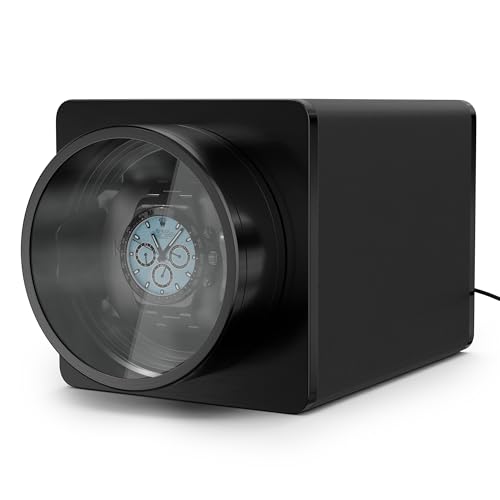
Klarstein TimeSync
- Quiet Mabuchi motor: the Japanese classic that significantly more expensive devices also use
- Battery or mains power, so the device also fits in a cabinet or safe without a socket
- Vegan leather cover, homelier than bare plastic and still in the entry-level class
- One slot and entry-level class: if the collection grows, you will soon need a multi-watch winder instead of a second single winder

Heisse und Söhne Madrid 8
- Eight slots in one housing are almost always cheaper and quieter than four single devices side by side
- The motors can be programmed separately. This lets a chronograph with a 7750-type movement run in clockwise rotation only, while a three-hand movement next to it is wound in both directions
- The bracelet holder clamps the case instead of just resting it, and so securely carries heavier watches with steel bracelets too
- A device of this size needs a fixed footprint and, because of its height, belongs on the chest of drawers rather than in a shelf compartment

Swiss Kubik Velour Windsor for 1 automatic watch
- Factory battery operation makes the device suitable for safes, because a cable passage drilled afterwards voids a safe's certification
- Swiss Kubik is the only brand in the niche to state independently certified noise values. In an industry full of marketing words, that is a robust argument
- The run cycles are programmable, so you set 650 to 800 turns specifically instead of choosing a programme name
- Manufactory price for a single slot, and the manufacturer does not state a maximum case size
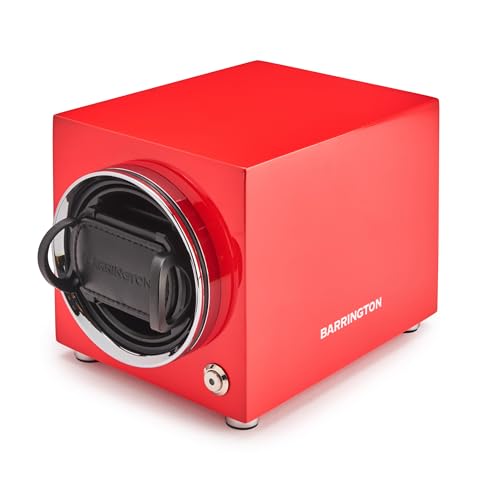
Barrington Single Watch Winder Crimson Red
- Five speed levels are listed as concrete numbers in the data sheet, plus clockwise, counterclockwise and alternating rotation as separate settings
- This lets you deliberately hit the usual 650 to 800 turns per day instead of relying on a vague mode name
- The Japanese motor runs on the power adapter or on two AA batteries and so also fits in a cabinet without a socket
- The standard cushion is the weak point: for cases over 44 millimetres and over 100 grams, a clamping bracelet holder is more secure
How a watch winder works
A watch winder keeps your automatic watch running when you are not wearing it: a motor turns the watch at programmed intervals, so the rotor in the movement swings and tensions the mainspring, just as on the wrist. Time, date and complications stay up to date, and the watch is ready to wear at any moment. Overwinding is ruled out by design, because the slipping clutch in the barrel of every modern automatic limits the tension.
Important for putting it in perspective: a winder is a convenience, not a necessity. A stopped automatic watch is not damaged, it simply shows the wrong time. Whether buying one is worthwhile in your situation at all, we answer brutally honestly in the article Does my watch need a watch winder?. This page is about the follow-up question: if yes, which one?
Types at a glance
Watch winders differ mainly in the number of slots and the concept behind them. Four types cover practically the entire market, and each has its own purpose.
| Type | Positions | Typical price range | Who it is for |
|---|---|---|---|
| Single winder | 1 | affordable to mid-range | First automatic, second watch, gift |
| Multi-watch winder | 2 to 4 | Mid-range | Rotating wearers with a small collection, the most popular class |
| Winder display cabinet | 6 to 12+ | Mid-range to upscale | Collectors who keep many watches running at the same time |
| Premium and manufactory | 1 to 24 | Luxury class | High-quality collections, showpieces, complications |
Modular systems, in which individual winder cubes are stacked or expanded, and winder modules in safes play a special role. The latter combine winding and burglary protection and are the logical final stage for valuable collections; we cover them in detail in the comparison Safe with watch winder.
The buying criteria that really matter
Product pages like to advertise display-cabinet looks and LED lighting. What decides a purchase is something else, namely what determines function and everyday suitability. You should check five criteria in this order.
1. Turns per day and direction of rotation
The most important criterion first: a good winder lets you set the turns per day (TPD) and handles all three directions of rotation, that is clockwise, counterclockwise and alternating. The standard range of 650 to 800 TPD bidirectional keeps the vast majority of modern movements, from ETA through Sellita and Miyota to Seiko, fully wound. Some calibres only wind efficiently in one direction, in which case the matching setting helps. The specific values for your movement are in our TPD table for common calibres.
2. Motor, noise level and smooth running
The motor decides whether the winder disappears into the living space or becomes a nuisance. High-quality devices use smooth-running motors that are barely audible in operation, while very cheap devices often whirr noticeably. If the winder stands in the bedroom, quiet running is the knockout criterion above all. A look at the manufacturer specifications and documented user experiences on noise level is worth more here than any feature detail.
3. Programmes and rest phases
Reputable winders do not turn nonstop but in intervals: short turning phases, long pauses, spread over 24 hours. Some devices additionally offer a start delay or night-rest programmes in which they stand still for hours at a time. This spares motor and movement alike and is entirely sufficient, because winding does not require constant rotation. Fixed programmes with sensible presets are often more practical for beginners than endless free configuration.
4. Power supply and location
Mains operation is the first choice for a fixed spot, battery operation the solution for safes without a power feed-through and for flexible placement. Many good devices handle both. Think about the location right away: direct sun bleaches dials and straps, damp rooms are off limits, and anyone displaying the winder openly should plan dust protection with a cover or display-cabinet door. For valuable watches, the security question also belongs here; more on that in the watch safe buying guide.
5. Watch holder and large cases
Underrated but decisive in everyday use: the watch holder must hold your watch securely and without tension. Soft, size-adjustable cushions accommodate small ladies' watches and massive divers alike, while rigid holders quickly reach their limits with heavy watches over 44 millimetres or narrow straps. Check the maximum case size and maximum weight before buying, especially with steel bracelets. How to measure the case size correctly is explained by our sister site in the watch size guide.
Recommendations by collection size and budget
The right device class follows almost automatically from your collection. We have a separate comparison with concrete model recommendations for each size; here is the honest short version as a signpost.
One automatic watch
For a single watch, a compact single winder with adjustable TPD, selectable direction of rotation and a quiet motor is enough. More money mainly buys nicer materials and quieter technology here, not a better basic function. Solid devices are available from the two-digit to the low three-digit euro range; the recommendations are in the comparison the best watch winders for 1 watch.
Two to four automatic watches
The most popular class, because it fits the typical way a collection is built: everyday watch, dress watch, sports watch. What counts here are independently controllable rotors or at least sensibly grouped programmes, so that each watch gets its matching settings. The mid-range offers the best ratio of technology to price. You will find our concrete model recommendations from Modalo to Beco in the big comparison of the best watch winders for 2 to 4 watches.
Six watches and more
From six automatic watches, the winder becomes a display cabinet: several motors, central control, often lighting and lockable doors. Separately controllable motor groups are important, because a larger collection almost always mixes calibres with different needs. The question of placement also changes, because an illuminated cabinet wants to be seen. The recommendations for 6, 8 and 12 slots are collected in the comparison Watch winders for 6 watches and more.
Premium and luxury class
Above the display cabinets, the manufactory class begins: elaborate housings made of real wood and leather, extremely smooth-running motor technology and names that carry weight in watch circles themselves. Here you buy showpiece value as well as function, suited to collections in which individual watches cost five figures. What the luxury class really does better and where only the name gets more expensive is clarified by our premium watch winder comparison.
Turns per day: the short version
Because this question comes up in every consultation, here are the most important guideline values up front. They come from the settings databases of the winder manufacturers and the technical data of the movement manufacturers; you can find the full table with sources in the TPD article.
| Movement / Calibre | Turns per day | Rotation direction |
|---|---|---|
| Unknown modern automatic movement | 650 to 800 | bidirectional |
| ETA 2824-2 / Sellita SW200-1 | approx. 650 to 800 | bidirectional |
| Miyota 8215 (and 82xx family) | approx. 650 to 950 | winds in one direction only, bidirectional if in doubt |
| Seiko 4R36 / NH36 | approx. 650 to 800 | bidirectional |
| Modern Rolex calibres (e.g. 3235) | approx. 650 | bidirectional |
Basic rule: it is better to start with the standard of 650 to 800 TPD in both directions and only adjust if the watch stops after a day on the winder or the power reserve visibly drops. More turns than necessary bring no benefit; they only mean more movement.
Honestly: do you need one at all?
Finally, the question that any serious buying guide must ask first: if you own only one automatic watch and wear it daily, you do not need a device, because your wrist does the winding. A winder is worthwhile for people who rotate their watches, for watches with calendar and moon phase complications, and for anyone for whom a watch that is ready to wear is worth the extra cost. You can find the detailed, honest weighing up, including the question of wear, in the knowledge article Does my watch need a watch winder?.
And if you are just entering the world of automatic watches: our watch sister site TopWatchReviews shows you the best automatic watches from entry level to icon. First the right watch, then the right accessories: this order remains the best buying advice.
Conclusion: three steps to the right watch winder
First: clarify the size of your collection and therefore the device class, from a single winder to a display cabinet. Second: check the technology, meaning adjustable turns per day, all three directions of rotation, rest phases and a quiet motor. Third: think about where it will stand, with power supply, dust protection and, if applicable, security. If you proceed this way, you will find a device in every price range that keeps your watches running reliably and quietly, and you will not spend money on features you never use.
The text of this page was created with an AI language model and was reviewed and approved editorially before publication. Editorial responsibility lies with Seydhan Cakmak. The product images shown are not AI images but manufacturer and retailer photos from the Amazon catalogue, which we embed unchanged.
A limitation we disclose: Amazon and the retailers selling there now use generative tools in their listings themselves. Whether an individual catalogue image is affected, we cannot check from the outside, so we claim it neither one way nor the other. As soon as an image demonstrably comes from a generative model, we label it visibly on the image with the label AI image. More on this on the AI transparency page.