The market at a glance
We sort the relevant providers into three classes, with everything that can be reliably substantiated. Where manufacturers do not publish details, we say so instead of inventing figures. There are currently no affiliate programme links for any of the providers mentioned, and they are named purely for editorial reasons.
| Provider / line | Resistance grade | Winder positions | Price range | Character |
|---|---|---|---|---|
| VVT Tresore (incl. KWL series) | I to IV (depending on model) | 4 to 36 | four-figure to low five-figure range | Configurable, sober, functional |
| Hartmann Signature Safes | EN 1143-1, grade depending on configuration | 6 to 16, modular | on request | Configurable design line |
| Chronovision (Daytona H2, Majesty H3) | I, selectable up to IV for the Majesty H3 | 8 to 24 | mid five-figure range | Design watch safe with app control |
| Buben & Zörweg (Time-Mover safes) | VdS certified, grade per model not public | depends on the model | high five-figure range upwards | Luxury manufacture, prestige |
| Döttling (incl. The Fortress) | III to V | 8, individually controllable | high five-figure to six-figure range | Handcrafted maximum security |
Configurable watch safes: the sensible route
Providers such as VVT Tresore build classic security safes with winder walls: one example is a Grade III model per EN 1143-1 with four winders for a private cover guideline of €200,000. Hartmann Tresore applies the same idea to its Signature Safes line in a more domestic look, usually with six to sixteen modules, some of them removable. The strength of this class: security, number of modules and budget can be chosen separately, and the certification is beyond question. If you buy rationally, start here.
Designer watch safes: Chronovision
Chronovision from Germany builds watch safes that look like furniture from a watchmaking manufacturer: the Daytona H2 comes with Grade I and eight to twenty-four app-controllable winder modules, while the flagship Majesty H3 lets you choose the resistance grade up to Grade IV and weighs over half a tonne. In price terms, this sits in the mid five-figure range. In return you get a complete system from a single source, including lighting, interior fit-out and controls, which is also a visual statement.
Luxury manufactory: Buben & Zörweg and Döttling
Buben und Zörweg combines its patented Time Mover modules with safes ranging from the compact Solitaire to the walk-in Private Museum; the manufacturer mentions VdS certification, but does not publish the specific grades per model, which is worth asking about at these budgets. Döttling from Sindelfingen handcrafts one-off pieces such as The Fortress with grades up to V and eight winders individually controllable via software. Here you buy manufactory craftsmanship with a security certificate, at prices that reach six figures depending on specification.
Available to order directly: the lockable entry class
Below the certified safe world there is an intermediate class, which we show for completeness and classify clearly: lockable winder boxes in a safe format. The Safewinder devices combine a digital lock, bolting and full winder technology, but are not security safes certified to EN 1143-1 and do not replace a safe for insurance purposes. They protect against dust, prying eyes and opportunistic access, not against a prepared burglary. If you take them for what they are, you get the currently cheapest directly orderable combination of lockability and winding.
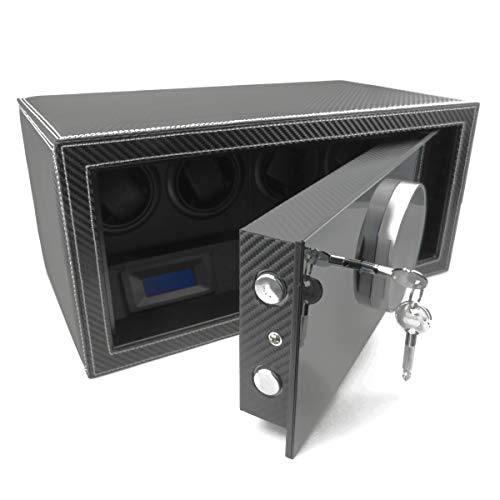
Safewinder SmoothX 4 Carbon
- Four individually programmable winders with touch panel and LCD, five speed levels from 650 to 1,950 turns
- Door with two bolts, concealed hinges and digital lock including emergency key
- LED interior lighting when the door opens, carbon look with mirrored front, compact width of around 43 centimetres
- No EN 1143-1 certification: for insurance purposes a lockable piece of furniture, not a security safe

Safewinder SmoothX 8 Carbon
- Eight individually programmable positions with the same controls as the four-watch version
- Bolted door with digital lock, LED interior lighting and carbon look
- Significantly cheaper than any certified safe with eight winder modules
- Here too: a lockable box is not certified security, and high collection values belong in a grade-rated safe
The other way: a battery-capable winder for your existing safe
If you already own a certified security safe, you do not need a new safe, but a winder module that works without a cable. These three devices solve the core problem: a cable duct drilled afterwards voids the safe's certification, whereas battery operation does not. You need to measure the shelf height and depth of the safe beforehand, and the batteries need to be replaced regularly.
The three differ clearly: MODALO moves two watches and needs the most space, the Swiss Kubik is the only device with verified noise values, and the Moon from Heisse und Söhne is the most compact at 11 x 11 x 16.5 centimetres. More battery-capable devices can be found under battery-powered winders.

MODALO Safe Systems for 2 watches
- Runs on either the supplied 5-volt power adapter or four C-size batteries, so the safe body stays untouched and the certification is preserved
- 650 to 1,000 turns per day in clockwise, anticlockwise and alternating modes cover the range in which practically any modern automatic movement stays fully wound
- The holder is documented for watches up to 400 grams and 60 millimetres in diameter with a strap length of 15 to 21 centimetres, which also suits heavy dive watches
- The Amazon listing does not state the device generation. MODALO lists the series as MV3 and MV4 with differing numbers of programmes, different displays and deviating dimensions. We therefore deliberately give none of these details and advise asking the retailer about dimensions and features before buying

Swiss Kubik Velour Windsor for 1 automatic watch
- Battery operation makes the device suitable for a safe, since a drilled-out power feed-through destroys the safe's certification
- Swiss Kubik is the only brand in the niche to state tested noise values, according to the manufacturer 49 to 63 dB SPL, certified by the engineering school HEIG-VD
- The compact cube shape fits into safe compartments where a wide display case will not fit
- Manufacturer price for a single position; for several watches the bill quickly becomes uncomfortable

Heisse & Söhne Watch Winder Moon
- At 11 x 11 x 16.5 centimetres and 0.9 kilograms, model 70019-130 is expressly intended by the manufacturer for safes and drawers
- Two LR14 batteries last up to three months according to Heisse und Söhne, so you don't need a power feed-through, which would cost a safe its certification
- According to the manufacturer, the device moves one watch and stores another, and the 4-centimetre-wide clasp covers circumferences from 16.5 to 19.5 centimetres
- Only two turn settings, and even the lower one, at 950, sits above the 650 that many Swiss three-hand movements need
The large Safewinder models: orderable, but without a verified resistance class
The same provider offers two significantly larger devices, the Safewinder Type 12 B and the Type 12 S, both with twelve individually driven watch winders. The Type 12 B measures about 500 by 500 by 800 millimetres, weighs around 100 kilograms and offers three drawers, a document compartment and operation via touch pad and LCD display. The Type 12 S stays more compact at about 400 by 400 by 480 millimetres and around 50 kilograms, opens via a number combination and additionally a key, and is expressly intended for installation in walls and furniture. In price terms, both are in the four-figure range, and a verified security level cannot be demonstrated for either device. The provider names neither a resistance class per EN 1143-1 nor a VdS or ECB-S certification, and a targeted search across several independent sources found none: they are uncertified standard safes. If you invest a four-figure sum, the configurable providers further up this page give you a documented resistance class for the money, so we list the two devices here only for context and do not link them.
Why this device class is special
For most accessory questions there are separate answers: a watch box against dust, a watch winder for winding, a safe for security. The watch safe with winder modules combines all three and thus resolves the dilemma of valuable automatic collections: the watches should lie protected and still stay ready to wear, with the correct date, moon phase or GMT display.
This class is also the most demanding purchase decision in the whole range, because safety standards, watch technology and sometimes considerable budgets meet here. An honest preliminary remark therefore belongs at the start: the combination is never necessary, as stationary watches come to no harm. It is the comfort and showcase solution for collections where both are worthwhile.
What to look out for with the combination
The grade remains the basis
Winder modules change nothing about the basic rule: the resistance grade must match the collection's value, and our article on safe security levels explains the guideline values from Grade I at €65,000 to Grade III at €200,000 privately. You should be suspicious of watch safes that offer plenty of technology but no verifiable certificate, because an uncertified cabinet remains a piece of furniture for insurance purposes, no matter how many motors it carries.
Power in armoured steel
Winders need energy, but a safe is deliberately sealed. Reputable manufacturers solve this with factory-tested power feed-throughs or with battery modules. Factory-tested means literally that: a feed-through drilled afterwards destroys the certification and with it the insurance classification. If you want to retrofit, you should therefore choose battery operation or have the conversion carried out and documented by the manufacturer.
Modules and settings
The same quality criteria apply to the modules as to freestanding devices: adjustable turns per day, all three directions of rotation, rest phases. The right values per calibre are provided by our TPD table. Individual control is also practically relevant, because in a safe full of different watches, not all positions should have to run the same programme.
The honest alternative: buy separately
The combination carries a structural premium, because you buy security steel and precision mechanics from a single source. The pragmatic alternative: a certified safe without modules for security, alongside a good multi-watch winder for the watches that need rotation. Together that often costs only a fraction, scales more flexibly and separates two device classes that age at different speeds. The combination wins where watches should be wound and locked away even when you are absent, and wherever it simply brings pleasure. Both are legitimate reasons, you just should know which one you are paying for.
Conclusion: security decision first, technology decision second
The safe with watch winder is the premier class of watch storage, and it is best conquered in the right order: put a figure on the collection's value, choose the resistance grade, involve the insurer, then configure the number of modules, controls and look. Rationally, the journey begins with the configurable providers, emotionally it not infrequently ends with the manufactory. Both can be right, as long as the plaque on the inside of the door is correct.
The text of this page was created with an AI language model and was reviewed and approved editorially before publication. Editorial responsibility lies with Seydhan Cakmak. The product images shown are not AI images but manufacturer and retailer photos from the Amazon catalogue, which we embed unchanged.
A limitation we disclose: Amazon and the retailers selling there now use generative tools in their listings themselves. Whether an individual catalogue image is affected, we cannot check from the outside, so we claim it neither one way nor the other. As soon as an image demonstrably comes from a generative model, we label it visibly on the image with the label AI image. More on this on the AI transparency page.