This design solves a very specific problem: the two or three automatic watches you wear regularly should keep running, while the rest of the collection should still be stored neatly, and both without two pieces of furniture side by side. The market serves this more narrowly than the search results suggest. This overview sorts eight devices by capacity and states for each how many watches are actually moved.
The recommendations at a glance
| Model | Moving positions | Drawer for | Control | Rating |
|---|---|---|---|---|
| Designhütte San Diego 4 LCD | 4 | up to 6 watches | LCD | 4,2/5 |
| Designhütte Basel 6 LCD | 6 | up to 4 watches | LCD, individual motors | 4,2/5 |
| Barrington for 9 watches | 9 | more watches, no number given | Display and remote control | 4,0/5 |
| Designhütte Basel 3 LCD Doak | 3 | up to 4 watches | LCD | 4,1/5 |
| Barrington for 4 watches | 4 | Watches, straps, tools | Display and remote control | 4,1/5 |
| Designhütte Basel 2 LCD Doak | 2 | up to 3 watches | LCD, 12 programmes | 4,2/5 |
| Designhütte San Diego 2 LCD | 2 | up to 3 watches | LCD, 12 programmes | 4,2/5 |
| Klarstein ChronoVault | 2 | 3 storage positions plus jewellery compartment | 4 programmes | 4,2/5 |
The eight devices in detail

Designhütte San Diego 4 LCD for 4 automatic watches
- Four moving positions and, according to the manufacturer, room for up to six more watches on separate cushions make ten watches in one piece of furniture
- A single device thus covers the typical collection size without needing a second box next to it
- Programming is done via the LCD control, and according to retailer information the speed levels range from 650 to 1,950 turns per day
- Mains power only, and the high-gloss surfaces show fingerprints clearly

Designhütte Basel 6 LCD for 6 automatic watches
- Each of the six motors can be programmed separately, so each watch gets its own setting instead of a compromise programme
- In addition to the six moving positions, according to the manufacturer up to four more watches fit on separate cushions in the drawer
- The range of 650 to 1,950 turns and three running directions covers everything from vintage movements to chronographs
- Mains power only with no battery option; this display case is not intended for a safe without power

Barrington watch winder for 9 watches
- Nine individually programmable rotors keep an entire collection wound at the same time, which no other device in this selection manages
- Besides the five usual speed settings, the manufacturer says there is a speed-wind mode for watches that have stopped
- A digital display with clock, remote control, LED spotlights and a drawer for further watches are part of the equipment
- The Amazon description states battery operation, whereas the manufacturer's page lists the nine-watch device as mains-powered with an international adapter. Plan for a power socket
- For the drawer, Barrington gives no number of watches, unlike Designhütte

Designhütte Basel 3 LCD Doak for 3 automatic watches
- Three moving positions bridge the gap between the two-watch devices and the six-watch Basel, without paying for positions that stay empty
- There is also a drawer for up to four more watches, so the device keeps seven watches in one place
- The case measures 37 x 24.5 x 18 centimetres and weighs 4.1 kilograms, so it sits firmly, with a grey-black mottled Doak veneer under piano lacquer on the outside
- Price-wise the Basel range is clearly in the luxury class, and a simpler unit does the job just as well
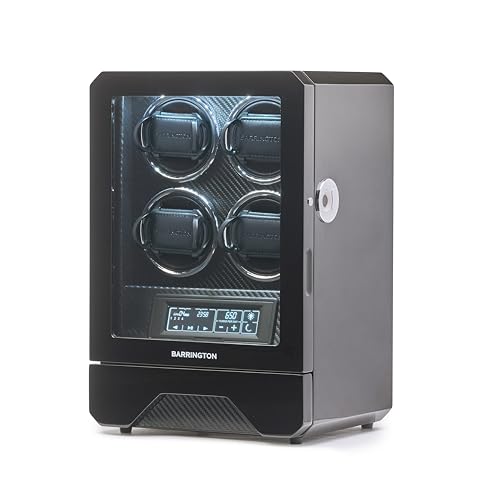
Barrington watch winder for 4 watches
- Four rotors can be programmed individually, so each watch gets its own speed setting and running direction
- Below the moving positions sits a drawer for more watches, spare straps or tools, which a pure watch compartment cannot offer
- It is operated via a digital display or the supplied remote control; according to the manufacturer, the case measures around 35 x 23.5 x 18.5 centimetres
- The closed cabinet housing is designed for mains operation; the battery advantage of the single units is not available here

Designhütte Basel 2 LCD Doak for 2 automatic watches
- Five selectable speed settings of 650, 900, 1,200, 1,500 and 1,800 turns cover everything from the frugal ETA to the thirsty chronograph movement
- Twelve programmes combine these settings with clockwise, anticlockwise and alternating rotation, including gentle interval switching
- Below the two positions sits a drawer with room for up to three more watches
- Battery operation is not provided for; the device is not the right choice for use in a safe without a power connection

Designhütte San Diego 2 LCD Black/Grey
- Twelve programmes and five fixed speed settings from 650 through 900, 1,200 and 1,500 to 1,800 turns cover every common automatic calibre
- The LCD display makes the setting easy to follow, instead of you having to translate mode numbers from a manual
- The drawer holds up to three more watches on their own cushions, so the winder doubles as storage
- Two moving positions remain two moving positions. If you regularly wear more automatic watches, you are better off with the Basel range

Klarstein ChronoVault for 5 watches
- The Japanese Mabuchi motor is regarded as quiet and durable; according to the manufacturer, Klarstein states a value of 10 decibels for the range
- Four rotation programmes and three rotation directions, with clockwise, anticlockwise and bidirectional rotation, cover the common automatic calibres
- MDF with high-gloss piano lacquer, vegan leather lining and white LEDs, plus a jewellery drawer with removable dividers
- According to Klarstein's data, the figure of five watches means two moving positions and three pure storage positions. If you want to keep five automatic watches wound, you need a different device
What the drawer can do, and what it can't
The most important sentence about this design rarely appears in product descriptions: there is no motor in the drawer. The watches in it lie on cushions and stop after two days at the latest, just as in any ordinary watch box. If you read the figure of five watches for the Klarstein ChronoVault, you get two moving positions and three storage positions.
That is not a flaw, but a question of expectation. For most collections, exactly this layout fits, because two to four watches are worn regularly anyway. The rest lie still and are wound by hand before wearing. How to do that properly is covered in the guide Winding an automatic watch correctly.
So always count two numbers separately: moving positions and drawer positions. Only their sum describes how many watches the piece of furniture holds. Only the first number describes how many watches stay wound.
What matters when buying
The number of moving positions is the expensive component, because every position needs its own motor. The drawer, by contrast, costs the manufacturer little. That is exactly why it pays to count honestly how many automatic watches really run in rotation. Two moving positions plus a drawer are usually the more economical choice than four positions without storage.
The controls clearly distinguish the classes. Designhütte consistently uses an LCD display with clearly labelled settings from 650 to 1,800 or 1,950 turns. Barrington is operated via display and remote control. Which value suits your movement is explained in the table in the guide Turns per day.
Mains power is the hard limit of this design. All eight devices need a socket, and none runs on batteries. That rules out the whole category for the closed safe, where only battery-powered winders or the solutions among the watch safes with watch winder help.
The design is easily deceptive when it comes to space requirements. A device with a drawer is taller and deeper than a plain display cabinet, and the Basel 3 measures 37 x 24.5 x 18 centimetres. Measure the footprint beforehand, especially for shelf compartments of fixed height.
Who benefits from which design
If you wear two watches in rotation and own three more, you are best served by the Designhütte Basel 2 or the San Diego 2. Both wind two watches and store three, which fully covers a typical starter collection.
If you have a growing collection, go for the San Diego 4 LCD. Four winding positions and six storage positions are the most generous ratio in this overview and leave room to grow. More four-watch devices without a drawer can be found among the winders for 2 to 4 watches.
If you actually want to keep six or more automatic watches running, you cannot get past the Basel 6 or the Barrington nine-watch device. The alternatives are listed among the winders for 6 watches and more.
If you are mainly looking for storage space and only occasionally wind a watch, you are better off buying separately: an inexpensive single device plus a large watch box. Together that often costs less than a combined display cabinet and can be placed more freely.
Why Designhütte shapes this design
Five of the eight devices in this overview come from Designhütte, and that is no coincidence of the selection. The brand consistently builds the combination of winding positions and drawer across the whole range, from two to six positions, and is one of the few to state the number of drawer positions concretely. This is exactly the detail most providers leave out.
The field is rounded out by Barrington, where the drawer is intended as a compartment for watches, spare straps and tools, and by Klarstein at the lower end of the price scale. With Klarstein, however, caution is advised: the manufacturer uses identical text blocks across several model series, which is why for the ChronoVault we list only the details documented specifically for that model.
Other specialist brands hardly build the combination. MODALO, Heisse und Söhne or Beco Technic usually keep winder and storage cleanly separate as two products. If you want their build quality, you therefore combine two pieces of furniture.
The text of this page was created with an AI language model and was reviewed and approved editorially before publication. Editorial responsibility lies with Seydhan Cakmak. The product images shown are not AI images but manufacturer and retailer photos from the Amazon catalogue, which we embed unchanged.
A limitation we disclose: Amazon and the retailers selling there now use generative tools in their listings themselves. Whether an individual catalogue image is affected, we cannot check from the outside, so we claim it neither one way nor the other. As soon as an image demonstrably comes from a generative model, we label it visibly on the image with the label AI image. More on this on the AI transparency page.