Bell and Ross is a special case in our brand comparison, and the chronograph is the reason. Almost all other chronographs in our range use the Valjoux 7750 family and therefore only wind clockwise. Here it is different, because the base movement works in both directions. On top of that comes the square BR 03 case, which tips over more easily on a watch cushion than a round one. We ranked six devices on exactly these two points.
The recommendations at a glance
| Model | Slots/type | Key feature | Price range | Rating |
|---|---|---|---|---|
| WOLF Heritage Single Winder | 1 position plus storage compartment | Lock-in Cuff up to 52 mm, 3 directions | Premium class | 4,0/5 |
| Heisse und Söhne Watch Guard 4 | 4 positions | 6 settings from 650 to 1,500, programmable per motor | Premium class | 4,4/5 |
| Beco Technic Boxy Carbon Single 1 Classic | 1 position, modular | Belt drive, 3 programmes, 3 directions | Mid-range | 4,4/5 |
| botta Cube | 1 position per module | 9 programmes from 600 to 1,800, around 14 decibels | upper mid-range | 4,2/5 |
| Barrington Single Watch Winder | 1 slot | 5 settings from exactly 650, mains or battery | Mid-range | 4,2/5 |
| Tolesum watch winder for 2 watches | 2 slots | 970 to 2,430 turns, USB-C | Entry level | 4,0/5 |
The highest overall rating, 4.4 out of 5 points, is shared by the Heisse und Söhne Watch Guard 4 and the Beco Technic Boxy. For Bell and Ross we still put the WOLF Heritage Single, with its 4.0 points, in first place, because the overall rating reflects features, depth of control and build quality. With this brand, however, the holder decides, and there the clamping Lock-in Cuff of the WOLF is structurally superior. If you are looking after four watches or want a modular system, you are better served by the two top-rated devices.
The devices in detail

WOLF Heritage Single Winder
- The patented Lock-in Dynamic Cuff locks into the drum and, according to the manufacturer, holds cases up to 52 millimetres, so even a square BR 03 case on the wide rubber strap sits firmly instead of loosely on a cushion
- The direction of rotation can be selected as clockwise, anticlockwise and bidirectional; for the bidirectionally winding Bell and Ross movements you simply set the alternating mode
- Operation either with the supplied universal adapter or on AA batteries, plus preprogrammed interval rotation with pauses, a storage compartment for the spare strap and a glass cover against dust
- The speed is fixed at 900 turns per direction and is therefore above our working value of 650 to 800; thanks to the slip clutch this is not critical, but it cannot be finely adjusted

Heisse und Söhne Watch Guard 4
- Six turn settings at 650, 750, 850, 950, 1,200 and 1,500 per day, plus alternating rotation and clockwise-only and anticlockwise-only rotation; the lowest setting exactly meets the lower limit of our working value
- Each of the four motors can be programmed individually, so a BR 03 in alternating mode runs right next to a 7750 chronograph from another brand that needs clockwise-only rotation
- The three-part watch clasp is 6 cm wide, fits circumferences from 14 to 22.5 cm and works with stainless steel ball catches, plus LCD control, dimmable LED, five-fold ball bearings, stop at 12 o'clock, 20.5 cm high, 43.5 cm wide, 18.8 cm deep, 4.47 kg
- Without a front door the collection stays open and exposed to dust, so outside a safe or closed cabinet the device is the wrong choice

Beco Technic Boxy Carbon Single 1 Classic
- The interval motor with belt drive does without a rattling gear train and, according to specialist retailers, offers three fixed programmes as well as all three directions of rotation; the alternating mode is the right one here
- German manufacturer from Rheinbach; the modules can be combined into larger units, so you start with one position and expand later instead of replacing the whole device
- The plastic case with acrylic glass dome stays under one kilogram, which makes it easier to move and to carry into the cabinet
- For this Classic module Beco Technic does not publish turns per programme; if you want to deliberately set a figure, choose the botta Cube or the Barrington

botta Cube
- Nine rotation programmes from 600 to 1,800 turns per day and three directions of rotation; our working value of 650 to 800 bidirectional can therefore be targeted precisely instead of only roughly
- Brushless direct drive with around 14 decibels, USB or battery operation, aluminium case measuring 110 x 104 x 125 millimetres and weighing 810 grams, so even the bedroom is a possible location
- Up to nine modules can be stacked, so the capacity grows with the collection without you having to replace the base unit
- Each additional module costs the full module price, and the mount is a cushion, not a clamping clasp; for a heavy BR 03 the WOLF is safer
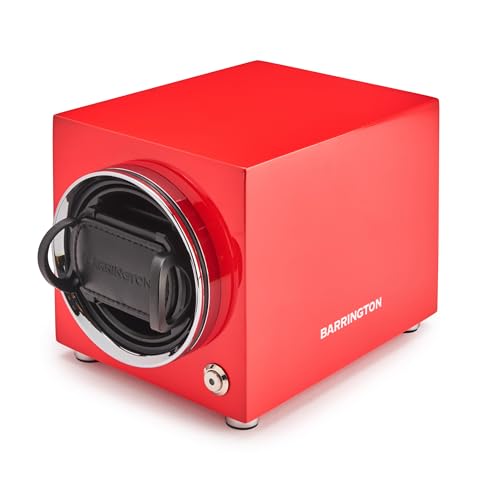
Barrington Single Watch Winder
- Five clearly documented speed settings at 650, 750, 850, 1,000 and 1,950 turns per day, plus clockwise, anticlockwise and alternating rotation instead of vague mode descriptions
- The 650 setting in alternating mode meets the lower limit of our working value exactly, and because at Bell and Ross even the chronograph winds in both directions, the same setting applies to the whole collection
- Runs on the supplied power adapter or on two AA batteries; according to the manufacturer, one set lasts almost two months in intermittent operation, so even the safe is an option
- The standard cushion is designed for round cases; a BR 03 on the wide rubber strap sits less stably on it than in a clamping clasp
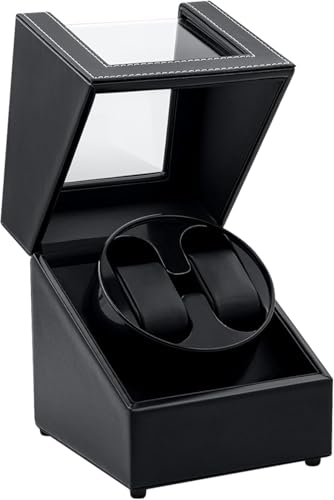
Tolesum watch winder for 2 watches
- The manufacturer states a concrete range of 970 to 2,430 turns per day, which is rare in this price class and allows a deliberate setting instead of pure guesswork
- Two separate positions in the black PU leather case keep a BR 03 and a BR 05 ready to go at the same time, that is, the chronograph next to the three-hand watch
- Operation is via USB-C with a bridge cable system, so several devices can be supplied from a single power source
- The range only starts at 970 turns and is therefore above our working value of 650 to 800; thanks to the slip clutch this is not critical, but it cannot be finely adjusted
Turns per day for Bell and Ross calibres
Bell and Ross does not publish turns per day for watch winders, neither in the data sheet nor in the instruction manual. Two things are therefore reliable: the documented construction of the base movements, above all the winding direction of the rotor, and the factory data of the suppliers Sellita and ETA. In the table we therefore explicitly label every turn figure as a working value and state openly where the manufacturer is silent, instead of inventing a recommendation.
| Calibre | Base | Beats | Power reserve | Winding direction | Turns per day |
|---|---|---|---|---|---|
| BR-CAL.302 and BR-CAL.302-1 | Sellita SW300-1 | 28,800 per hour (4 Hz) | around 54 hours | bidirectional, ball-bearing rotor | Manufacturer states no value, working value 650 to 800 |
| BR-CAL.321 and BR-CAL.321-1 | Sellita SW300 | 28,800 per hour (4 Hz) | Sources inconsistent: around 40 to 42 hours | bidirectional, ball-bearing rotor | Manufacturer states no value, working value 650 to 800 |
| BR-CAL.301 (chronograph) | ETA 2894-2 based on ETA 2892-A2 | 28,800 per hour (4 Hz) | around 42 hours | bidirectional, derived from the base movement | Manufacturer states no value, working value 650 to 800 |
| Other automatic movements of the brand | mostly Sellita and ETA | 28,800 per hour (4 Hz) | varies by movement | bidirectional, if in doubt check the base movement | Manufacturer states no value, working value 650 to 800 |
The movement data in detail. The BR-CAL.302 is a Sellita SW300-1 with its own rotor and its own date ring. It runs at 28,800 half-oscillations per hour, has 25 jewels, measures 25.6 millimetres in diameter at 3.6 millimetres in height, and comes with Incabloc, date, manual winding and seconds stop. The BR-CAL.321 of the BR 05 is built on the same Sellita base and shares the half-oscillations, jewel count, date and seconds stop. The sources are inconsistent on power reserve: depending on the source, it is around 40 or around 42 hours, and for the variant with the optimised barrel as many as 54 hours are quoted. We deliberately do not commit to any one of these values and give the range instead. For a watch winder, power reserve only matters for convenience, not for the settings.
The key difference: the chronograph winds in both directions
This is the real reason this page sits alongside the other brand pages. Almost all chronographs in our inventory are built on the Valjoux 7750 family, for example the TAG Heuer Calibre 16, the Longines L688, the Oris calibres 771 and 774, the Tissot A05.H31, the Hamilton movements H-21 and H-31, and the Sinn 103. This family winds exclusively clockwise. If you choose the bidirectional mode there, you waste half of the movement, and a purely anticlockwise rotation does not wind the watch at all.
Bell and Ross is the exception. The chronograph movement BR-CAL.301 is based on the ETA 2894-2, and this movement is not a standalone chronograph but a chronograph module on the ETA 2892-A2. The 2892-A2 winds in both directions via reversing wheels, at 28,800 half-oscillations per hour and around 42 hours of power reserve. The BR-CAL.301 then adds 37 jewels, a date and a 30-minute counter, and it is found in the BR 03-94 and the BR 126, among others. The consequence for you is pleasantly simple: the bidirectional mode works fully with Bell and Ross, even for the chronograph.
One caveat belongs here, and we state it openly. Bell and Ross itself does not publish the winding direction of its calibres. We derive it from the respective base movement, that is, from the Sellita SW300-1 and the ETA 2892-A2, whose winding systems are well documented. This is a derivation, not a manufacturer statement. In practice it is reliable, because a chronograph module does not change the winding mechanism of the base movement. Our table of turns per day collects all documented values by calibre.
Why the holder comes before the turn count here
The second key point of this brand is the case shape. The BR 03 has a square case, and for the current models bellross.com gives 41 millimetres at 9.65 millimetres in height and 100 metres of water resistance. For older production years, 42 millimetres is also in circulation, and the BR 03-94 chronograph series is still listed at 42 millimetres. If in doubt, measure your own case rather than relying on a year. The BR 05 is the more compact alternative at 40 millimetres and 10.4 millimetres in height, also with 100 metres.
A square case sits differently on a watch cushion than a round one. It has edges instead of a continuous curve, so it rests on only two contact points and tips to the side more easily with every rotation. Added to that are the wide rubber and leather straps that Bell and Ross uses from the factory. They need a wide mount, otherwise the strap bends over the edge of the cushion. This is exactly why a wide, form-stable holder matters more here than any turns-per-day setting.
This underpins our recommendation. The WOLF Heritage actively clamps the case with its Lock-in Cuff for watches up to 52 millimetres, rather than just resting it. The Heisse und Söhne Watch Guard 4 uses a 6 cm wide three-part clasp for wrist circumferences from 14 to 22.5 cm and, because it has no front door, is intended for a safe or cabinet anyway. Both are structural solutions, not compromises on the cushion. How quietly a unit runs is covered in our overview of the quiet watch winder, and for the closed safe the comparison watch safe with watch winder helps.
Which unit for whom
If you mainly wear a BR 03 and want maximum security in the mount, the WOLF Heritage Single is the first choice. Its snap-in cuff solves exactly the problem that a square case creates on a cushion. If, on the other hand, you want to set a precisely named figure, reach for the Barrington Single with its 650 setting or the botta Cube with nine programmes. Our watch winder buying guide gives the overall picture of all designs, and you will find more single units under watch winders for 1 watch.
As the collection grows, the calculation changes. For two watches, such as a BR 03-94 next to a BR 05, the Tolesum with its two separate slots is enough. If you look after four watches and mix brands, you can hardly avoid the Heisse und Söhne Watch Guard 4, because each motor can be programmed individually. The comparison watch winders for 2 to 4 watches shows more models in this class, and larger units are listed under watch winders for 6 watches or more.
If you are interested in a particular supplier, you will find the ranges collected in the brand overview, for example for WOLF, Heisse und Söhne, Beco Technic or Barrington. The full data sheets are in our overview of the data checks. If you wear other chronograph brands alongside your Bell and Ross, take a look at watch winders for TAG Heuer, for Sinn and for Longines, where the direction of rotation is different.
Editorial verdict
With Bell and Ross the technology is pleasingly uniform: bidirectional winding for the three-hand movements and the chronograph, 28,800 half-oscillations per hour in all three calibres, and a power reserve between around 40 and around 54 hours. The bidirectional mode is therefore right for the whole collection, and you do not need to switch it per watch. For turns per day we use 650 to 800, explicitly as our own working value and not as a manufacturer recommendation.
The real decision is made at the holder. The WOLF Heritage Single is our recommendation for the square case, the Heisse und Söhne Watch Guard 4 for four watches in the safe, the Beco Technic Boxy as the top-rated all-rounder with an expansion option, the botta Cube for the finest gradation, the Barrington Single for the exact 650 value and the Tolesum for two slots as an entry point. You do not need to fear too many turns, because the slip clutch in the barrel prevents the mainspring from being overwound. Whether a unit is worthwhile for you at all is answered by our basics article Does my watch need a watch winder?, and Power reserve explained puts the range in context. And for clarity: none of the units presented here is recommended, licensed or certified by Bell and Ross, and we assess only the technical suitability.
Buying guides for other watch brands
A square case sits differently on the cushion than a round one, so the holder counts for more here than any turns-per-day setting. Other brands weigh this differently: Panerai, Sinn, IWC, Rolex, Omega, Tudor, Breitling, TAG Heuer, Longines, Oris, Seiko, Cartier, Jaeger-LeCoultre, Zenith, Hamilton, Tissot, Certina, Mido, Grand Seiko, Glashütte Original, Nomos, Rado, Maurice Lacroix, Frederique Constant, Junghans. Our table of turns per day collects all documented values by calibre.
WOLF and Heisse und Söhne lead the way with wide, form-stable holders for angular cases. The brand overview covers all manufacturers.
The text of this page was created with an AI language model and was reviewed and approved editorially before publication. Editorial responsibility lies with Seydhan Cakmak. The product images shown are not AI images but manufacturer and retailer photos from the Amazon catalogue, which we embed unchanged.
A limitation we disclose: Amazon and the retailers selling there now use generative tools in their listings themselves. Whether an individual catalogue image is affected, we cannot check from the outside, so we claim it neither one way nor the other. As soon as an image demonstrably comes from a generative model, we label it visibly on the image with the label AI image. More on this on the AI transparency page.