With TAG Heuer, it is not the holder that decides which watch winder is right, but the direction of rotation. The brand's three-hand movements wind in both directions, whereas the best-selling chronograph movement, the Calibre 16, winds in one direction only. Anyone who overlooks this difference buys a device on which the Carrera Chronograph stops after two days even though it seems to be running correctly. We have ranked six devices from our stock precisely on this point and placed the documented turns values per calibre next to them.
The recommendations at a glance
| Model | Slots/type | Key feature | Price range | Rating |
|---|---|---|---|---|
| Barrington Single Watch Winder | 1 slot | Clockwise separately selectable, 850 setting | Mid-range | 4,2/5 |
| WOLF Heritage Single | 1 position plus storage compartment | Lock-in Cuff up to 52 mm, 900 clockwise | Premium class | 4,0/5 |
| Beco Technic Boxy Carbon Single 1 | 1 position, modular | Belt drive, 3 programmes, 3 directions | Mid-range | 4,4/5 |
| ROTHWELL double watch winder | 2 slots | own direction and speed per slot | Mid-range | 4,2/5 |
| MODALO Ambiente MV4 for 1 watch | 1 slot | Solid Makassar wood, stop at 12 o'clock | upper mid-range | 4,2/5 |
| Klarstein St. Gallen II | 1 slot | 650 to 1,500, touch operation, LED | Entry level | 4,1/5 |
The highest overall rating in the field goes to the Beco Technic Boxy, because drive, build quality and expandability fit together best in it. For TAG Heuer we nevertheless put the Barrington Single in first place, because it states its speed settings in numbers and allows pure clockwise as a setting of its own. These are exactly the two properties a chronograph with Calibre 16 needs, and exactly where many devices with vague mode descriptions fail.
The devices in detail
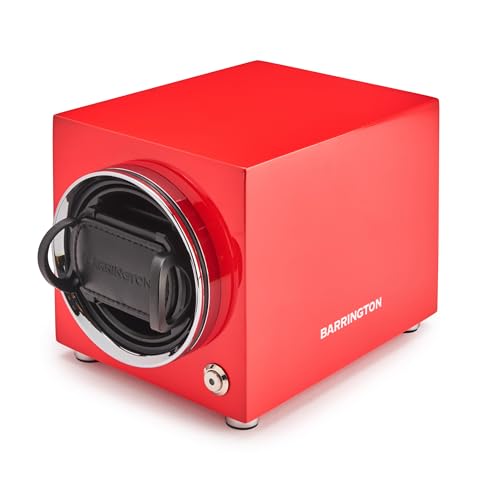
Barrington Single Watch Winder
- Five documented speed levels with 650, 750, 850, 1,000 and 1,950 turns per day, plus clockwise, anticlockwise and alternating rotation as separate settings instead of vague programme names
- For a Calibre 16 you select pure clockwise and the 850 setting; it lies just above the required 800 and remains uncritical thanks to the slipping clutch
- For Aquaracer and Carrera with Calibre 5 or 7 you simply set alternating rotation and 650, so the same winder is usable for both movement types
- Runs on the supplied power adapter or on two AA batteries; according to the manufacturer, one set lasts nearly two months in intermittent operation, so a cabinet without a socket is also an option
- The standard cushion holds common cases securely; a clamping bracket as on the WOLF would be the more robust solution for a heavy Carrera on a steel bracelet

WOLF Heritage Single Winder
- The direction of rotation can be set to clockwise, anticlockwise and both directions, so a single device covers both the Calibre 16 and the three-hand calibres
- The fixed 900 turns per day in pure clockwise rotation sit comfortably above the 800 documented for the Calibre 16, and this buffer is more of an advantage for the 7750 winding mechanism
- The patented lock-in holder clicks into the drum and, according to the manufacturer, carries cases up to 52 millimetres, so even a 45 millimetre Carrera Chronograph on a steel bracelet sits rock solid
- Operation via the supplied universal adapter or AA batteries, plus a storage compartment for a spare strap or second watch and a glass cover against dust
- The speed cannot be adjusted, and for an economical Calibre 5 with a documented 650 turns, the 900 are permanently above what is needed

Beco Technic Boxy Carbon Single 1 Classic
- The belt-driven interval motor does without a rattling gear train and, according to specialist retailers, offers three fixed programmes and all three rotation directions, including pure clockwise
- Ready to use straight away as a complete unit and at the same time the starting point of a system: if a Carrera Chronograph joins the Aquaracer later, you stack another Boxy module with its own direction on top
- The plastic housing with acrylic glass dome stays under one kilogram, which makes it easier to move around on a shelf and to carry into the cabinet
- Beco Technic does not give the exact turns per programme in figures, and if you want to hit the 800 for a Calibre 16 precisely, you are better off with the Barrington

ROTHWELL double watch winder
- Five speed levels and three rotation directions can be set separately for each position, so a Carrera Chronograph runs clockwise on the left and an Aquaracer in alternating mode on the right
- This very separation is the decisive advantage with TAG Heuer, because the Calibre 16 and Calibre 5 simply do not tolerate a shared setting
- The wooden frame with PU leather cover and the red interior make for an appearance that goes well beyond the plain plastic class
- There is no battery compartment; the device needs a permanent power socket and is therefore ruled out for a closed safe

MODALO Ambiente MV4 for 1 watch
- Three running directions with left, right and bidirectional cover both TAG Heuer worlds, and for a Calibre 16 you choose pure clockwise rotation
- Black Makassar with piano lacquer looks darker and calmer than walnut and suits a Carrera with a black dial exceptionally well
- The MV4 motor system stops at the 12 o'clock position during the rest phase, so the watch on the shelf is always neatly aligned instead of slanted in the cushion
- On turns per day the sources differ: specialist retailers state up to 1,700, the manufacturer for the series rather up to 1,000, so you should check the exact value with the retailer before buying

Klarstein St. Gallen II
- Four speed programmes start at exactly 650 turns per day and thus hit the documented value of the Calibre 5, 6 and 7 from the factory
- Three running directions including pure clockwise rotation make the device usable for a Calibre 16 as well, where you choose the 900 level just above the required 800
- An attachment for larger watches is included, which helps with sturdy chronograph cases with a thick rubber strap
- Mains power only and a plastic housing, so for the power-free safe and for the open shelf there are nicer solutions in this selection
Turns per day for TAG Heuer calibres
TAG Heuer does not publish its own turns values for watch winders. Two sources are therefore reliable: the setting databases of the winder manufacturers, which list individual calibres by name, and the documented winding direction of the respective base movement. Both agree pleasingly clearly for TAG Heuer, because the brand builds its movements almost entirely on well-known base calibres from ETA and Sellita. Where no entry exists, we state this openly in the table instead of inventing figures.
| Calibre | Typical models | Recommended turns per day | Rotation direction |
|---|---|---|---|
| Calibre 16 (based on ETA/Valjoux 7750 or Sellita SW500) | Carrera Chronograph, Aquaracer Chronograph, Formula 1 Chronograph | 800 | clockwise only |
| Calibre 5 (based on ETA 2824-2 or Sellita SW200-1) | Aquaracer, Carrera three-hand, Formula 1 Automatic | 650 | bidirectional |
| Calibre 6 | older Carrera and Aquaracer with seconds hand | 650 | bidirectional |
| Calibre 7 and Calibre 7 GMT (based on Sellita SW300-1) | Aquaracer GMT, Carrera Twin-Time | 650 | bidirectional |
| Calibre 17 | Monaco, older Formula 1 chronographs | 650 | bidirectional |
| Calibre 11 | Monaco reissues | 650 | bidirectional |
| Calibre 36 | Carrera flyback chronographs | 650 | bidirectional |
| Calibre Heuer 02 (in-house movement, around 80 h power reserve) | current Carrera Chronograph | no own entry: 650 to 800 | Rotor winds in one direction according to the calibre datasheet, successor TH20-00 bidirectional |
| All other TAG Heuer automatic movements | Models without a documented entry | 650 to 800 (rule of thumb) | bidirectional |
The table shows a clear break: everything with three hands and a date runs at 650 turns bidirectional. As soon as a chronograph with Calibre 16 is involved, the value jumps to 800 and the direction to pure clockwise. This is not a detail for connoisseurs, but the difference between a watch that is running on Monday and one that has stopped. You will find all values for ETA, Sellita, Seiko, Miyota and other manufacturers in our complete table of turns per day.
For the in-house movement Calibre Heuer 02, the situation is less clear. It does not yet appear in the winder databases, the calibre datasheets describe the ball-bearing rotor as winding in one direction, while the successor TH20-00 works bidirectionally again. In practice this means for you: start with bidirectional mode and around 800 turns, and if the watch loses power reserve after two days, switch to pure clockwise. Our guide to the power reserve also describes this approach.
What matters in a watch winder for TAG Heuer
The most important point of this page is the one-directional winding direction of the 7750 family. In the ETA Valjoux 7750 and its Sellita counterpart SW500, the rotor transmits movement to the mainspring in only one direction of rotation, and in the opposite direction it practically spins freely, producing the rotor noise typical of this movement. Because the Calibre 16 is built on exactly this base, the rule applies one to one to TAG Heuer. The databases of the winder manufacturers accordingly list the Calibre 16 at 800 turns per day clockwise.
The practical consequence for choosing a device is bigger than it sounds. If you set a winder to bidirectional alternating mode with 800 turns, only around 400 of them arrive as real winding output, because the opposite direction achieves nothing on the 7750. A device that runs only anticlockwise or that fixes its direction in alternation therefore winds a Carrera Chronograph poorly or not at all. When buying, you therefore absolutely need a model with a freely selectable single direction, not just several speeds.
One small stumbling block remains the viewing direction. The terms clockwise and anticlockwise for winders usually refer to the view of the dial from the front, while factory specifications often mean the view of the caseback. If your watch loses power reserve after two days despite a correctly set single direction, simply try the opposite direction. That costs nothing and settles the question more reliably than any table.
Only after that do the classic purchase criteria come in. A Carrera Chronograph in 44 or 45 millimetres on a steel bracelet has weight that acts as a lever on the holder with every rotation, and here a clamping holder like the WOLF Heritage plays to its strengths. If the device will stand in the bedroom, our overview of the quiet watch winder is worth a look, and if it is going into a cabinet without a socket, you need a model from the battery-powered watch winders category. How much design your collection needs in the first place is covered by the watch winder buying guide.
Which unit for whom
If you mainly wear a chronograph with Calibre 16, there is no way around a device with a separately selectable single direction, and the Barrington Single is the clearest choice there. It discloses its five speed levels in figures, offers pure clockwise rotation as its own setting and, with 850 turns, cleanly hits the required range. If weight also comes into play because your chronograph hangs on a massive steel bracelet, the WOLF Heritage with its clicking-in cuff and the fixed 900 turns clockwise is the sturdier answer. The comparison watch winders for 1 watch shows further single devices of this class.
If you own both, that is, an Aquaracer with Calibre 5 and a Carrera Chronograph, you need two separately adjustable positions. This is exactly what the ROTHWELL Double does, where speed and direction are set individually for each position. If the collection grows beyond that, take a look at the comparison watch winders for 2 to 4 watches, because from three watches a shared cabinet quickly becomes more economical than several single devices.
If your watch stands on an open shelf and the piece of furniture should not be disturbed, the MODALO Ambiente MV4 in solid Makassar wood is the most beautiful solution in this selection. If you would like to start small and still want to see figures rather than programme names, the Klarstein St. Gallen II is the right choice. If you are interested in a particular provider, you will find the ranges bundled in the brand overview, for example at Barrington, WOLF or Klarstein. The complete datasheets are in our overview of the data checks.
Editorial verdict
With TAG Heuer, everything comes down to a single question: is there a chronograph with Calibre 16 in your collection or not? If yes, you need 800 turns per day in pure clockwise rotation and therefore a device that offers this single direction at all. If not, 650 turns bidirectional are enough, and the choice becomes much more relaxed. Our recommendation is the Barrington Single for the most precise setting, the WOLF Heritage for heavy cases, the Beco Technic Boxy as the highest-rated all-rounder, the ROTHWELL Double for mixed pairs, the MODALO Ambiente MV4 for the open shelf and the Klarstein St. Gallen II for a low-cost entry.
You do not need to fear too many turns here, because the slipping clutch in the barrel prevents the mainspring from being overwound. A setting that is slightly too high costs only electricity and nothing else, which is why the WOLF's 900 are completely harmless for a Calibre 16. Whether a device is worth it for you at all is settled in a few minutes by our basics article Does my watch need a watch winder?. If you wear other brands besides TAG Heuer, the sister pages watch winders for Longines with the same chronograph topic, plus for Rolex, for Omega and for Breitling will help further.
Buying guides for other watch brands
With the Calibre 16, the winding direction decides between success and a stopped watch. Here is how it looks for other brands: Longines, Breitling, Oris, Rolex, Omega, Tudor, IWC, Panerai, Seiko, Cartier, Jaeger-LeCoultre, Zenith, Hamilton, Tissot, Certina, Mido, Grand Seiko, Bell and Ross, Sinn, Glashütte Original, Nomos, Rado, Maurice Lacroix, Frederique Constant, Junghans. Our table of turns per day collects all documented values for each calibre.
You will find devices with a freely selectable single direction from Beco Technic and ROTHWELL. The brand overview gives you the full list of manufacturers.
The text of this page was created with an AI language model and was reviewed and approved editorially before publication. Editorial responsibility lies with Seydhan Cakmak. The product images shown are not AI images but manufacturer and retailer photos from the Amazon catalogue, which we embed unchanged.
A limitation we disclose: Amazon and the retailers selling there now use generative tools in their listings themselves. Whether an individual catalogue image is affected, we cannot check from the outside, so we claim it neither one way nor the other. As soon as an image demonstrably comes from a generative model, we label it visibly on the image with the label AI image. More on this on the AI transparency page.