On this question, Grand Seiko is both pleasantly clear and inconvenient. Clear, because every automatic movement winds in both directions, so alternating rotation is always the right setting. Inconvenient, because the brand does not publish a turns figure and part of the range does not belong on such a device at all. We rank six devices and then set out which values are documented and which remain only working values.
The recommendations at a glance
| Model | Slots/type | Key feature | Price range | Rating |
|---|---|---|---|---|
| Barrington Single Watch Winder | 1 slot | 5 settings from 650, 3 rotation directions | Mid-range | 4,2/5 |
| Beco Technic Boxy Carbon Single 1 | 1 position, modular | Belt drive, 3 programmes, 3 directions | Mid-range | 4,4/5 |
| Swiss Kubik Velour Windsor | 1 slot | Battery operation as standard, Swiss manufacturer | Premium class | 4,3/5 |
| MODALO Ambiente MV4 for 1 watch | 1 slot | Solid Makassar wood, stop at 12 o'clock | upper mid-range | 4,2/5 |
| ROTHWELL double watch winder | 2 slots | 5 settings and 3 directions per slot | Mid-range | 4,2/5 |
| SONGMICS watch winder for 1 watch | 1 slot | 4 modes, LED, lock, USB-C | Entry level | 4,0/5 |
The devices in detail
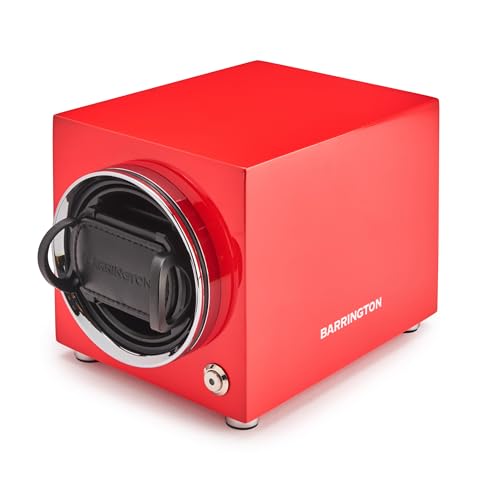
Barrington Single Watch Winder
- Five clearly documented speed settings at 650, 750, 850, 1,000 and 1,950 turns per day, plus clockwise, anticlockwise and alternating rotation instead of vague mode descriptions
- The two lowest settings cover the working value of 650 to 800 per day that we use for Grand Seiko, and they combine cleanly in alternating rotation
- Runs on the supplied power adapter or on two AA batteries; according to the manufacturer, one set lasts almost two months in intermittent operation, so even the safe is an option
- The standard cushion holds a Grand Seiko on a steel bracelet securely; a clamping bracket would be the more robust solution for very heavy cases such as the Diver's Collection

Beco Technic Boxy Carbon Single 1 Classic
- The interval motor with belt drive does without a rattling gear train and, according to specialist retailers, offers three fixed programmes and all three directions of rotation
- Ready to use straight away as a complete device and at the same time the starting point of a system: if a Hi-Beat joins the Snowflake later, you simply stack another Boxy module
- The plastic case with acrylic glass dome stays under one kilogram, which makes it easier to move and to carry into the cabinet
- Beco Technic does not state the exact turns per programme as numbers; if you want to set the working value as a concrete figure, the Barrington is the better choice

Swiss Kubik Velour Windsor for 1 automatic watch
- Swiss manufacturer that has its noise levels certified instead of just claiming them
- Designed for battery operation as standard, which makes it suited to safes and cabinets without a power feed-through
- Blue velour cover with yellow decorative stitching, a colour scheme away from the usual black that suits a blue dial well
- Only one slot: if you want to look after several watches, you buy several units

MODALO Ambiente MV4 for 1 watch
- Solid black Makassar wood with a piano lacquer finish looks darker and calmer than light walnut and makes a white dial look all the clearer
- Three rotation directions cover the bidirectional mode that Grand Seiko's automatic calibres need
- During the rest phase the MV4 drive stops in the 12 o'clock position, so the watch always sits neatly aligned behind the glass front
- MODALO does not state concrete turns figures per programme; if you want to set an exact numerical value, the Barrington is the better choice

ROTHWELL double watch winder
- Five speed settings and three rotation directions can be set separately for each slot, so a mechanical Grand Seiko runs next to a Spring Drive with its own values
- Two positions cover the most common collection, namely one watch for everyday wear and one for special occasions
- The wooden frame with PU leather cover and the red interior give an appearance that goes beyond the plain plastic class
- There is no battery compartment; the device needs a permanent power socket and is therefore ruled out for a closed safe

SONGMICS watch winder for 1 watch
- An adjustable watch cushion with velvet padding holds a 40-millimetre case as well as smaller models, without permanently overstretching the strap
- Four rotation modes with clockwise, anticlockwise and combined rotation can be adapted to the respective movement; the combined mode is the right one for Grand Seiko
- Switchable LED light, lockable glass front and a modern USB-C connection add up to a surprisingly complete feature set for the price class
- SONGMICS does not document how many turns per day each mode delivers, so we rely here solely on the information about the modes
Turns per day for Grand Seiko calibres
Grand Seiko does not publish turns per day for watch winders. The brand's calibre pages state construction type, half-oscillations, power reserve, jewels and rate accuracy, but no value for such a device. Only two things are therefore reliable: the documented winding construction and the working value of 650 to 800 turns per day that is established in the industry. We expressly label this working value as such in the table and do not present it as a manufacturer figure.
| Calibre | Type | Beats | Power reserve | Winding direction | Turns per day |
|---|---|---|---|---|---|
| Grand Seiko 9S65 | Automatic with hand winding | 28,800 per hour | around 72 hours | bidirectional, reversing gear train | Manufacturer states no value, working value 650 to 800 |
| Grand Seiko 9S85 Hi-Beat 36000 | Automatic with hand winding | 36,000 per hour | around 55 hours | bidirectional | Manufacturer states no value, working value 650 to 800 |
| Grand Seiko 9SA5 | Automatic with hand winding, Dual Impulse Escapement | 36,000 per hour | around 80 hours | bidirectional | Manufacturer states no value, working value 650 to 800 |
| Spring Drive 9R65 | Automatic with hand winding, Magic Lever | no balance wheel, manufacturer states no value | around 72 hours | bidirectional, Magic Lever | Manufacturer states no value, working value 650 to 800 |
| Grand Seiko 9S63 | Hand winding with small seconds | 28,800 per hour | around 72 hours | no rotor, no self-winding | does not belong on a watch winder |
| Spring Drive 9R31 | Hand winding | no balance wheel, manufacturer states no value | around 72 hours | no rotor, no self-winding | does not belong on a watch winder |
| Spring Drive 9R02 | Hand winding | no balance wheel, manufacturer states no value | around 84 hours | no rotor, no self-winding | does not belong on a watch winder |
| Quartz calibres of the 9F family, such as 9F85 | Quartz with battery | Quartz oscillator, no balance value | Battery life around 3 years | no winding mechanism | does not belong on a watch winder |
One point deserves a closer look, because it is often told wrongly. In the 9S65 calibre, winding does not run via the Magic Lever but via a reversing gear train with reverser wheels, as Caliber Corner describes. It still winds in both rotor directions. In the Spring Drive 9R65, by contrast, Grand Seiko itself states that the Magic Lever developed in 1959 is used. This mechanism too converts the rotor movement in both directions into winding work and has practically no dead zone.
For you, this means: with a watch winder, Spring Drive is not a special case but a normally bidirectionally winding movement. What matters for classification is that Spring Drive needs no battery. The energy comes solely from the mainspring, and the quartz oscillator is fed from the same source. According to Grand Seiko, a 9R65 runs for around 72 hours, works with 30 jewels and holds a rate accuracy of ±15 seconds per month. It comes with a power reserve indicator, date and seconds stop. Our table of turns per day collects all documented values from other manufacturers.
Which Grand Seiko does not belong on the winder
This is the most important point on this page, and it is rarely stated openly. The quartz calibres of the 9F family have no winding mechanism. They run on a battery; according to Grand Seiko, the 9F85 lasts around three years and is accurate to ±10 seconds per year. A watch winder does nothing for these watches, it just turns a case in circles.
Purely hand-wound movements do not belong on such a device either. In its calibre overview, Grand Seiko lists the mechanical 9S63 as hand-wound with small seconds, along with the Spring Drive movements 9R31 and 9R02 as hand-wound. They lack the rotor and are wound via the crown. A winder does not keep them running, it at most wears the bearings. Before buying, therefore, check on the calibre page of your watch whether it says self-winding.
And then there is the power reserve. A 9S65 runs for around 72 hours, a 9SA5 for around 80 hours. A Grand Seiko therefore gets through a full weekend in a drawer without stopping. A watch winder is therefore a convenience, not a must. It is worthwhile if you switch between several watches or do not want to keep resetting the date and time. If you wear your watch almost daily, you do not need a device, which is also how our basics article Does my watch need a watch winder? classifies it.
What matters in a watch winder for Grand Seiko
The first point is the rotation direction, and it is quickly settled: bidirectional. Whether a reversing gear train as in the 9S65 or a Magic Lever as in the 9R65, both constructions use every rotor movement. A purely clockwise or anticlockwise rotation works too, but winds the movement more slowly. Alternating rotation is therefore the right default setting for every automatic calibre of the brand.
The second point is the holder. Grand Seiko makes cases from around 37 to over 44 millimetres, and a solid steel bracelet adds considerable weight. This weight acts as a lever on the mount with every rotation, and a loose cushion can slip under it. A well-adjustable cushion, as supplied by Barrington, MODALO, SONGMICS and Beco Technic, is sufficient for most models. If in doubt, check the manufacturer's figure for the maximum case diameter and whether your strap fits over the mount.
The third point is the location. A device in the bedroom should run quietly, and we have a separate overview of the quiet watch winder for that. If the winder is to go in the safe, you need battery operation, because a cable feed-through drilled afterwards voids the safe's certification. You can find more in the comparison Watch safe with watch winder, and what power reserve means in practice is explained in the article Power reserve explained.
Which unit for whom
If you want to set the working value as a concrete number, the Barrington Single is the first choice. Its 650 setting in alternating rotation hits the lower end of the range exactly, and the 750 setting hits the middle. The highest overall score in this field, however, goes to the Beco Technic Boxy with 4.4 out of 5 points, because drive, build quality and expandability fit together best in it. We still put the Barrington first, because documented figures are worth more than programme names from a brand that gives no manufacturer specification.
If the device is going into a safe or a cabinet without a power socket, the route leads to the Swiss Kubik Velour Windsor, which is designed for battery operation from the factory. If your watch stands on an open shelf instead and the piece of furniture should not look out of place, the MODALO Ambiente MV4 in solid Makassar wood is the most attractive solution in this selection. Our overview Watch winders for 1 watch shows further single devices, and the watch winder buying guide gives the full overview.
If a second watch joins the collection, for example a mechanical Grand Seiko next to a Spring Drive, the ROTHWELL Doppel with separately adjustable positions is the logical step. The comparison Watch winders for 2 to 4 watches shows more models in this class. If you want to start small and lock the watch away at the same time, the SONGMICS is the right choice. You can find the providers' ranges collected in the brand overview, for example at Barrington, Swiss Kubik or MODALO, and the complete data sheets in our overview of data checks.
Editorial verdict
With Grand Seiko the technology is clear, but the data is thinner than for many Swiss brands. The winding direction is clear: bidirectional, for the change-wheel system as for the Magic Lever. The figures are thin because the company does not publish turns per day. We therefore apply the proven working value of 650 to 800 per day and state openly that it does not come from Grand Seiko.
The Barrington Single is our recommendation for the most precise setting, the Beco Technic Boxy the best-rated all-rounder, the Swiss Kubik the choice for the safe, the MODALO Ambiente MV4 for the open shelf, the ROTHWELL Doppel for two watches and the SONGMICS for a low-cost start. You do not need to fear too many turns, because the slip clutch in the barrel prevents the mainspring from being overwound. And for clarity: none of these devices is recommended, licensed or certified by Grand Seiko; we only assess technical suitability. If you also wind a Seiko from the main range, you will find the values on the page Watch winders for Seiko.
Buying guides for other watch brands
Spring Drive and Hi-Beat are two completely different answers from one company, and both wind bidirectionally via the Magic Lever. For other brands the technology is different: Seiko, Zenith, Glashütte Original, Rolex, Omega, Tudor, Breitling, IWC, Panerai, TAG Heuer, Longines, Oris, Cartier, Jaeger-LeCoultre, Hamilton, Tissot, Certina, Mido, Bell und Ross, Sinn, Nomos, Rado, Maurice Lacroix, Frederique Constant, Junghans. Our table of turns per day collects all documented values by calibre.
Because Grand Seiko itself gives no figure for turns, devices with finely graded programme selection from Beco Technic and Barrington are worthwhile. The brand overview gives an overview of all manufacturers.
The text of this page was created with an AI language model and was reviewed and approved editorially before publication. Editorial responsibility lies with Seydhan Cakmak. The product images shown are not AI images but manufacturer and retailer photos from the Amazon catalogue, which we embed unchanged.
A limitation we disclose: Amazon and the retailers selling there now use generative tools in their listings themselves. Whether an individual catalogue image is affected, we cannot check from the outside, so we claim it neither one way nor the other. As soon as an image demonstrably comes from a generative model, we label it visibly on the image with the label AI image. More on this on the AI transparency page.