Oris is a special case when it comes to the winder question, and in the best sense. While most watch manufacturers simply stay silent on the subject of watch winders, Oris explains in its own help centre how the in-house Calibre 400 can be wound. At the same time, many Oris models contain a Sellita movement that wants to be treated quite differently, and the chronographs contain a movement of the 7750 family with a third requirement. We have ranked six devices by how well they cover these three worlds, and have also noted which values are documented and which are not.
The recommendations at a glance
| Model | Slots/type | Key feature | Price range | Rating |
|---|---|---|---|---|
| botta Cube | 1 slot per module, stackable | 9 programmes 600 to 1,800, all directions | upper mid-range | 4,2/5 |
| Barrington Single Watch Winder | 1 slot | Speed levels in figures, 3 directions | Mid-range | 4,2/5 |
| Beco Technic Boxy Carbon Single 1 | 1 position, modular | Belt drive, 3 programmes, 3 directions | Mid-range | 4,4/5 |
| MODALO Ambiente MV4 for 1 watch | 1 slot | Solid Makassar wood, stop at 12 o'clock | upper mid-range | 4,2/5 |
| Klarstein St. Gallen II | 1 slot | 650 to 1,500, touch operation, LED | Entry level | 4,1/5 |
| SONGMICS watch winder for 1 watch | 1 slot | 4 modes, LED, lock, USB-C | Entry level | 4,0/5 |
The highest overall rating in the field goes to the Beco Technic Boxy, because drive, build quality and expandability fit together best in it. For Oris, we still put the botta Cube in first place, because it is the only device in the selection that combines nine speed programmes with a freely selectable single direction. This is exactly the combination you need as soon as a one-way winding Calibre 400 has to be looked after alongside a Sellita movement. The Barrington Single follows directly behind, because its 650 setting hits the only documented database value for Oris precisely.
The devices in detail

botta Cube
- Nine rotation programmes from 600 to 1,800 turns per day cover the documented 650 for the Cal. 733 just as well as the 800 for the chronograph movements of the 7750 family, without you having to settle for a compromise value
- All three running directions are freely selectable: bidirectional for the Sellita movements, clockwise only for an Aquis Chronograph and a single direction only for the one-way winding Calibre 400, where a high programme makes up for the missing second direction
- The brushless direct drive without a gearbox comes close to a whisper at around 14 decibels, so the module can stand on the bedside table next to the Divers Sixty-Five without any concern
- USB or battery operation with a runtime of around four months makes the aluminium module usable even without a power socket, and later it can be stacked up to nine positions
- Every additional module costs the full module price, so if you want to look after three or four Oris watches straight away, a ready-made multi-watch cabinet works out cheaper
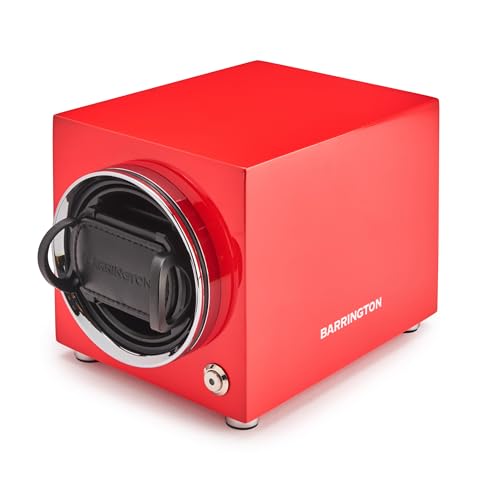
Barrington Single Watch Winder
- Five cleanly documented turns settings with 650, 750, 850, 1,000 and 1,950 turns per day, plus clockwise, anticlockwise and alternating rotation instead of vague mode names
- The 650 setting in alternating rotation matches exactly the value that the winder databases list for the Oris Cal. 733, and you could hardly serve an Aquis Date or a Divers Sixty-Five more precisely
- For a Calibre 400 that winds in one direction only, you set a pure single direction and choose the high 1,950 setting, so that the missing opposite direction is made up for by sheer volume
- Runs on the supplied power adapter or on two AA batteries; according to the manufacturer, one set lasts nearly two months in intermittent operation, so a spot without a power socket is also an option
- There is a big gap between 1,000 and 1,950; if you are looking for a medium value in a single direction for the Calibre 400, you will find it in finer steps on the botta Cube

Beco Technic Boxy Carbon Single 1 Classic
- The interval motor with belt drive manages without a rattling gear train and, according to specialist retailers, offers three fixed programmes and all three rotation directions, including both single directions
- Ready to use straight away as a complete unit and at the same time the starting point of a system: if an Aquis joins the Big Crown later, you stack another Boxy module with its own direction on top
- The plastic housing with acrylic glass dome stays under one kilogram, which makes it easier to move around on a shelf and to carry into the cabinet
- Beco Technic does not give the exact turns per programme in figures; if you want to set 650 exactly for a Cal. 733 or deliberately turn it up high for the Calibre 400, you are better served by the botta Cube or the Barrington

MODALO Ambiente MV4 for 1 watch
- Black Makassar with piano lacquer looks darker and calmer than walnut and suits an Artelier or a Big Crown Pointer Date on a leather strap extremely well
- Three rotation directions cover both winding types: alternating in both directions for the Sellita-based calibres and a pure single direction for chronograph movements or the Calibre 400
- The MV4 motor stops in the 12 o'clock position during the rest phase, so the watch always sits neatly aligned behind the glass front on the shelf
- A single unit does not grow with you; if you are likely to be winding a second Oris, it is better to plan for the twin version straight away or choose a stackable system

Klarstein St. Gallen II
- Four turns programmes start at exactly 650 turns per day and thus hit the documented value of the Cal. 733 straight out of the box, without you having to work through menus
- Three rotation directions including both single directions also make the unit usable for an Aquis Chronograph, where you choose the 900 setting, just above the required 800
- An attachment for larger watches is included, which noticeably helps with an Aquis of 43.5 millimetres and a thick rubber strap
- Mains operation only and a plastic housing; for a spot without a power socket and for the open shelf, this selection has nicer solutions

SONGMICS watch winder for 1 watch
- An adjustable watch cushion with velvet padding holds a Divers Sixty-Five of 40 millimetres just as well as an Aquis of 43.5 millimetres, without permanently overstretching the strap
- Four rotation modes with clockwise, anticlockwise and combined rotation can be adapted to the respective movement; for the Sellita-based Oris calibres, the combined mode is the right one
- Switchable LED light, lockable glass front and a modern USB-C connection add up to a surprisingly complete feature set for the price class
- SONGMICS does not document how many turns per day each mode delivers, so we rely here solely on the information about the modes
Turns per day for Oris calibres
Oris does not publish turns-per-day values for watch winders, just as most other watch manufacturers do not. Two sources are therefore reliable: the settings databases of the winder manufacturers and the documented technical characteristics of the movements, above all the winding direction of the rotor. The database lists the Cal. 733 by name with 650 turns per day in both rotation directions, along with the older Oris automatic movements of the 551 to 690 series. For the newer calibres there is no separate entry, and we state that openly in the table instead of inventing figures.
| Calibre | Typical models | Recommended turns per day | Rotation direction |
|---|---|---|---|
| Oris Cal. 733 (based on Sellita SW200-1) | Aquis Date, Divers Sixty-Five, ProPilot Date, Artelier | 650 | bidirectional |
| Oris Cal. 751 (based on Sellita SW220-1) | Big Crown ProPilot with date, Artelier Date | no own entry: 650 to 800 | bidirectional |
| Oris Cal. 754 (based on SW200-1 with pointer date) | Big Crown Pointer Date (older generation) | no own entry: 650 to 800 | bidirectional |
| Oris Cal. 774 (based on Sellita SW500) | Aquis Chronograph, older chronographs | no separate entry: 800 as for SW500 | expected clockwise only |
| Oris Cal. 771 (based on Sellita SW510) | Aquis Chronograph from model year 2024 | no separate entry: 800 as for the 7750 family | expected clockwise only |
| Oris Cal. 400 (in-house calibre) | Aquis Date Calibre 400, Divers Sixty-Five 12H | no TPD value published: 3,700 rotations for a full wind | one direction, anticlockwise according to Oris |
| Oris Cal. 403 (in-house calibre, pointer date) | Big Crown Pointer Date Calibre 403 | as for Cal. 400, no TPD value published | one direction, anticlockwise according to Oris |
| Older Oris automatic movements 551 to 690 | Models from before the Sellita generation | 650 | bidirectional |
| All other Oris automatic movements | Models without a documented entry | 650 to 800 (rule of thumb) | bidirectional |
To put the individual rows in context: the Cal. 733 is a Sellita SW200-1 with an Oris rotor, runs at 28,800 half-oscillations per hour and, depending on the version, offers 38 or 41 hours of power reserve. The Cal. 751 is based on the SW220-1 from the same family, and the Cal. 754 adds the pointer date of the Big Crown. Because all three belong to the SW200 family, the same 650 to 800 turns per day in bidirectional mode apply to them, as shown in our complete table of turns per day for the Sellita base movements.
The chronographs are a different case. The Cal. 774 uses the Sellita SW500 as its base, the newer Cal. 771 the SW510, and both ultimately go back to the Valjoux 7750. For this design principle, our TPD page documents 800 turns per day clockwise only, because the rotor tensions the mainspring in one direction only and spins freely in the opposite direction. There is no separate database entry for the Oris designations, which is why the table deliberately says "expected": the movement family is documented, the brand-specific recommendation is not.
The most interesting case is the in-house Calibre 400. It works with a rotor on a plain bearing that winds in one direction only and spins freely in the opposite direction, which Oris describes as a deliberate simplification with less wear. For this, Oris specifies anticlockwise rotation and gives a full wind from standstill as 3,700 rotations. This is expressly not a turns-per-day value in the usual sense but a total quantity, which is why we derive no TPD recommendation from it. Honesty also requires saying this: the manufacturer information does not make clear from which viewing direction the specification applies, and we already know the same problem from the Miyota movements.
In practice, this means two things for you. A bidirectional programme will also wind a Calibre 400, just with roughly half the yield, because every second rotation direction has no effect. If you prefer to be more precise, choose a pure single direction with a high programme and check after two days whether the watch keeps running reliably, using the other single direction if necessary. This step-by-step rate check is the most honest method anyway whenever no documented value exists for a calibre.
What matters in a watch winder for Oris
The most important question comes before the purchase, not after: do you need a unit at all? This is exactly where the Calibre 400 is a real spoilsport for the winder industry, because it stores around five days of power reserve via two barrels with extended mainsprings. If you take off an Aquis Date Calibre 400 on Friday evening, it is still running on Wednesday and showing the right time. Anyone who only occasionally takes off such a watch simply does not need a watch winder, and we say so clearly here, even though units are linked on this page.
A unit only makes sense in two situations. The first: you own several automatic watches and wear each one only every few weeks, so you save yourself from setting the time and date at every change. The second: your Oris contains a Sellita-based movement with 38 to 41 hours of power reserve that stops after just a long weekend. How power reserve, wearing habits and winder benefit relate to one another is explained in detail in our basics article Power reserve explained.
Once you have decided on a unit, the number of selectable rotation directions counts first. A mixed Oris collection can require three different settings, which rules out a winder with only one fixed programme. Second comes the holder: an Aquis of 43.5 millimetres with a thick rubber strap places different demands than a slim Artelier on a leather strap, which is why an adjustable cushion or a suitable attachment is a must. Only after that come matters such as looks, lighting or a lock.
The third point is the location. A unit in the bedroom should run quietly, and we have a separate overview of the quiet watch winder for that. If the winder is to stand away from a power socket, for example in a wardrobe or a safe, you need battery operation, as the comparison of battery-powered watch winders shows. And whether the purchase is worth it for you at all is settled in a few minutes by the article Does my watch need a watch winder?.
Which unit for whom
If you want to operate your Oris as precisely as possible and own more than one movement, the botta Cube is the first choice. Nine programmes from 600 to 1,800 turns per day and three freely selectable directions of rotation cover the Sellita movements, the chronograph calibres and the one-directional Calibre 400 without compromise. If a single watch with a Sellita movement is enough for you, the Barrington Single hits the documented 650 value exactly and costs less. Our buying guide to watch winders gives the full overview of all designs, and you can find more single devices under watch winders for 1 watch.
If you are looking for the most well-rounded device regardless of exact figures, choose the Beco Technic Boxy, which has the best rating in this selection. If your watch sits on an open shelf and the furniture should not be disturbed, the MODALO Ambiente MV4 in solid Makassar wood is the most beautiful solution. If you want an entry-level device but still want clear rotation figures on the display, you will find it in the Klarstein St. Gallen II; the comparison of affordable watch winders shows more models in this class. If a second Oris joins the collection, take a look at watch winders for 2 to 4 watches.
If you are interested in a particular manufacturer, you will find the ranges gathered in the brand overview, for example at Barrington, Beco Technic, MODALO or Klarstein. The full data sheets for the individual devices are in our overview of data checks. If you wear other brands besides Oris, the sister pages watch winders for Rolex, for Tudor, for Longines and for Seiko will help you further.
Editorial verdict
Oris demands more thought from a watch winder than most other brands, and that is down to the variety of movements. A Cal. 733 wants 650 turns per day in both directions, an Aquis Chronograph 800 clockwise, and the Calibre 400 winds in one direction only. If you have all three worlds in your cabinet, you therefore do not buy a device with a fixed programme, but one with a freely selectable direction and graduated turns per day. The botta Cube is our recommendation for exactly this case, the Barrington Single for the most precise setting with Sellita movements, the Beco Technic Boxy as the best-rated all-rounder, the MODALO Ambiente MV4 for the open shelf, and Klarstein and SONGMICS for getting started.
You do not need to fear too many turns here, because the slip clutch in the barrel prevents the mainspring from being overwound. A setting that is slightly too high costs only electricity and nothing else, so where database values are missing you can safely work up to the right value from below. And for clarity, because it is easily misunderstood here: none of the devices presented is recommended, licensed or certified by Oris. Oris only explains in general terms how the Calibre 400 winds, and from that we assess solely the technical suitability of the devices.
Buying guides for other watch brands
The Calibre 400 winds in one direction and lasts five days, which fundamentally shifts the winder question. With other brands the question looks different: Longines, TAG Heuer, Seiko, Rolex, Omega, Tudor, Breitling, IWC, Panerai, Cartier, Jaeger-LeCoultre, Zenith, Hamilton, Tissot, Certina, Mido, Grand Seiko, Bell und Ross, Sinn, Glashütte Original, Nomos, Rado, Maurice Lacroix, Frederique Constant, Junghans. Our table of turns per day collects all documented values by calibre.
If you want to cover the three settings a mixed Oris collection needs, you will find them at Beco Technic and Barrington. The brand overview gives the overview of all manufacturers.
The text of this page was created with an AI language model and was reviewed and approved editorially before publication. Editorial responsibility lies with Seydhan Cakmak. The product images shown are not AI images but manufacturer and retailer photos from the Amazon catalogue, which we embed unchanged.
A limitation we disclose: Amazon and the retailers selling there now use generative tools in their listings themselves. Whether an individual catalogue image is affected, we cannot check from the outside, so we claim it neither one way nor the other. As soon as an image demonstrably comes from a generative model, we label it visibly on the image with the label AI image. More on this on the AI transparency page.