A watch winder for Sinn has to solve two tasks at once. It has to hold securely a case that on the U1 comes to 44.0 millimetres in diameter, 14.7 millimetres in height and 113 grams without strap, and it has to distinguish between two winding worlds: the bidirectionally winding Sellita movements of the three-hand models and the 7750-type chronographs, which absorb energy only clockwise. Sinn Spezialuhren from Frankfurt am Main does not publish any turns figures itself, so we derive every value on this page from the respective movement base and state openly where a manufacturer figure is missing.
The recommendations at a glance
| Model | Slots/type | Key feature | Price range | Rating |
|---|---|---|---|---|
| WOLF Heritage Single Winder with storage | 1 position plus storage compartment | Lock-in Cuff up to 52 mm, 3 directions | Premium class | 4,0/5 |
| Beco Technic Boxy Carbon Single 1 Classic | 1 position, modular | German manufacturer, stackable system | Mid-range | 4,4/5 |
| botta Cube | 1 position per module | 9 programmes from 600 to 1,800, approx. 14 decibels | upper mid-range | 4,2/5 |
| Barrington Single Watch Winder Crimson Red | 1 slot | 5 levels in figures, mains or battery | Mid-range | 4,2/5 |
| ROTHWELL double watch winder | 2 slots | separate setting for two movement types | Mid-range | 4,2/5 |
| Swiss Kubik Velour Windsor for 1 automatic watch | 1 slot | certified noise levels, battery operation | Premium | 4,3/5 |
The highest overall rating in the field goes to the Beco Technic Boxy with 4.4 out of 5 points, because drive, build quality and expandability fit together best in it. For Sinn, however, we put the WOLF Heritage Single in first place, because its latching cuff accepts cases up to 52 millimetres according to the manufacturer. That makes it the only holder in this selection that still leaves noticeable reserve for a U1 at 44.0 millimetres and 113 grams without strap. For a brand whose dive watches are made of solid submarine steel, this is exactly the decisive buying point.
The devices in detail

WOLF Heritage Single Winder with storage
- The patented Lock-in Cuff latches into the drum and accepts cases up to 52 millimetres, so even a U1 at 44.0 millimetres in diameter and 113 grams without strap sits securely on the holder. With Sinn, this is the decisive buying point
- Because the cuff actively clamps the case instead of merely holding it, the watch does not tip even when a heavy steel bracelet acts as a lever on every rotation
- All three directions of rotation are selectable: alternating for a Sellita movement, clockwise only for a 7750-type chronograph, plus mains or AA battery operation
- The speed is fixed at 900 turns per direction and therefore above the derived 650 to 800, uncritical thanks to the slipping clutch, but not finely adjustable

Beco Technic Boxy Carbon Single 1 Classic
- Beco Technic is a German manufacturer and so fits a German brand from Frankfurt am Main in substance, with a tangible point of contact instead of an anonymous imported device
- The interval motor with belt drive does without a rattling gear train and, according to specialist retailers, offers all three directions of rotation, so alternating for a Sellita movement and clockwise only for a chronograph
- The Boxy system is modular: if a U1 or a 103 St Sa joins the 556 I later, you simply stack another module
- The watch cushion is designed for standard cases; with a U1 at 113 grams without strap, a clamping bracket as on the WOLF offers more security

botta Cube
- Nine rotation programmes from 600 to 1,800 turns per day cover both Sinn worlds; you hit the 650 for a Sellita movement as precisely as the 800 for a 7750-type chronograph
- All three directions of rotation are freely selectable, so the pure clockwise setting that a 103 St Sa requires by design can be set too
- The brushless direct drive is close to a whisper at around 14 decibels, and USB or battery operation makes the aluminium module usable without a socket too
- Each additional module costs the full module price, and the mount is a standard cushion: ideal for a 556 I at 65 grams, but with a U1 a clamping cuff is safer
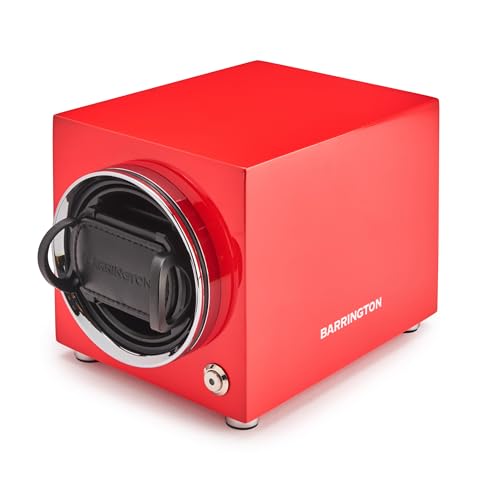
Barrington Single Watch Winder Crimson Red
- Five documented speed levels at 650, 750, 850, 1,000 and 1,950 turns per day, plus clockwise, anticlockwise and alternating rotation as separate settings instead of vague mode names
- For a 556 I, a 104 St Sa A or a U1 you choose alternating rotation and the 650 level, for a 103 St Sa pure clockwise rotation and the 850 level
- The Japanese motor runs on the power adapter or on two AA batteries, so it also fits into a cupboard without a socket or into a closed safe
- A level at exactly 800 is missing, and the standard cushion is the weak point of this brand: a 556 I sits cleanly, but with a U1 there is a residual risk without a clamping cuff

ROTHWELL double watch winder
- Two positions solve exactly the problem that Sinn raises: a 556 I or U1 runs in bidirectional alternation, while next to it a 103 St Sa is served in pure clockwise rotation
- Five speed levels and three rotation directions give enough room to hit the derived range of 650 to 800 turns per day cleanly
- The quiet motor makes the device tolerable even on the chest of drawers in the bedroom, and the black housing with a red interior looks more valuable than the price class would suggest
- The holder is a standard cushion without a clamping bracket, which is the weaker solution for a U1 with 44.0 millimetres and 113 grams

Swiss Kubik Velour Windsor for 1 automatic watch
- Swiss Kubik is the only brand in the niche to state independently certified noise values, which is a reliable argument in an industry full of advertising words
- Factory battery operation makes the device suitable for safes, because a cable passage drilled afterwards voids a safe's certification
- The running cycles can be programmed, so you deliberately set the derived 650 to 800 turns per day instead of going by a programme name
- Manufacture price for a single position, and the manufacturer does not state a maximum case size: with a U1 you should clarify the fit before buying
Turns per day for Sinn calibres
Sinn does not publish turn figures for watch winders, neither on the model pages nor in the documents for the individual watches. The only reliable route is therefore the movement base, and with this brand it works well: Sinn states the installed calibre for each model, and for the Sellita movements as well as for the 7750 design the winding direction is documented. Our existing overview of turns per day already lists the Sellita SW 200-1 and the SW 300-1 at 650 to 800 bidirectional, while the Sellita SW 500 and the ETA/Valjoux 7750 are listed at 800 clockwise only. Exactly these two lines make up the Sinn range.
| Calibre | Movement basis and features | Derived turns per day | Rotation direction |
|---|---|---|---|
| Sellita SW 200-1 | Based on ETA 2824-2, 26 jewels, 28,800 A/h, around 38 h; among others 556 I and U1 | 650 to 800 | bidirectional |
| Sellita SW 220-1 | SW 200 family with day and date; among others 104 St Sa A | 650 to 800 | bidirectional |
| Sellita SW 300-1 | Based on ETA 2892-A2, built flatter; among others U50 | 650 to 800 | bidirectional |
| Concepto C99001 | dimensionally identical replica of the Valjoux 7750, 25 jewels, around 48 h; among others 103 St Sa | 800 | clockwise only (7750 design, no manufacturer statement) |
| ETA/Valjoux 7750 | older 103 and 144 chronographs | 800 | clockwise only |
| Other Sinn automatic movements | without a clearly documented base movement | 650 to 800 (rule of thumb) | bidirectional; clockwise for chronographs |
The table shows a clean cut through the collection. Everything that carries a Sellita movement runs in bidirectional alternation, because the SW 200-1, SW 220-1 and SW 300-1 all work with a ball-bearing rotor and bidirectional winding. This applies to the 556 I with a diameter of 38.5 millimetres and 65 grams without strap just as much as to the 104 St Sa A with 41 millimetres and 73 grams, the U1 with 44.0 millimetres and 113 grams, and the U50 with 41 millimetres and the flatter SW 300-1, which at 3.6 millimetres of height stays below the 4.6 millimetre SW 200-1. For all of these watches you set alternating rotation and 650 to 800 turns, nothing more is needed.
The chronograph is a different case. The Concepto C99001 of the 103 St Sa is manufactured in La Chaux-de-Fonds and is a dimensionally identical replica of the Valjoux 7750: 30 millimetres in diameter, 7.9 millimetres in height, 25 jewels, 28,800 half-oscillations per hour, around 48 hours of power reserve, a ball-bearing rotor and additionally hand-windable. Because the construction is dimensionally identical, the pawl winding system that transfers energy only clockwise applies there too. However, we do not have an explicit manufacturer statement from Concepto on the winding direction, so we mark the value as a derivation. With older 103 and 144 chronographs that carry the ETA/Valjoux 7750 itself, on the other hand, the matter is clear. We use the same derivation on the sister pages watch winders for Hamilton and watch winders for TAG Heuer, where movements of the 7750 design are also fitted in the case.
What matters in a watch winder for Sinn
The most important purchase point for this brand is the holder, and there is a simple physical reason for that. The U1 measures 44.0 millimetres in diameter, is 14.7 millimetres high and weighs 113 grams without strap, because the case and crown are made of high-strength, seawater-resistant German submarine steel and the watch remains pressure-resistant to a diving depth of 1,000 metres. For comparison: a 556 I at 38.5 millimetres weighs 65 grams, so barely half. With a solid steel bracelet the difference grows further, and with every turn this mass acts as a lever on the holder. A holder that is too small or too soft does not carry such a watch cleanly: either the strap is overstretched, or the watch sits crooked and slips. So check the maximum span in millimetres and the design of the holder, because a clamping cuff holds better by design than a loose cushion. We make the same calculation in the comparison watch winders for Panerai, where the cases are larger still.
The second key point is the split between movement families. The Sellita three-hand movements wind in both directions via a ball-bearing rotor, whereas a chronograph of the 7750 design winds only clockwise. If you set bidirectional alternation with 800 turns for a 103 St Sa, only around half arrives as winding output, because the rotor practically spins freely in the opposite direction. As soon as a Sinn chronograph is involved, you therefore absolutely need a device with a freely selectable single direction and not just one with several speeds. One stumbling block remains here, the viewing direction: clockwise and anticlockwise specifications on winders usually refer to the view from the front onto the dial, whereas movement specifications often mean the view onto the caseback. If your watch loses power reserve after two days despite a set single direction, simply try the opposite direction.
A third topic comes up regularly with Sinn, and we deliberately place it here: the Ar dry-keeping technology. According to the manufacturer it consists of three elements, a drying capsule filled with copper sulphate, EDR seals and a protective gas filling. The capsule permanently binds humidity from inside the case and turns blue as the water content rises, so the degree of saturation can be read off. The noble gas argon displaces the moisture-laden air almost completely and, as a large-molecule gas, slows diffusion from outside. Sinn states extended service intervals, absolute freedom from fogging and more stable rate accuracy during temperature changes as the result, and together with the special oil 66-228 the manufacture guarantees functional reliability from minus 45 to plus 80 degrees Celsius. And now the honest assessment: this technology has nothing to do with a watch winder. It makes such a device neither necessary nor superfluous, because it concerns the climate inside the case and not the winding of the mainspring. It is still relevant for this page, because it shows that Sinn relies on long service intervals, and because a winder changes nothing about that.
Only then come the usual points that apply to every device. If the winder stands in the bedroom, a look at our overview of the quiet watch winder is worthwhile, because a permanently running motor on the bedside table quickly becomes a nuisance. If the device is to go in a safe, you need battery operation, because a subsequently drilled cable feed-through voids the safe's certification, and the comparison of battery-powered watch winders collects suitable models. If you are looking for a high-end display solution, you will find it under premium watch winders. And because the SW 200-1 offers only around 38 hours of power reserve, a Sinn left in a drawer over a weekend generally stands still, which the basics article power reserve explained puts into context in more detail.
Which unit for whom
If you wear a single large Sinn, that is a U1, a U50 or a 104 St Sa A, and want maximum security in the holder, the WOLF Heritage Single is the first choice. Its lock-in cuff up to 52 millimetres leaves reserve even with the 44 case, and the additional storage compartment holds a spare strap or the spring bar tool. The overall picture of all designs is given by our buying guide to watch winders, and further single devices are shown in the comparison watch winders for 1 watch.
If, on the other hand, a 556 I or another slim three-hand watch is the focus and the device should grow with you, the Beco Technic Boxy is the more rounded solution, if only because a German manufacturer suits a German brand well and further modules can easily be stacked on later. If you want to hit 650 and 800 precisely while staying almost silent, take the botta Cube with its nine programmes. If a three-hand watch and a chronograph come together, you need two positions with separate settings, and the ROTHWELL double watch winder stands for that; more models of this class are shown in the comparison watch winders for 2 to 4 watches.
If you want clear numerical values on the switch instead of programme names, you reach for the Barrington Single, and if the watch is to go into a closed safe and run as quietly as possible, there is hardly a way around the Swiss Kubik Velour Windsor. If you are interested in a particular provider, you will find the ranges at WOLF, Beco Technic, ROTHWELL, Barrington and Swiss Kubik, gathered in the brand overview. The full data sheets for the individual devices are in our overview of data checks.
Editorial verdict
With Sinn, the buying decision comes down to two questions, and both are quickly answered. First: how large and how heavy is your watch? For a U1 at 44.0 millimetres and 113 grams without strap, the holder comes first; for a 556 I at 38.5 millimetres and 65 grams it is uncritical. Second: is there a 7750-type chronograph in the collection? If so, you need around 800 turns per day in clockwise-only rotation, and therefore a device that offers that single direction at all. If not, 650 to 800 in alternating directions is enough for the Sellita movements. Our recommendation is therefore the WOLF Heritage Single for the large watch, the Beco Technic Boxy as the best-rated all-rounder, the botta Cube for the most precise and quietest setting, the Barrington Single for documented figures, the ROTHWELL Doppel for a three-hand watch and a chronograph side by side, and the Swiss Kubik Velour Windsor for the safe.
You do not need to fear too many turns, because the slipping clutch in the mainspring barrel prevents the mainspring from being overwound, which is why the fixed 900 of the WOLF is harmless for a Sinn. Whether a device is worthwhile for you at all is answered in a few minutes by our basics article Does my watch need a watch winder?: with around 38 hours of power reserve from the SW 200-1, a winder is real convenience if you often switch between several watches, but not a necessity for the daily wearer. And for clarity: none of the devices presented here is recommended, licensed or approved by Sinn; we only assess technical suitability.
Buying guides for other watch brands
Cases made of U-boat steel at 44 millimetres shift the question from the number of turns to the load capacity of the holder. For other brands the focus lies elsewhere: Panerai, IWC, Hamilton, Rolex, Omega, Tudor, Breitling, TAG Heuer, Longines, Oris, Seiko, Cartier, Jaeger-LeCoultre, Zenith, Tissot, Certina, Mido, Grand Seiko, Bell und Ross, Glashütte Original, Nomos, Rado, Maurice Lacroix, Frederique Constant, Junghans. All documented values per calibre are collected in our table of turns per day.
Holders that securely grip more than 100 grams are offered by WOLF and Beco Technic. The brand overview gives an overview of all manufacturers.
The text of this page was created with an AI language model and was reviewed and approved editorially before publication. Editorial responsibility lies with Seydhan Cakmak. The product images shown are not AI images but manufacturer and retailer photos from the Amazon catalogue, which we embed unchanged.
A limitation we disclose: Amazon and the retailers selling there now use generative tools in their listings themselves. Whether an individual catalogue image is affected, we cannot check from the outside, so we claim it neither one way nor the other. As soon as an image demonstrably comes from a generative model, we label it visibly on the image with the label AI image. More on this on the AI transparency page.