With Certina, the winder question is clear-cut as long as you know which movement is in the watch. The brand relies on the Powermatic 80, a movement with an 80-hour power reserve that uses any direction of rotation. As soon as a chronograph is on the table, the recommendation flips, because these movements wind in one direction only. We have classified six devices precisely for these two cases and summarised all documented values in a separate calibre table.
The recommendations at a glance
| Model | Slots/type | Key feature | Price range | Rating |
|---|---|---|---|---|
| Barrington Single Watch Winder | 1 slot | 650 setting and three directions of rotation | Mid-range | 4,2/5 |
| botta Cube | 1 slot per module, expandable | Direct drive, 9 programmes, very quiet | upper mid-range | 4,2/5 |
| MODALO Ambiente MV4 for 1 watch | 1 slot | Solid Makassar wood, stop at 12 o'clock | upper mid-range | 4,2/5 |
| Klarstein St. Gallen II | 1 slot | 4 programmes from 650, touch and LED | Entry level | 4,1/5 |
| SONGMICS watch winder for 2 watches | 2 slots | 4 modes, lock, USB-C | Entry level | 4,1/5 |
| Tolesum watch winder for 2 watches | 2 slots | 970 to 2,430 turns, USB-C | Entry level | 4,0/5 |
Three devices share the top spot with 4.2 out of 5 points, each for a different reason. For Certina we put the Barrington Single in first place because it is the only device in the field that combines an exactly named 650 setting with a pure clockwise rotation, and thus serves both Certina movement families cleanly. The botta Cube wins on noise level and expandability, the MODALO Ambiente MV4 on material and presence on an open shelf. If you want to spend little, Klarstein, SONGMICS and Tolesum offer three usable entry-level solutions, but you have to accept compromises there on documented data.
The devices in detail
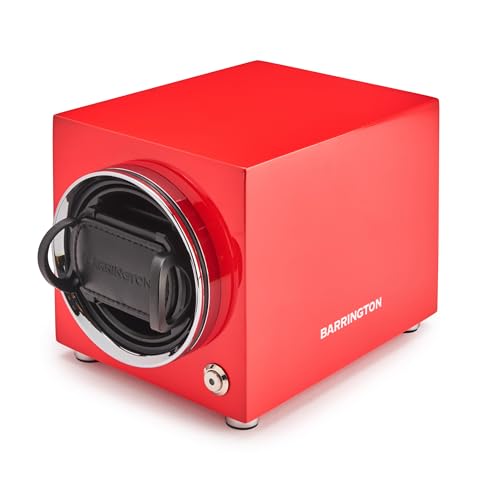
Barrington Single Watch Winder
- Five cleanly documented speed settings with 650, 750, 850, 1,000 and 1,950 turns per day, the lowest setting hitting the value customary for the 2824 base exactly
- Clockwise, anticlockwise and alternating rotation can each be selected: for the bidirectional Powermatic 80 you take alternating rotation, for the Valjoux-based DS Action Diver Chrono pure clockwise
- It runs either on the mains adapter or on two AA batteries, and according to the manufacturer one set lasts almost two months, so even a cabinet without a socket is an option
- One slot stays one slot: if you want to wind a DS Action and a DS Chronograph in parallel, you need two devices or a double winder right away

botta Cube
- The modular direct drive does without a rattling gear mechanism and therefore runs noticeably quieter than classic geared motors
- Nine programmes span the range from 600 to 1,800 turns per day, so the corridor of 650 to 800 that suits the Powermatic 80 can be targeted finely
- On battery power a module runs for around four months according to the manufacturer, or alternatively it is powered via USB, and up to nine modules can be added, with one to start you off here
- Each additional module costs the full module price, so for two or three Certina watches a ready-made multi-watch device is considerably cheaper

MODALO Ambiente MV4 for 1 watch
- Black solid Makassar wood with a glass front looks darker and calmer than light walnut and goes well with the DS-7 on a leather strap
- Three directions of rotation cover both the bidirectional running for the Powermatic 80 and the pure clockwise running for the Valjoux-based chronographs
- During the rest phase the MV4 drive stops in the 12 o'clock position, so the watch always sits neatly aligned behind the glass front
- MODALO does not state concrete turn counts per programme; if you want to set an exact figure, you are better off with the Barrington or the botta Cube

Klarstein St. Gallen II
- The first of the four programmes is at exactly 650 turns per day and thus hits the value derived for the Powermatic 80 from the ETA 2824-2 base
- Anticlockwise, clockwise and bidirectional running are available; for a DS Chronograph you choose pure clockwise plus the 900 setting, just above the assumed 800 turns
- Switchable LED lighting and a touch panel make for operation without fiddly switches, and the watch stays visible yet protected from dust
- The manufacturer gives no reliable figures on motor noise and power consumption; for the bedroom the botta Cube is the safer choice
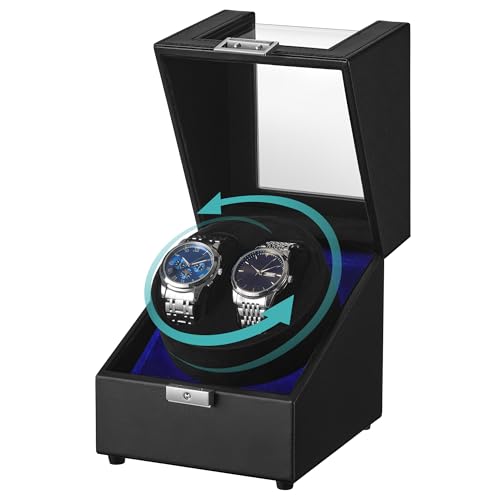
SONGMICS watch winder for 2 watches
- Two slots at an entry-level price: a DS Action for everyday wear and a DS-7 for special occasions stay wound at the same time
- Four rotation modes with clockwise, anticlockwise and combined running can be adapted to the movement; for the bidirectional Powermatic 80 the combined mode is the right one
- An adjustable watch cushion, switchable LED light, lockable glass front and USB-C connection make for complete features in this price class
- SONGMICS does not document how many turns per day each mode delivers, so we rely here solely on the information about the modes and the direction of rotation
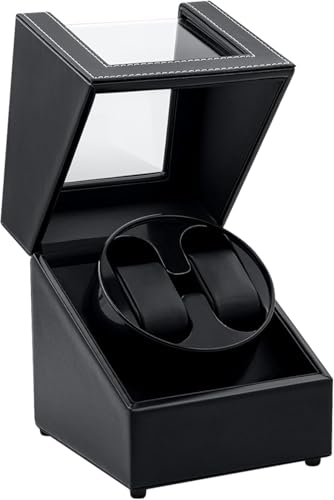
Tolesum watch winder for 2 watches
- The manufacturer states a concrete range of 970 to 2,430 turns per day, which is rare in this price class and allows a deliberate setting instead of pure guesswork
- Two separate slots in the black PU leather housing keep an everyday watch and a second watch ready to go at the same time
- Operation is via USB-C with a bridge cable system, so several devices can be supplied from a single power source
- The range only starts at 970 turns and thus lies above the 650 to 800 assumed for the Powermatic 80; thanks to the slip clutch this is uncritical, but not finely adjustable
Turns per day for Certina calibres
Certina does not publish its own turn values for watch winders, neither in the data sheet nor in the instruction manual. Two sources are therefore reliable: the documented design of the movements, above all the winding direction of the rotor, and the setting databases of the winder makers. In the table we therefore label every numerical value as a database value and state openly where no entry of its own exists, instead of inventing numbers. The practical core is quickly told: bidirectional for the Powermatic 80 models, clockwise only for the chronographs.
| Calibre | Typical models | Recommended turns per day | Rotation direction |
|---|---|---|---|
| Powermatic 80 (ETA C07.611) | DS Action, DS-7, DS Action GMT, DS Action Day-Date | 650 to 800 (database value) | bidirectional (ball-bearing rotor) |
| ETA 2824-2 (base movement of the Powermatic 80) | Basis of the Powermatic family | 650 (database value) | bidirectional |
| ETA A05.231 (based on Valjoux 7753) | DS Action Diver Chrono | 800 (database value) | clockwise only |
| ETA A05.H31 (Valjoux 7753 adaptation) | DS Chronograph Automatic 1968 | 800 (database value) | clockwise only |
| All other Certina automatic movements | Models without their own database entry | 650 to 800 (rule of thumb) | bidirectional |
The Powermatic 80 deserves a closer look because it differs from many other Swiss automatic movements. It runs on 25 jewels, measures 25.6 millimetres and beats at 21,600 half-oscillations per hour, i.e. 3 hertz instead of the usual 4 hertz, or 28,800 half-oscillations. This reduced frequency is exactly the reason for the 80 hours of power reserve. It also has a balance spring made of Nivachron, which is designed to be non-magnetic and resistant to temperature and shock. This changes nothing about the winder settings, but it makes the device a convenience item rather than a necessity.
One thing in common is practical for research: Certina and Mido use the same base calibre, the ETA C07.611, so the direction of rotation and the range of turns are identical for both brands. Do not confuse it with the C07.111, a different movement variant from the same family, as fitted in Tissot. If you have both brands in your cabinet, you will find the classification on our page Watch winders for Tissot. All documented values for ETA, Sellita, Seiko, Miyota and other movement manufacturers are collected in our table of turns per day.
What matters in a watch winder for Certina
Point one is the direction of rotation, and with Certina it is the only place where you can really go wrong. The Powermatic 80 winds in both directions via its ball-bearing rotor, as is usual for the whole movement family around the ETA 2824-2. If you accidentally set only counter-clockwise here, nothing bad happens, as the watch is still wound. The DS Action Diver Chrono with its ETA A05.231 and the DS Chronograph Automatic 1968 with the ETA A05.H31 are a different matter: both trace back to the Valjoux 7753 and, like the entire 7750 family, wind in one direction only. A purely counter-clockwise setting does move the watch there, but it does not wind it.
Point two is the number of turns, and here you can relax. Between 650 and 800 turns per day is the safe corridor for the Powermatic 80 models, and for the chronographs the databases specify 800 clockwise. A slightly too high setting is harmless, because the slipping clutch in the mainspring barrel prevents overwinding of the mainspring; it merely costs a little more power. Details can be found in the article Power consumption of watch winders. Too little movement is the bigger problem, because then the watch has stopped in the morning despite the device running.
Point three is the location. A device next to the bed has to run quietly, and we have a separate overview on this, the quiet watch winder. If the winder is to go in a cabinet without a power socket or in the safe, you need battery operation, as offered by Barrington and botta; a suitable selection is available under battery-powered watch winders. And because 80 hours of power reserve is already a very comfortable buffer, it is worth asking yourself honestly beforehand whether a device makes sense for you at all. The basic article Power reserve explained puts this in context in a few minutes.
Which unit for whom
If you wear a Certina with a Powermatic 80 and want to get the setting as precise as possible, the Barrington Single is the first choice: 650 turns as a named level, plus a purely clockwise rotation for a later chronograph. If the device is to stand in the bedroom or later grow into a small row, the botta Cube is the better answer. If the watch is on display on an open shelf, the MODALO Ambiente MV4 made of solid Makassar wood wins. Our watch winder buying guide gives an overview of all designs, and you will find more single devices under Watch winders for 1 watch.
If you want to spend little and still set a named figure, go for the Klarstein St. Gallen II with its 650 level. If a second Certina joins, such as a DS Action next to a DS-7, the SONGMICS Double with four modes and a lockable glass front is the well-rounded solution, with the Tolesum as the alternative with a specifically stated range of turns. The comparison Watch winders for 2 to 4 watches shows more models in this class.
If you are interested in a particular provider, you will find the ranges gathered in the brand overview, for example at Barrington, MODALO, Klarstein or SONGMICS. The complete data sheets of the devices are in our overview of data checks.
Editorial verdict
With Certina the technical situation is clear: the Powermatic 80 with the movement designation ETA C07.611 winds bidirectionally, so the bidirectional mode with 650 to 800 turns per day is the right basic setting. The Valjoux-based chronograph movements ETA A05.231 and ETA A05.H31, on the other hand, require purely clockwise rotation at usually 800 turns. A device that covers both cases is the most practical purchase, and this is exactly what the Barrington Single does best. The botta Cube is the quiet alternative, the MODALO Ambiente MV4 the most beautiful, and Klarstein, SONGMICS and Tolesum cover the entry level.
You do not need to fear too many turns, because the slipping clutch in the mainspring barrel protects the mainspring, which is why even the Tolesum with its 970 turns as a lower limit remains harmless. More important than the last bit of fine-tuning is a holder that takes your case without tension on the strap. Whether a winder is worthwhile for you at all is answered in the article Does my watch need a watch winder?. And for clarification: none of the devices presented here is recommended, licensed or certified by Certina; we only assess technical suitability.
Buying guides for other watch brands
The Powermatic 80 with the base movement ETA C07.611 is shared by Certina with a sister brand from the same group, while other houses build entirely their own calibres. This is how the other brands sort out: Mido, Tissot, Hamilton, Rolex, Omega, Tudor, Breitling, IWC, Panerai, TAG Heuer, Longines, Oris, Seiko, Cartier, Jaeger-LeCoultre, Zenith, Grand Seiko, Bell and Ross, Sinn, Glashütte Original, Nomos, Rado, Maurice Lacroix, Frederique Constant, Junghans. All documented values per calibre are collected in our table of turns per day.
In price terms, the devices from Klarstein and SONGMICS suit the entry class of this silo, both with a freely selectable single direction for the chronograph. The brand overview gives an overview of all manufacturers.
The text of this page was created with an AI language model and was reviewed and approved editorially before publication. Editorial responsibility lies with Seydhan Cakmak. The product images shown are not AI images but manufacturer and retailer photos from the Amazon catalogue, which we embed unchanged.
A limitation we disclose: Amazon and the retailers selling there now use generative tools in their listings themselves. Whether an individual catalogue image is affected, we cannot check from the outside, so we claim it neither one way nor the other. As soon as an image demonstrably comes from a generative model, we label it visibly on the image with the label AI image. More on this on the AI transparency page.