Longines builds two kinds of automatic watches, and for the watch winder this difference makes all the difference. The three-hand movements of the L888 family wind in both directions and are entirely uncritical, while the column-wheel chronograph L688 comes from the Valjoux 7750 family and winds in one direction only. A device with a fixed alternating rotation therefore keeps a Master Collection Chronograph running only with difficulty or not at all, even though it visibly works. We have sorted six devices from our inventory according to precisely these two requirements and placed the documented values per calibre alongside.
The recommendations at a glance
| Model | Slots/type | Key feature | Price range | Rating |
|---|---|---|---|---|
| botta Cube | 1 slot per module, stackable | 9 programmes 600 to 1,800, all directions | upper mid-range | 4,2/5 |
| Barrington Single Watch Winder | 1 slot | Speed levels in figures, 3 directions | Mid-range | 4,2/5 |
| Beco Technic Boxy Carbon Single 1 | 1 position, modular | Belt drive, 3 programmes, 3 directions | Mid-range | 4,4/5 |
| DESIGNHÜTTE San Diego 4 LCD | 4 slots plus drawer | LCD control, 650 to 1,950 | upper mid-range | 4,2/5 |
| MODALO Ambiente MV4 for 1 watch | 1 slot | Solid Makassar wood, stop at 12 o'clock | upper mid-range | 4,2/5 |
| SONGMICS watch winder for 1 watch | 1 slot | 4 modes, LED, lock, USB-C | Entry level | 4,0/5 |
The Beco Technic Boxy takes the highest overall rating in the field because drive, build quality and expandability fit together best in it. For Longines we still put the botta Cube first, because its nine programmes from 600 to 1,800 turns cover both the 650 of the three-hand movements and the 800 of the L688 precisely, and all three rotation directions are freely selectable. The Barrington Single follows directly behind, because it too states its levels in figures rather than programme names.
The devices in detail

botta Cube
- Nine rotation programmes from 600 to 1,800 turns per day hit both the 650 for an L888 and the 800 for the L688 chronograph without compromise
- All three rotation directions are freely selectable: for the L688 you set pure clockwise, for the three-hand movements the alternating mode
- The brushless direct drive without a gearbox comes close to a whisper at around 14 decibels, so the module can go on the bedside table without concern
- USB or battery operation with roughly four months of runtime makes the aluminium module usable in a cabinet without a power socket too, and later it can be stacked up to nine positions
- Every additional module costs the full module price, so if you want to look after three or four Longines straight away, a ready-made multi-watch cabinet works out cheaper
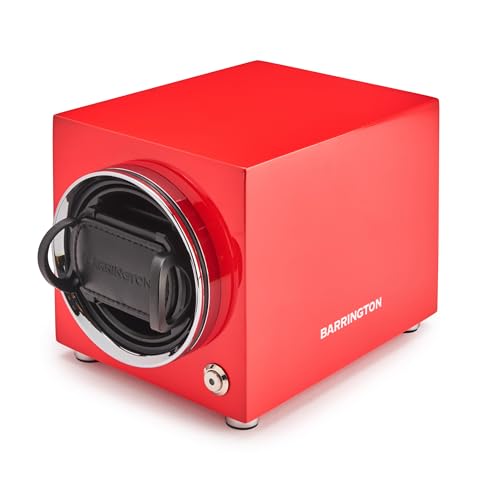
Barrington Single Watch Winder
- Five documented speed settings of 650, 750, 850, 1,000 and 1,950 turns per day, plus clockwise, anticlockwise and alternating rotation as separate settings
- The 650 setting in alternating mode matches exactly the value that the databases list for Longines three-hand calibres such as the L619
- For a chronograph with an L688, you switch to pure clockwise and the 850 setting, which sits just above the required 800 and stays uncritical thanks to the slip clutch
- Runs on the supplied power adapter or on two AA batteries; according to the manufacturer, one set lasts almost two months in intermittent operation
- The standard pillow holds common case sizes securely, but for a HydroConquest on a solid steel bracelet a clamping bracket would be the more robust solution

Beco Technic Boxy Carbon Single 1 Classic
- The belt-driven interval motor does without a rattling gear train and, according to specialist retailers, offers three fixed programmes and all three rotation directions, including pure clockwise
- Ready to use straight away as a complete unit and also the starting point of a system: if a Master chronograph joins the Spirit later, you stack another Boxy module with its own direction on top
- The plastic housing with acrylic glass dome stays under one kilogram, which makes it easier to move around on a shelf and to carry into the cabinet
- Beco Technic does not give the exact turns per programme in figures, so if you want to target the 800 for an L688 precisely, you are better off with the botta Cube or the Barrington

DESIGNHÜTTE San Diego 4 LCD
- The LCD control of the Designhütte range works with speed settings from 650 to 1,950 turns per day and three rotation directions, and according to retailer information the San Diego 4 covers the same range
- This allows a HydroConquest at 650 bidirectional to be looked after next to a Master chronograph at 800 clockwise, without either watch being shortchanged
- Four moving positions and, according to the manufacturer, room for up to six more watches on separate pillows in the drawer, so even a mixed collection finds a place in one spot
- The unit runs on the power adapter only, and the high-gloss surfaces show fingerprints clearly, so it is not made for a safe without power

MODALO Ambiente MV4 for 1 watch
- Three rotation directions with left, right and bidirectional cover both Longines movement families; for an L688 you select pure clockwise rotation
- Black Makassar with piano lacquer looks darker and calmer than walnut and suits a classic Master Collection on a leather strap perfectly
- The MV4 motor system stops at the 12 o'clock position during the rest phase, so the watch on the shelf is always neatly aligned instead of slanted in the cushion
- On turns per day the sources differ: specialist retailers state up to 1,700, the manufacturer for the series rather up to 1,000, so you should check the exact value with the retailer before buying

SONGMICS watch winder for 1 watch
- An adjustable watch pillow with velvet padding holds a HydroConquest in 41 or 43 millimetres just as well as a slim Master Collection
- Four rotation modes with clockwise, anticlockwise and combined rotation can be adapted to the respective movement; for an L888 the combined mode is the right one
- Switchable LED light, lockable glass front and a modern USB-C connection add up to a surprisingly complete feature set for the price class
- SONGMICS does not document how many turns per day each mode delivers, so for a chronograph with an L688 and its required 800 clockwise there is no control
Turns per day for Longines calibres
Longines does not publish official turns values for watch winders. Two sources are therefore reliable: the setting databases of the winder manufacturers, which list individual Longines calibres by name, and the documented winding direction of the respective base movement. The brand belongs to the Swatch Group and builds on ETA base movements, so the rotation direction can be traced back cleanly for almost every calibre. Where no entry exists, the table says so openly instead of us inventing a figure.
| Calibre | Typical models | Recommended turns per day | Rotation direction |
|---|---|---|---|
| L688 (based on ETA A08.L01 from the 7750 family) | Master Collection Chronograph, Spirit Chronograph, Conquest Chronograph | 800 | clockwise only |
| L678 (based on ETA 7751) | Master Collection Moon Phase Chronograph | 800 | clockwise only |
| L690, L699 and L705 (7750 design) | other Longines chronographs | 800 | clockwise only |
| L619 | older automatic models with date | 650 | bidirectional |
| L633 and L650 | older three-hand automatic | 650 | bidirectional |
| L888 (based on ETA A31.L01, around 72 h power reserve) | HydroConquest, Spirit, Master Collection, Conquest | no own entry: 650 to 800 | bidirectional (standard recommendation) |
| L844 (based on ETA A31, silicon hairspring, COSC) | Spirit Zulu Time | no own entry: 650 to 800 | bidirectional (standard recommendation) |
| ETA/Valjoux 7750 (base movement of the chronographs) | Basis of the L688 family | 800 | clockwise only |
| All other Longines automatic movements | Models without a documented entry | 650 to 800 (rule of thumb) | bidirectional |
The table shows a clear split. Everything with three hands and a date runs at 650 turns in bidirectional mode and is therefore completely uncritical. Every chronograph of the 7750 family, by contrast, requires 800 turns and pure clockwise rotation, and far from every unit on the market meets this requirement. All values for ETA, Sellita, Seiko, Miyota and other manufacturers are in the full table of turns per day.
For the current three-hand movements the databases have no entry of their own so far, and we would rather say so than claim a figure. The L888 is based on the ETA A31.L01, runs at a comparatively calm 25,200 half-oscillations per hour and, in the more recent versions, comes with a silicon hairspring and around 72 hours of power reserve. The same applies to the L844 of the Spirit Zulu Time, which is also built on the A31 base with a silicon hairspring and is COSC-certified. For both, the proven standard of 650 to 800 turns bidirectional is the safe choice, and it keeps practically every modern automatic movement fully wound.
What matters in a watch winder for Longines
The most important point of this page is the one-way winding direction of the 7750 family, to which the Longines L688 also belongs. The movement came about when ETA fitted a base movement of the 7750 line with a column wheel, vertical clutch and a new kind of zero-reset hammer, but carried over the winding unchanged. In the Valjoux 7750 the rotor transfers energy to the mainspring in one direction of rotation only; in the opposite direction it practically spins freely, producing the rotor noise typical of this movement. The winder databases consequently list the L688 at 800 turns per day clockwise.
The practical consequence for choosing a unit is considerable. If you set a winder to bidirectional alternating rotation at 800 turns, only around 400 of those arrive as actual winding, because the opposite direction does nothing on this movement. A unit that runs only anticlockwise, or one that fixes its direction in alternation, therefore winds a Longines chronograph poorly or not at all. When buying, you therefore absolutely need a model with a freely selectable single direction, not just several speed settings.
One small stumbling block remains the viewing direction. The terms clockwise and anticlockwise on winders usually refer to the view from the front onto the dial, whereas movement specifications often mean the view onto the caseback. If your watch loses power reserve after two days despite a correctly set single direction, simply try the opposite direction. It costs nothing and settles the question more reliably than any table.
Only then come the remaining buying points. A HydroConquest on a solid steel bracelet brings weight that acts as a lever on the holder with every rotation, so the pillow should sit firmly and the maximum case diameter should suit your watch. If the unit is going in the bedroom, it is worth looking at our overview of the quiet watch winder; if it is to manage without a power socket, you need a model from the battery-powered watch winders category. How much design your collection needs at all is explained in the watch winder buying guide.
Which unit for whom
If you mostly wear a HydroConquest, Spirit or Master Collection with a three-hand movement, you have a free choice, because every unit in this selection handles 650 turns in bidirectional mode. If a chronograph with an L688 joins, the list gets short: then you need the botta Cube or the Barrington Single, because only they make the required 800 turns in pure clockwise rotation controllable in figures. The botta Cube has the finer graduation and the clearly quieter mechanism, and further single units are shown in the comparison watch winders for 1 watch.
If you own several Longines with different movements, the DESIGNHÜTTE San Diego 4 LCD is the obvious solution, because it brings four positions under one lid and makes the programmes visible via an LCD control. For two to four watches, the comparison watch winders for 2 to 4 watches is also worth a look, and for larger collections the overview watch winders for 6 or more watches. In every case it remains important that rotation direction and speed can be set separately for each position.
If your watch stands on an open shelf and the piece of furniture should not be disturbed, the MODALO Ambiente MV4 in solid Makassar wood is the most beautiful solution in this selection. If you want to start small first and lock the watch away, the SONGMICS is the right choice. If you are interested in a particular provider, you will find the ranges gathered in the brand overview, for example at Designhütte, Barrington or MODALO. The full data sheets are in our overview of the data checks.
Editorial verdict
For Longines, the buying decision hinges on a single question: is there a chronograph in your collection or not? Without one, 650 to 800 turns per day in bidirectional mode are enough, and you can decide by looks, noise level and number of slots. With an L688, however, you absolutely need a device with clockwise-only rotation and 800 turns, otherwise the watch stops despite the motor running. Our recommendation is the botta Cube as the most precise all-rounder, the Barrington Single as an alternative with clear figures, the Beco Technic Boxy as the highest-rated device in the field, the DESIGNHÜTTE San Diego 4 LCD for several watches, the MODALO Ambiente MV4 for the open shelf and the SONGMICS for a low-cost start.
You don't need to worry about too many turns, because the slipping clutch in the barrel prevents the mainspring from being overwound. A setting that is slightly too high costs only electricity and nothing else. Whether a winder is worth it for you at all, with roughly 72 hours of power reserve, is settled in a few minutes by our basics article Does my watch need a watch winder?, and Power reserve explained adds the background. If you wear other brands besides Longines, the sister pages Watch winders for TAG Heuer with the same chronograph topic, plus for Rolex, for Tudor and for Seiko will help.
Buying guides for other watch brands
L888 and L688 require different settings, even though both are made in the same house. Other brands are sorted like this: TAG Heuer, Oris, Omega, Rolex, Tudor, Breitling, IWC, Panerai, Seiko, Cartier, Jaeger-LeCoultre, Zenith, Hamilton, Tissot, Certina, Mido, Grand Seiko, Bell and Ross, Sinn, Glashütte Original, Nomos, Rado, Maurice Lacroix, Frederique Constant, Junghans. All documented values per calibre are collected in our table of turns per day.
For mixed collections with three-hand watches and chronographs, Designhütte and MODALO are worth a look, with separately programmable slots. The brand overview gives an overview of all manufacturers.
The text of this page was created with an AI language model and was reviewed and approved editorially before publication. Editorial responsibility lies with Seydhan Cakmak. The product images shown are not AI images but manufacturer and retailer photos from the Amazon catalogue, which we embed unchanged.
A limitation we disclose: Amazon and the retailers selling there now use generative tools in their listings themselves. Whether an individual catalogue image is affected, we cannot check from the outside, so we claim it neither one way nor the other. As soon as an image demonstrably comes from a generative model, we label it visibly on the image with the label AI image. More on this on the AI transparency page.