For decades Junghans in Schramberg has been building small, flat cases with narrow straps, and that is exactly what shapes the choice of device. A max bill Automatic measures 38 millimetres across and 10 millimetres in height, and weighs little on its leather strap. It needs a softly adjustable cushion rather than a holder for heavy dive watches, plus a discreet housing and quiet running. We have ranked six devices on exactly these points, once the more important question has been settled.
The recommendations at a glance
| Model | Slots/type | Key feature | Price range | Rating |
|---|---|---|---|---|
| botta Cube | 1 position per module | 9 programmes from 600 to 1,800 TPD, approx. 14 decibels | upper mid-range | 4,2/5 |
| Beco Technic Boxy Carbon Single 1 Classic | 1 position, modular | German manufacturer, belt drive, 3 programmes | Mid-range | 4,4/5 |
| Barrington Single Watch Winder | 1 slot | 650 as its own setting, mains or battery | Mid-range | 4,2/5 |
| MODALO Ambiente MV4 for 1 watch | 1 slot | Solid Makassar wood, stop at 12 o'clock | upper mid-range | 4,2/5 |
| Klarstein St. Gallen II | 1 slot | 650 as the first programme, touch control panel | Entry level | 4,1/5 |
| SONGMICS watch winder for 1 watch | 1 slot | 4 modes, LED light, lock, USB-C | Entry level | 4,0/5 |
The highest overall rating in the field goes to the Beco Technic Boxy with 4.4 out of 5 points. For Junghans, though, we put the botta Cube in first place. It comes from a German design studio, and its understated aluminium form looks calm rather than obtrusive next to a Max Bill. Above all, with nine programmes from 600 to 1,800 turns per day it offers the finest gradation in this selection. That way you hit the documented value of 650 for the J800.1 in the lower range, instead of skipping over it with a coarse setting. Our buying guide to watch winders sets out which other designs exist.
The devices in detail

botta Cube
- Nine rotation programmes from 600 to 1,800 turns per day give the finest gradation in this selection. For a J800.1 you stay neatly in the lower range around 650, instead of landing at 900 straight away
- The brushless direct drive comes close to a whisper at around 14 decibels. A max bill Automatic can therefore sit on the bedside table too, without a motor noise lingering in the room
- Die-cast aluminium instead of glossy plastic: a single module stays small, looks matter-of-fact next to a Bauhaus dial and can be placed freely via USB or battery
- Each additional module costs the full module price, and the holder is a standard cushion. With the narrow leather strap of a max bill Kleine Automatic, you should check the fit after placing the watch

Beco Technic Boxy Carbon Single 1 Classic
- Beco Technic manufactures in Germany and so suits a watch factory from the Black Forest in spirit. Instead of an anonymous imported device, you have a tangible contact for spare parts
- The interval motor with belt drive works without a rattling gear train. For a flat movement like the J800.1, calm, even running is a more fitting environment than a hectic direct drive
- Three fixed programmes and three rotation directions cover the alternating rotation that Junghans automatic movements need. If a second automatic joins later, you simply stack another Boxy module on top
- Beco Technic does not state specific turns per programme in the Amazon details. If you want to set 650 deliberately, botta, Barrington or Klarstein are more precise
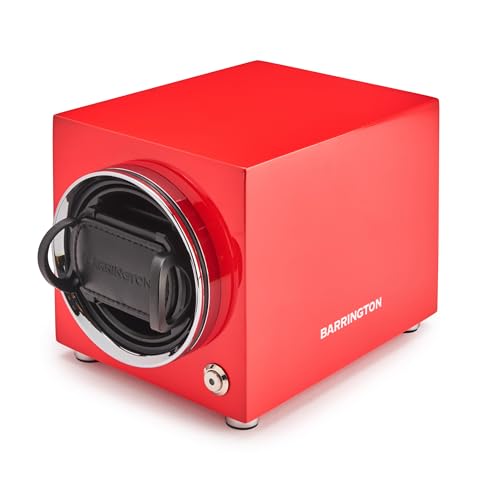
Barrington Single Watch Winder
- Five speed settings are shown as numbers on the device: 650, 750, 850, 1,000 and 1,950 turns per day. For a J800.1 you choose alternating rotation and the 650 setting, hitting the documented database value exactly
- Clockwise, anticlockwise and alternating rotation can be selected separately. If your watch contains a Meister Chronoscope with the J880.1 on a 7750 base, you set clockwise here specifically
- The Japanese Mabuchi motor runs on the power adapter or on two AA batteries. That means the device also fits in a drawer or cabinet without a socket, and several units can be coupled
- The cushion is designed for medium-sized cases. With a max bill Kleine Automatic at 34 millimetres and a narrow leather strap, it can look too bulky and strain the strap unnecessarily

MODALO Ambiente MV4 for 1 watch
- Black makassar with piano lacquer looks darker and calmer than walnut. A silver Bauhaus dial stands out visibly against it, without being outshone by a garish display case
- Three rotation directions cover the two-way alternating rotation that Junghans automatic movements need according to the manufacturer's instructions. More adjustment is technically not needed at all for a J800.1
- The MV4 motor mechanism stops at the 12 o'clock position during the rest phase. As a result the watch always sits neatly aligned on the shelf, which stands out especially with a strictly gridded dial
- MODALO does not state specific turns per programme for this model, and a single device does not grow with you. If you foresee winding a second automatic, it is better to plan for the double version straight away

Klarstein St. Gallen II
- The first of the four programmes is at exactly 650 turns per day. The documented database value for the J800.1 is therefore available directly as the factory setting, with no searching or calculating
- Three rotation directions with anticlockwise, clockwise and bidirectional rotation cover all Junghans cases. For the three-hand movements you take the bidirectional mode, for a J880.1 clockwise rotation
- At around 350 grams the device is light and quickly repositioned. The front door with acrylic window keeps dust off the dial, and the LED light can be switched on or off
- A plastic housing with LED lighting is visually the opposite of Bauhaus restraint. Functionally it suits the max bill, but in design terms botta and MODALO are the finer neighbours

SONGMICS watch winder for 1 watch
- The adjustable watch cushion can be set to a narrow leather strap. That is exactly what matters more with a max bill than any maximum size specification, because the straps are narrow and soft
- Four rotation modes cover clockwise, anticlockwise and combined rotation. For a J800.1 or a J840 you choose the combined mode and you are done
- Lockable glass front, switchable LED light and USB-C operation add up to a surprisingly complete feature set in this price range
- SONGMICS does not document how many turns per day each mode delivers. Here we rely solely on the details about modes and rotation direction
Turns per day for Junghans calibres
With Junghans, the construction type comes before any number. That is why our table deliberately also lists the quartz, radio-controlled, solar and manual-winding calibres, even though they should never end up on a watch winder. For the automatic movements the direction is cleanly documented: in its own operating instructions for the calibres J810.5 and J840, Junghans explicitly writes of a two-way automatic winding. The brand does not, however, publish a turns figure for watch winders. The settings databases of the winder suppliers list the J800.1 at 650 turns per day in alternating rotation and the J880.1 at 800 clockwise. Where there is no entry of its own, we give the standard value of 650 to 800 two-way and mark it as such.
| Calibre | Construction type and typical models | Turns per day | Rotation direction |
|---|---|---|---|
| J800.1 | Automatic, base ETA 2824-2 or Sellita SW 200-1, 25.6 mm diameter, 28,800 A/h, 25 or 26 jewels, approx. 38 h; max bill Automatic 38 mm, max bill Kleine Automatic 34 mm, Meister fein Automatic | 650 (database value), range 650 to 800 | bidirectional |
| J800.2 and J800.3 | Automatic with calendar, ETA 2824 base, on the J800.3 with an added Dubois Dépraz module for weekday, month and moon phase, approx. 38 h; Meister Kalender | no entry of its own: 650 to 800 (standard value) | two-way (derived from the base construction) |
| J805.1 | Manual winding, base ETA 2801-2, 28,800 A/h, 42 h; max bill Handaufzug 34 mm, Meister Handaufzug | Manual winding, does not belong on a watch winder | not applicable |
| J810.5 | Automatic with date, weekday, calendar week and power reserve indicator, modular movement on an ETA 2892 base, 28 jewels, 28,800 A/h, 42 h; Meister Agenda | no entry of its own: 650 to 800 (standard value) | two-way (Junghans statement in the instructions) |
| J820 series | Automatic, depending on variant based on Soprod A10 or ETA 2892-A2, 28,800 A/h, approx. 42 h, in some cases DIN-tested chronometer; Meister Classic, Meister Chronometer | no entry of its own: 650 to 800 (standard value) | two-way (Junghans statement in the instructions) |
| J830.5 | Automatic, listed in the winder databases as a Junghans calibre of its own; Junghans does not publicly document the base movement or model assignment | 650 to 950 (database value) | two-way (database entry) |
| J840 | Automatic with date, 28,800 A/h, 42 h, antimagnetic to DIN 8309, Incabloc; FORM A | no entry of its own: 650 to 800 (standard value) | two-way (Junghans statement in the instructions) |
| J880.1 | Automatic chronograph, base ETA 7750, 25 jewels, 28,800 A/h, 48 h; Meister Chronoscope 40.7 mm | 800 (database value) | clockwise only (derived from the 7750 design) |
| J880.3 and J880.4 | Automatic chronograph as a modular movement, ETA automatic base with Dubois Dépraz chronograph module, 28,800 A/h, approx. 38 to 42 h; Meister Driver Chronoscope, Meister Pilot Chronoscope | no entry of its own: 650 to 800 (standard value) | two-way (derived from the base construction) |
| J101 radio movements, including J101.65 | Radio-controlled quartz movement with autoscan across five frequencies; max bill MEGA, Meister MEGA | Quartz and radio-controlled, does not belong on a watch winder | not applicable |
| J101.85 | Radio-controlled solar quartz movement with app connection, up to three years of power reserve in the dark; max bill MEGA Solar 38 mm | Quartz, radio-controlled and solar, does not belong on a watch winder | not applicable |
| J615.84 | Multi-frequency radio-controlled solar movement, up to 21 months of power reserve in the dark, rest mode after 72 hours; Force Mega Solar, Milano Mega Solar, Spektrum Mega Solar | Quartz, radio-controlled and solar, does not belong on a watch winder | not applicable |
We name one contradiction openly. A database from a watch winder supplier lists the J880.1 as winding in both directions. That does not fit the documented construction, because the ETA 7750 base movement by design winds only clockwise. We therefore do not adopt this entry and follow the construction and the two other databases, which give clockwise there. In practice the difference is small: alternating rotation does not harm a 7750, it only winds the spring more slowly.
With Junghans, the calibre designation on the data sheet matters more than the model name. The name max bill says nothing about the winding type, because it exists as an Automatic with the J800.1, as a hand-wound model with the J805.1 and as a MEGA Solar with the radio-controlled solar movement J101.85. The same applies to the Meister range, which includes MEGA Solar models alongside automatic movements. If your data sheet shows a number from the J800, J810, J820, J830, J840 or J880 series, a winder makes sense. If it shows J101, J615 or J805, the watch belongs in your hand or in the light. Our table of turns per day collects all documented values per calibre, and Winding an automatic watch correctly explains proper winding.
What matters in a watch winder for Junghans
The first point is not a purchase decision but a check. Junghans is one of the few well-known names where a large part of the range does not belong on such a device at all. MEGA technology is a radio-controlled quartz movement, the solar models charge via cells in the dial, and neither needs any movement. The multi-frequency radio-controlled solar movement J615.84 from Force, Milano and Spektrum lasts up to 21 months in the dark, and the J101.85 of the max bill MEGA Solar even up to three years. The same applies to hand-wound movements, whose spring you tension yourself via the crown. Whether a winder is worthwhile for your watch can be settled in a few minutes with Does my watch need a watch winder?.
The second point is the holder, and with Junghans, a gentle touch counts for more than strength. The max bill Automatic measures 38 millimetres in diameter, is 10 millimetres high and weighs little on a leather strap. The max bill Kleine Automatic and the max bill hand-wound model stay even smaller at 34 millimetres. A cushion built for a 45 mm case with a steel bracelet permanently overstretches a narrow strap and pushes the lugs apart. So look for a softly adjustable or compact cushion rather than a high load capacity. Even the sturdier Meister chronographs remain moderate at around 40.7 millimetres, and load capacity is never the bottleneck with this brand.
The third point is the appearance of the device itself. A Max Bill is a design classic, and a brightly lit plastic housing with chrome trim quickly looks cheap next to it. Aluminium, solid wood or a calm matt housing suit a Bauhaus line that has remained almost unchanged since the 1960s. Then there is the noise, because a motor on the bedside table is more annoying than you might think. You can find more in our overview of the quiet watch winder and in the background article Noise level of watch winders.
Location and budget come only after that. If the device is to go somewhere without a power socket, the comparison of battery-powered watch winders helps, and if you want to spend little, you will find suitable models under affordable watch winders. And because the J800.1 offers only around 38 hours of power reserve, a max bill Automatic reliably stands still in the drawer after a weekend. If you want to find it running and showing the right date on Monday, you gain convenience, nothing more. Power reserve explained covers what lies behind the figure.
Which unit for whom
If you wear a max bill Automatic or a Meister with an automatic movement and want quiet and precise operation, the botta Cube is the first choice. Nine programmes from 600 to 1,800 turns per day give you a gradation that no other device in this selection offers, and at around 14 decibels it remains almost inaudible. If you want the same precision as clear numbers on the switch, take the Barrington Single with its 650 setting. The comparison Watch winders for 1 watch collects further single devices.
If the device should come from a German manufacturer and grow with you later, the Beco Technic Boxy is the most well-rounded solution. One module stays compact, and a second can be stacked on at any time when a Meister joins the max bill. If your watch stands on an open shelf instead and the surroundings should look high-quality, the MODALO Ambiente MV4 in black solid Makassar wood is the most beautiful choice. Our overview Wooden watch winders shows more devices of this kind, and you will find two-slot models under Watch winders for 2 to 4 watches.
If you want to spend little and still have the 650 as the factory setting, go for the Klarstein St. Gallen II. If the watch should also be locked away and the cushion finely adjustable, the SONGMICS is the cheapest entry point. If you are interested in a particular provider, you will find the ranges at Beco Technic, Barrington, MODALO, Klarstein and SONGMICS, bundled in the brand overview. The full data sheets are in our overview of the data checks.
Editorial verdict
With Junghans, the first question matters more than any product choice: does your watch have a rotor at all? For Mega, Force, Milano, Spektrum and all MEGA Solar variants the answer is no, because they use a quartz movement with radio control and a solar cell. For the max bill hand-wound model with the J805.1 the answer is also no. If, on the other hand, a J800.1, a J810.5, a calibre of the J820 series, a J830.5 or a J840 is in the case, the setting is quickly found. Alternating direction is enough, because Junghans specifies bidirectional automatic winding for these movements, plus 650 to 800 turns per day. Only for the Meister Chronoscope with the J880.1 based on the 7750 do you set clockwise.
Our recommendation is therefore the botta Cube for the finest and quietest setting, the Beco Technic Boxy as the top-rated all-rounder made in Germany, the Barrington Single for documented numerical values, the MODALO Ambiente MV4 for the open shelf, the Klarstein St. Gallen II as the cheapest route to the 650 and the SONGMICS for the lockable entry model. In every case, pay more attention to a soft, finely adjustable cushion than to a high load capacity, because Junghans builds small and light. You do not need to fear too many turns, because the slipping clutch in the barrel prevents the mainspring from being overwound. And to be clear: none of the devices shown here is recommended, licensed or certified by Junghans, and we only assess technical suitability.
Buying guides for other watch brands
With Junghans, another question comes before the question of the device: a large part of the range runs on quartz, radio control or solar and does not belong on a winder at all. For these brands the question is different: Nomos, Glashütte Original, Sinn, Rolex, Omega, Tudor, Breitling, IWC, Panerai, TAG Heuer, Longines, Oris, Seiko, Cartier, Jaeger-LeCoultre, Zenith, Hamilton, Tissot, Certina, Mido, Grand Seiko, Bell und Ross, Rado, Maurice Lacroix, Frederique Constant. Our table of turns per day collects all documented values per calibre.
The understated devices from Beco Technic and MODALO suit small, light Bauhaus cases, both with softly adjustable cushions for narrow straps. The brand overview gives an overview of all manufacturers.
The text of this page was created with an AI language model and was reviewed and approved editorially before publication. Editorial responsibility lies with Seydhan Cakmak. The product images shown are not AI images but manufacturer and retailer photos from the Amazon catalogue, which we embed unchanged.
A limitation we disclose: Amazon and the retailers selling there now use generative tools in their listings themselves. Whether an individual catalogue image is affected, we cannot check from the outside, so we claim it neither one way nor the other. As soon as an image demonstrably comes from a generative model, we label it visibly on the image with the label AI image. More on this on the AI transparency page.