Panerai places a demand on a watch winder that hardly any other brand makes so sharply: the watches are large. A Luminor case of the 1950s line reaches up to 47 millimetres, the classic Luminor Base Logo comes in at 44 millimetres, and on a solid steel bracelet or a thick calfskin strap this adds up to a weight that a weak mount is simply unable to handle. We assessed six devices from our stock precisely on this point, and also noted which turns-per-day values are documented for Panerai calibres, which are not, and which models do not belong on such a device at all.
The recommendations at a glance
| Model | Slots/type | Key feature | Price range | Rating |
|---|---|---|---|---|
| WOLF Heritage Single | 1 position plus storage compartment | Lock-in Cuff up to 52 mm, 3 directions | Premium class | 4,0/5 |
| WOLF Cub double watch winder | 2 slots | two cuffs up to 52 mm, 900 turns | Premium class | 4,1/5 |
| Beco Technic Boxy Carbon Single 1 | 1 position, modular | Belt drive, 3 programmes, 3 directions | Mid-range | 4,4/5 |
| Swiss Kubik Velour Windsor | 1 slot | certified noise values, battery operation only | Premium | 4,3/5 |
| Designhütte San Diego 4 LCD | 4 slots plus drawer | LCD control, 650 to 1,950 turns | upper mid-range | 4,2/5 |
| Barrington Single Watch Winder | 1 slot | 5 documented speed settings, battery operation | Mid-range | 4,2/5 |
The Beco Technic Boxy earns the highest overall rating in the field, because drive, build quality and expandability fit together best in it. For Panerai, however, we put the WOLF Heritage in first place, because its snap-in cuff, according to the manufacturer, carries cases up to 52 millimetres and is thus the only holder in this selection designed with headroom for a 47 mm Luminor case. The WOLF Cub follows directly behind as soon as two watches need looking after, because it brings the same holder along twice.
The devices in detail

WOLF Heritage Single Winder
- The patented lock-in holder snaps into the drum and, according to the manufacturer, carries cases up to 52 millimetres, so even with a 47 mm Luminor case there is still span to spare
- Because the cuff actively clamps the case instead of merely supporting it, the watch does not tip even when a heavy steel bracelet acts as a lever with every rotation
- The direction of rotation is selectable: clockwise, counterclockwise or bidirectional. For a P.9010 you set alternating rotation, for an older OP calibre clockwise only
- The speed is fixed at 900 turns per direction, which is above the 800 documented for the OP calibres. This is uncritical thanks to the slip clutch, but it cannot be fine-tuned
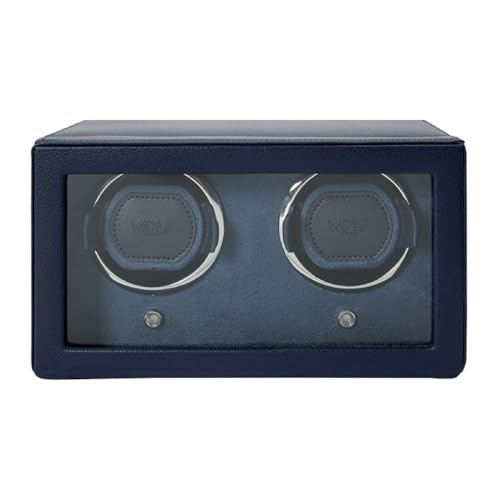
WOLF Cub double watch winder
- Large, padded cuffs take watches up to 52 millimetres in diameter, so even two wide Panerai cases with steel bracelets sit firmly side by side
- 900 turns per day bidirectional from the factory, plus preprogrammed intervals with rest phases and a ten second start delay, exactly the right mode for the in-house movements of the P.9000 series
- Operation via the supplied universal adapter or AA batteries, with lithium cells lasting considerably longer than alkaline according to the manufacturer
- No selectable speed levels and no turn counting like the larger WOLF classes, so an older OP calibre cannot be forced to clockwise only here

Beco Technic Boxy Carbon Single 1 Classic
- The interval motor with belt drive does without a rattling gear train and, according to specialist retailers, offers three fixed programmes and all three directions of rotation
- Ready to use straight away as a complete unit and at the same time the starting point of a system: if a Radiomir joins the Luminor later, you simply stack another Boxy module
- The carbon look with acrylic glass dome suits the technical Panerai lines visually and stays under one kilogram in weight
- The watch cushion is designed for standard cases. For a 47 millimetre Luminor on a steel bracelet, a clamping bracket like the one from WOLF offers considerably more security

Swiss Kubik Velour Windsor
- Swiss Kubik is the only brand in the niche to cite independently verified noise values, which is a genuine argument in an industry full of advertising buzzwords
- Pure battery operation makes the device suitable for safes, because a retrofitted power feed-through destroys the safe's certification and often the insurance cover with it
- The running cycles can be programmed, so you deliberately set the 650 to 800 turns per day suited to Panerai instead of guessing
- Premium price for a single position, and the manufacturer does not state a maximum case size. For a 47 millimetre Luminor you should clarify the fit of the holder before buying

Designhütte San Diego 4 LCD
- Four moving positions and, according to the manufacturer, room for up to six more watches on separate cushions in the drawer, so even a mixed collection of automatic and hand-wound watches finds a place in one spot
- Programming is done via the LCD control. According to retailer information the speed levels range from 650 to 1,950 turns per day and thus cover both the 650 and the 800 for the OP calibres
- Wooden housing with multi-layer high-gloss finish and a fine velour interior, a high-quality look on the shelf instead of a plastic appearance
- The unit runs only on mains power, the high-gloss surfaces show fingerprints clearly, and the cushions are designed for standard sizes, not for 47 millimetre cases
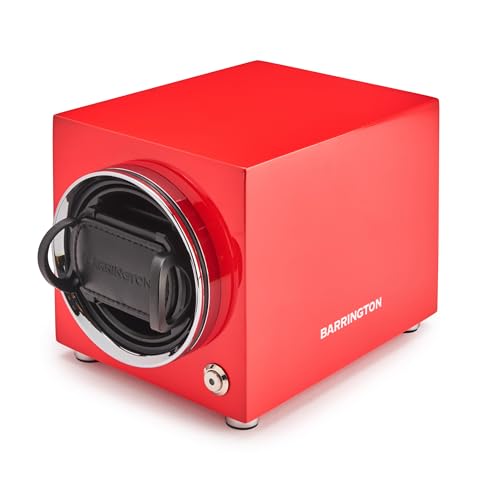
Barrington Single Watch Winder
- Five clearly documented speed settings at 650, 750, 850, 1,000 and 1,950 turns per day, plus clockwise, anticlockwise and alternating rotation instead of vague mode descriptions
- For an in-house movement of the P.9000 series you choose the 650 or 750 level in alternating rotation, for an OP calibre the 850 level in clockwise rotation, which is close to the documented 800
- Runs on the supplied power adapter or on two AA batteries; according to the manufacturer, one set lasts almost two months in intermittent operation, so even the safe is an option
- The standard cushion is the weak point for this brand: a Luminor on a steel bracelet does sit, but without a clamping cuff a residual risk remains with the largest cases
Turns per day for Panerai calibres
Panerai itself does not publish turn recommendations for watch winders. Two sources are therefore reliable: the setting databases of the winder manufacturers and the documented technical properties of the movements, above all the winding direction. One detail is interesting here: for the in-house calibres of the P.9000 series, the watch-winder.store database lists the direction of rotation but leaves the field for turns empty. We state this openly in the table instead of inventing a number.
| Calibre | Typical models | Recommended turns per day | Rotation direction |
|---|---|---|---|
| Panerai P.9010 | Luminor Marina, Submersible, Radiomir | no own entry: 650 to 800 | bidirectional (rotor winds in both directions) |
| Panerai P.9000 and P.9001 | Luminor 1950 3 Days Automatic, Luminor Submersible | Database without a figure: 650 to 800 | bidirectional (documented) |
| Panerai P.9002 | Luminor 1950 with GMT and power reserve indicator | Database without a figure: 650 to 800 | bidirectional (documented) |
| Panerai P.2003 | Luminor 1950 10 Days GMT | 1.800 | bidirectional |
| Panerai OP III | older Luminor Marina Automatic | 800 | clockwise only |
| Panerai OP XII | older Luminor and Radiomir with supplier movement | 800 | clockwise only |
| ETA 2893-2 as OP base | older Luminor GMT (e.g. PAM 023) | 650 | bidirectional |
| Panerai P.6000 (hand-wound) | Luminor Base Logo, Luminor Logo | not applicable: no winder needed | not applicable (no rotor) |
| ETA 6497 and 6498 (hand-wound) | older Luminor Base and Radiomir | not applicable: no winder needed | not applicable (no rotor) |
| All other Panerai automatic movements | Models without a documented entry | 650 to 800 (rule of thumb) | bidirectional |
The most important point for you: the current in-house movements wind in both directions. Panerai describes the P.9010 as a movement with two barrels whose mainsprings are tensioned by a rotor working in both directions, with three days of power reserve as the house standard and 28,800 beats per hour. For you that means: set alternating rotation, choose 650 to 800 turns, done. Only for the older OP calibres is it worth looking at the table, because they are listed there with clockwise-only rotation. All values for ETA, Sellita, Seiko, Miyota and other manufacturers are in the full table of turns per day.
Hand-wound models do not belong on the winder
This is the point where most wrong purchases happen with Panerai. A large part of the collection runs on hand winding, above all the Luminor Base Logo and the Luminor Logo with the in-house calibre P.6000 introduced in 2018. This movement simply has no rotor; it stores its three days of power reserve in a single barrel that is wound exclusively via the crown. A watch winder would therefore swing such a watch back and forth all day without generating a single turn of winding.
The same applies to the older hand-wound models. According to its own statements, Panerai developed the P.6000 to replace the no longer available ETA movements 6497 and 6498, and these calibres, too, are pure hand-wound movements without a rotor. So if you own a Radiomir or a Luminor Base from that period, you do not need a winder but a watch box or a case. You will find suitable options in our overviews of watch boxes and travel cases, and the article Winding an automatic watch correctly explains how to wind such a watch properly.
How can you tell the difference? Two simple ways lead to the answer. First, with Panerai the model name often says it all, since Base and Logo stand for hand winding, while Marina, Submersible and Automatic generally come with a rotor. Second, a look at the case back or the papers helps: if a calibre of the P.9000 series is listed there, it is an automatic; if it says P.6000 or an ETA hand-wound movement, the watch belongs in the drawer and not on a winder.
What matters in a watch winder for Panerai
With this brand the holder is by far the most important buying point, for a purely physical reason. A 47 millimetre steel case has a considerably larger radius than a typical 40 millimetre watch, and a solid steel bracelet adds extra mass. With every rotation of the winder, this weight acts as a lever on the mount, and the further the centre of gravity is from the pivot, the greater the load. A cushion that merely carries the watch can slip or tip under it.
You should therefore check three details before buying. First, the maximum span or maximum case diameter: WOLF states 52 millimetres for both Heritage and Cub, which is the clearest figure in this field. Second, the construction of the mount, because a clamping cuff holds better by design than a loose cushion. Third, the opening width for the strap, because a wide Panerai calfskin strap with pin buckle needs more room than a narrow metal bracelet. The comparison of premium watch winders shows more units with robust holders.
Only then come the usual points. A unit in the bedroom should run quietly; we have a separate overview of the quiet watch winder for that. If the winder is going into the safe, you need battery operation, because a subsequently drilled cable feed-through voids the safe's certification. You can find more in the comparison watch safe with watch winder and in the overview of battery-powered watch winders. And because a P.9010 lasts three days, a winder is pure convenience if you wear the watch daily, which the article Power reserve explained puts into context in more detail.
Which unit for whom
If you wear a single Luminor or Submersible and want maximum security in the mount, the WOLF Heritage Single is the first choice, because its latching cuff up to 52 millimetres still leaves reserve even for the largest case. If a second Panerai joins, say a Marina for everyday and a Submersible for the weekend, you reach for the WOLF Cub Double with the same holder in duplicate. Our watch winder buying guide gives the overall overview of all designs, and you will find more double units under watch winders for 2 to 4 watches.
If you are looking for the most well-rounded unit for a mixed collection and value a system that grows with you, the Beco Technic Boxy, with the best overall rating in this selection, is the right choice. If the watch is to go into a closed safe and run as quietly as possible, there is hardly a way around the Swiss Kubik Velour Windsor. If your collection grows beyond two watches, the Designhütte San Diego 4 LCD with four moving positions and an additional drawer is the obvious solution; the comparison watch winders for 6 or more watches shows larger models. And anyone who wants clear figures instead of mode names and wears a smaller case takes the Barrington Single.
If you are interested in a particular provider, you will find the ranges bundled in the brand overview, for example for WOLF, Designhütte or Barrington. The full data sheets are in our overview of data checks. If you wear other brands besides Panerai, the sister pages watch winders for Rolex, for IWC and for Tudor will help, since they too deal with large cases and movements that wind in both directions.
Editorial verdict
With Panerai, the order of the buying criteria differs from most brands. First comes the question of whether your watch has a rotor at all, because manual-wind models with the P.6000 or the older ETA calibres 6497 and 6498 simply do not belong on a device like this. Next comes the holder, because a case diameter of 44 to 47 millimetres and a heavy bracelet push any weak mount to its limit. Only in third place comes the setting, which is quickly found anyway at 650 to 800 turns in both directions.
Our recommendation is therefore the WOLF Heritage Single for one large watch, the WOLF Cub Double for two, the Beco Technic Boxy as the top-rated all-rounder, the Swiss Kubik Velour Windsor for the safe, the Designhütte San Diego 4 LCD for a growing collection, and the Barrington Single for anyone who wants documented figures and a smaller case. You do not need to fear too many turns, because the slip clutch in the barrel prevents the mainspring from being overwound. A slightly too high setting costs only electricity and nothing else, which is why the 900 turns of the two WOLF devices are harmless for a Panerai.
Whether a device is worth it for you at all is answered in a few minutes by our basics article Does my watch need a watch winder?. With a power reserve of three days, a Luminor with the P.9010 gets through a weekend without any help, so a winder is a convenience and not a necessity. And to be clear: none of the devices presented here is recommended, licensed or certified by Panerai, we only assess technical suitability.
Buying guides for other watch brands
At 44 to 47 millimetres, the holder matters more than any number of turns. Other brands shift this weighting considerably: IWC, Breitling, Rolex, Omega, Tudor, TAG Heuer, Longines, Oris, Seiko, Cartier, Jaeger-LeCoultre, Zenith, Hamilton, Tissot, Certina, Mido, Grand Seiko, Bell und Ross, Sinn, Glashütte Original, Nomos, Rado, Maurice Lacroix, Frederique Constant, Junghans. All documented values per calibre are collected in our table of turns per day.
For these case sizes, WOLF and Swiss Kubik offer the most dependable holders. The brand overview covers all manufacturers.
The text of this page was created with an AI language model and was reviewed and approved editorially before publication. Editorial responsibility lies with Seydhan Cakmak. The product images shown are not AI images but manufacturer and retailer photos from the Amazon catalogue, which we embed unchanged.
A limitation we disclose: Amazon and the retailers selling there now use generative tools in their listings themselves. Whether an individual catalogue image is affected, we cannot check from the outside, so we claim it neither one way nor the other. As soon as an image demonstrably comes from a generative model, we label it visibly on the image with the label AI image. More on this on the AI transparency page.