Frederique Constant is a special case among the Swiss houses in this price class. The Geneva house has been building its own in-house calibres since 2004 and also buys base movements from Sellita. For the winder, both end up with the same recipe, namely bidirectional and around 650 turns. The second question is more interesting: the brand thrives on slim dress watches on narrow leather straps, and these place very different demands on cushions and running noise than a dive watch on a steel bracelet. This is exactly the basis on which we classify six devices.
The recommendations at a glance
| Model | Slots/type | Key feature | Price range | Rating |
|---|---|---|---|---|
| Beco Technic Boxy Carbon Single 1 Classic | 1 position, modular | Belt drive, 3 programmes, 3 directions | Mid-range | 4,4/5 |
| Swiss Kubik Velour Windsor | 1 slot | measured noise levels, battery only | Premium | 4,3/5 |
| Barrington Single Watch Winder | 1 slot | 650 setting documented in figures | Mid-range | 4,2/5 |
| MODALO Ambiente MV4 for 1 watch | 1 slot | Solid Makassar wood, stop at 12 o'clock | upper mid-range | 4,2/5 |
| ROTHWELL double watch winder | 2 slots | 5 settings and 3 directions per slot | Mid-range | 4,2/5 |
| SONGMICS watch winder for 1 watch | 1 slot | 4 modes, LED, lock, USB-C | Entry level | 4,0/5 |
We put the Beco Technic Boxy first because its belt drive works without a rattling gear train and its module system can grow with you later. If the watch sits in the bedroom, the Swiss Kubik is the quieter choice, as it is the only provider in this selection with measured noise levels. If you want to set the turns deliberately in figures, choose the Barrington Single with its own 650 setting.
The devices in detail

Beco Technic Boxy Carbon Single 1 Classic
- The interval motor works via a belt instead of a gear train, which keeps operation quiet enough for an open shelf in the living room
- Three directions of rotation cover the bidirectional winding that every Frederique Constant automatic movement from the FC-303 to the FC-930 needs
- As a Boxy module, the device is the starting point of a system: if a Classics Manufacture joins the Slimline later, you simply stack a second module on top
- Beco Technic does not state the turns per program in figures; if you want to set exactly 650, you are better off with the Barrington

Swiss Kubik Velour Windsor for 1 automatic watch
- Swiss Kubik is one of the few brands in the niche to state measured noise levels, and that is what matters most next to the bed
- The running cycles are programmable, so you can deliberately set the 650 turns bidirectional stated for Frederique Constant
- Battery-only operation from the factory makes the compact cube safe-compatible, because a cable passage drilled in afterwards voids a safe's certification
- Manufacture price for a single position; if you want to supply a Slimline and a Classics Manufacture at the same time, you pay considerably more
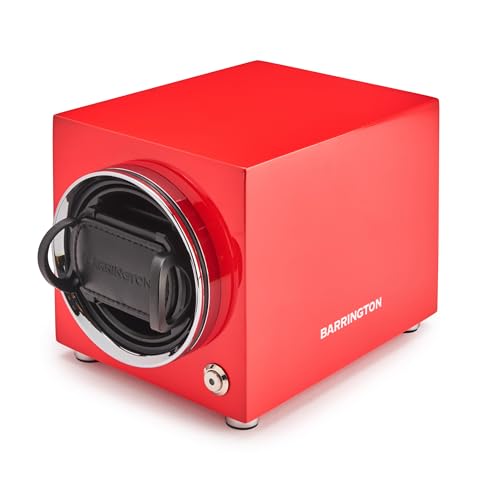
Barrington Single Watch Winder
- Five speed settings documented in figures with 650, 750, 850, 1,000 and 1,950 turns per day, plus clockwise, anticlockwise and alternating operation
- The 650 setting in alternating operation corresponds exactly to the value the databases list for almost every Frederique Constant automatic series
- Pure clockwise operation keeps the way open to an older Runabout Chronograph that is based on the 7750 design and only winds in that direction
- Operation via power adapter or two AA batteries, a Japanese Mabuchi motor drives the platter
- The device remains a single position; two couplable modules together cost more than a ready-made double device

MODALO Ambiente MV4 for 1 watch
- Black Makassar with piano lacquer suits a Slimline or Classics on a dark leather strap extremely well and looks calmer than high-gloss plastic
- Three directions of rotation reproduce the bidirectional winding that the brand's in-house calibres and Sellita movements alike need
- In the rest phase, the MV4 mechanism stops at the 12 o'clock position, so the watch always stands neatly aligned behind the glass front
- The closed glass front keeps dust off the leather strap, which is a real advantage on an open shelf in a living space
- A single unit does not grow with you: if you expect to be winding a second automatic watch soon, it is better to plan for the two-watch version straight away

ROTHWELL double watch winder
- Five settings from 650 to 1,950 turns and three directions of rotation can be set separately for each position, which is the core requirement for this brand
- This lets a Classics Manufacture run bidirectional at 650, while next to it an older Runabout Chronograph is supplied at 800 in pure clockwise operation
- Operation either via power adapter or AA batteries; the wooden frame with PU leather cover lifts the device out of the plain plastic class
- The PU leather cover is not real leather and looks plainer up close than the solid Makassar wood of the MODALO

SONGMICS watch winder for 1 watch
- The adjustable watch cushion can be closed far enough that even a flat 40 millimetre Slimline sits firmly on its narrow leather strap
- Four rotation modes with clockwise, anticlockwise and combined operation; for every Frederique Constant automatic movement, the combined mode is the right one
- Switchable LED light, lockable glass front and power supply via USB-C instead of a proprietary power adapter
- SONGMICS does not document how many turns per day each mode delivers, so we rely here solely on the information about the modes
Turns per day for Frederique Constant calibres
Frederique Constant itself does not publish turns figures for watch winders, and we state that explicitly. Two other sources are reliable. First, the documented properties of the movements, above all the winding direction of the rotor. Second, the settings databases of the winder providers, which cover this brand in unusual detail and name individual model names rather than just calibres. There, almost every automatic series is listed at 650 turns per day in bidirectional alternation and the chronographs at 800 clockwise.
| Calibre | Typical models | Recommended turns per day | Rotation direction |
|---|---|---|---|
| FC-303 (based on Sellita SW200-1) | Classics Automatic, Highlife Automatic, Runabout Automatic | 650 (database value) | bidirectional |
| FC-306 (based on Sellita SW300-1) | Slimline Automatic, Classics Delight Automatic | 650 (database value) | bidirectional |
| FC-310 and FC-312 (based on Sellita SW200-1) | Classics Heart Beat, Slimline Heart Beat | 650 (database value) | bidirectional |
| FC-710 (in-house calibre) | Classics Manufacture, Runabout Manufacture | 650 (database value) | bidirectional (bidirectional winding documented) |
| FC-718 (in-house Worldtimer calibre) | Classics Worldtimer Manufacture | 650 (database value) | bidirectional |
| FC-930 and FC-945 (in-house Heart Beat calibre) | Classics Heart Beat Manufacture, Heart Beat Silicium | 650 (database value) | bidirectional |
| FC-775 (in-house perpetual calendar calibre) | Slimline Perpetual Calendar Manufacture | 650 (database value for Heart Beat Perpetual) | bidirectional |
| FC-980 (in-house tourbillon calibre) | Classics and Slimline Tourbillon Manufacture | 650 (database value) | bidirectional |
| FC-810 Monolithic (in-house calibre, 40 hertz) | Slimline Monolithic Manufacture | no separate entry: 650 to 800 as standard value | bidirectional (derived from the FC-710 base) |
| FC-392 until 2020 (based on ETA 7750) | Runabout Chronograph, Vintage Rally Healey Chrono | 800 (database value) | clockwise only (derived from the 7750 design) |
| FC-392 from 2021 (based on La Joux-Perret, column wheel) | Runabout Chronograph Automatic of the new generation | 800 (database entry comes from the old generation) | not published by the manufacturer, alternating operation covers both cases |
| FC-2xx quartz, including FC-220, FC-240 and FC-292 | Classics Quartz, Highlife Ladies Quartz, quartz chronograph | does not belong on a watch winder | not applicable, no rotor present |
| MMT-282 (Horological Smartwatch, FC-282 series) | Horological Smartwatch Gents and Ladies | does not belong on a watch winder | not applicable, quartz movement with battery |
| Other automatic movements of the brand | Models without their own entry | 650 to 800 (default value) | Alternating direction as the safe setting |
To put the movements in context: the FC-710 from the manufacture family measures 30 millimetres in diameter, has 26 jewels, runs at 28,800 half-oscillations per hour and lasts around 42 hours. Its winding is expressly documented as bidirectional, so alternating direction is always the right choice here. The FC-718 in the Worldtimer also has 26 jewels, the same frequency and around 42 hours. The Heart Beat Manufacture FC-930 has 26 jewels and around 38 hours, while the FC-945 with silicon escapement reaches around 42 hours. The purchased movements are in the same range: FC-303 with 26 jewels and 38 hours, FC-306 with 25 jewels and 42 hours, both with 28,800 half-oscillations and winding in both directions.
There are two traps you need to know about before you set a number. The first concerns the chronograph: up to 2020, the Runabout Chronograph contained the FC-392 based on the ETA 7750 with 25 jewels and around 42 hours. Since 2021, the same calibre name has been used for a column-wheel movement from La Joux-Perret with a 55-hour power reserve. The name stayed, but the construction underneath did not. For the old design, we derive clockwise-only winding from the pawl winding of the 7750 family; for the new generation, we have no manufacturer information on the winding direction. The database entry of 800 turns clockwise clearly comes from the old generation, which is why alternating direction is the safe choice there.
The second trap lies in the databases themselves. Alongside the many entries with 650 bidirectional, one of these overviews lists an entry called Classics Heart Beat with 800 turns clockwise, plus a legacy entry Heart Beat 2007 with 820 clockwise. Both contradict the documented construction, because the FC-310 of the Classics Heart Beat is a Sellita SW200-1 with a bidirectional rotor, and the same overview correctly lists the Heavy Roman and Day-Date variants at 650 bidirectional. We therefore do not adopt these two outliers. Our table of turns per day collects the complete values for each base calibre.
What matters in a watch winder for Frederique Constant
The first point is not the device but your watch. Frederique Constant offers Slimline, Classics and Highlife each as a quartz and as an automatic line, sometimes in very similar cases. The Classics Quartz uses the FC-220 based on Ronda, the Highlife Ladies Quartz the FC-240 with around 60 months of battery life. Then there is the Horological Smartwatch with the quartz movement MMT-282. None of these movements has a rotor, so a winder does nothing for them. Check the calibre, not the model line. We know the same trap from the Tissot PRX and the Maurice Lacroix Aikon.
The second point is the holder, and here the situation is the reverse of a tool watch. A Slimline Automatic measures 40 millimetres with a height of around 9 millimetres, has a 20 millimetre lug width and usually wears a slim leather strap. The problem is not a cushion that is too weak but one that is too thick. A widely opened cushion needlessly stretches a fine calfskin strap over weeks and pushes it apart at the lugs. All the devices in this selection have adjustable cushions, but you really have to set them small. How to change straps gently is shown in the article Changing a watch strap.
The third point is the location. A dress watch is rarely kept in the safe and mostly stands in the living room or bedroom, so operating noise decides the peace at home. A belt drive like the Beco Technic and measured values like those of Swiss Kubik are worth more here than any extra function. Our article Watch winder noise levels explains which designs work how loudly, and the overview quiet watch winders collects suitable models. If the device is to go into the safe after all, the comparison Watch safe with watch winder helps.
The fourth point is the power reserve, and for this brand it is short. Most calibres lie between 38 and 42 hours, and the FC-303 of the Classics Automatic is even at the lower end. A watch you take off on Friday evening has stopped by Sunday. A winder is therefore less of a luxury here than with brands offering 70 or 80 hours, such as Tudor or Mido. The big exception is the Monolithic with around 80 hours from a single mainspring barrel. What the term means exactly is explained in Power reserve explained.
Which unit for whom
If you wear exactly one Frederique Constant automatic and want a well-rounded device without compromises, the Beco Technic Boxy is the first choice. Its belt drive stays quiet, three rotation directions cover the bidirectional winding, and the modular system grows with your collection. If the watch stands right next to the bed or is to go into a safe without a power socket, go for the Swiss Kubik Velour Windsor with purely battery operation. Watch winders for 1 watch shows more single-watch devices, and our watch winder buying guide gives the full overview.
If you want to set the turns deliberately in numbers, there is no way around the Barrington Single, because its 650 setting matches the brand's database value exactly. If the device is to look good on an open shelf next to the watch, the MODALO Ambiente MV4 in solid Makassar wood is the most beautiful solution; the overview wooden watch winders collects more devices of this type. If you want to start small and lock the watch away at the same time, the SONGMICS is the right choice; affordable watch winders shows more models in this price range.
If two watches come together, for example a Classics Manufacture next to an older Runabout Chronograph, you need separately adjustable positions, because the two movements wind in opposite directions. The ROTHWELL Doppel is our recommendation for this; the comparison Watch winders for 2 to 4 watches collects more models. You will find the providers' ranges at Beco Technic, Swiss Kubik, Barrington, MODALO, ROTHWELL and SONGMICS; the brand overview gives the big picture, and our overview of data checks has the data sheets.
Editorial verdict
At Frederique Constant, the technology is pleasingly uniform. Whether in-house calibre or purchased Sellita movement, winding is bidirectional, and the databases give 650 turns per day for it. Only the chronographs on the old 7750 base need 800 in purely clockwise direction. The real decision is therefore not made on the number but on noise, cushion and looks. The Beco Technic Boxy is our recommendation for the well-rounded overall package, the Swiss Kubik for the quietest spot, the Barrington for the most exact number, the MODALO for the open shelf, the ROTHWELL for two opposing movements and the SONGMICS for the affordable entry.
You do not need to fear too many turns, because the slipping clutch in the barrel prevents the mainspring from being overwound. A setting that is slightly too high only costs electricity. The step before is more important: does your watch contain an automatic movement at all? Quartz models and the Horological Smartwatch do not belong on a winder, and because Slimline, Classics and Highlife exist in both variants, the rule here is to check the calibre, not the model line. Whether a device is worthwhile for you at all is answered by our basics article Does my watch need a watch winder?. To be clear: none of the devices shown is recommended, licensed or certified by Frederique Constant; we only assess technical suitability.
Buying guides for other watch brands
The manufacture movements of the FC-700 and FC-900 series wind in both directions, but the same collection also exists as quartz. At other brands the pitfalls lie elsewhere: Longines, Certina, Oris, Rolex, Omega, Tudor, Breitling, IWC, Panerai, TAG Heuer, Seiko, Cartier, Jaeger-LeCoultre, Zenith, Hamilton, Tissot, Mido, Grand Seiko, Bell und Ross, Sinn, Glashütte Original, Nomos, Rado, Maurice Lacroix, Junghans. Our table of turns per day collects all documented values for each calibre.
For flat dress cases on slim leather straps, the holders from Beco Technic and MODALO are a good fit; both also hold thin straps without overstretching them. The brand overview gives the overview of all manufacturers.
The text of this page was created with an AI language model and was reviewed and approved editorially before publication. Editorial responsibility lies with Seydhan Cakmak. The product images shown are not AI images but manufacturer and retailer photos from the Amazon catalogue, which we embed unchanged.
A limitation we disclose: Amazon and the retailers selling there now use generative tools in their listings themselves. Whether an individual catalogue image is affected, we cannot check from the outside, so we claim it neither one way nor the other. As soon as an image demonstrably comes from a generative model, we label it visibly on the image with the label AI image. More on this on the AI transparency page.