A watch winder for Omega does not have to work miracles, it has to get three things right: turn in both directions, work in the range of 650 to 800 turns per day and hold your case securely. The brand's current Co-Axial calibres wind in both directions and are pleasantly undemanding, although a Seamaster Diver 300M on the solid steel bracelet puts considerable weight on the holder. And there is a special case that many guides leave out: the Speedmaster Moonwatch with calibre 3861 is a manual-winding watch and has no business on a winder. In this comparison we assess six devices that technically suit Omega automatic watches, from the quiet manufacture cube to the stackable single station with five documented speed levels.
The recommendations at a glance
The overview below shows which device brings which strength. We sort by our editorial rating, which is based on manufacturer and retailer information and does not replace laboratory testing. We deliberately do not quote prices, because they fluctuate strongly in marketplace retail; instead, we place each device in a price class.
| Model | Slots/type | Key feature | Price range | Rating |
|---|---|---|---|---|
| Beco Technic Boxy Carbon Single 1 Classic | 1 slot, modular system | Belt drive instead of gear drive | Premium class | 4,4/5 |
| Swiss Kubik Velour Windsor | 1 slot, battery-powered device | verified noise values, safe-compatible | Luxury class | 4,3/5 |
| botta Cube | 1 position per module | 9 programmes from 600 to 1,800 turns | upper mid-range | 4,2/5 |
| MODALO Ambiente MV4 for 1 watch | 1 slot, solid wood | Makassar wood, stop at 12 o'clock position | upper mid-range | 4,2/5 |
| Barrington Single Watch Winder | 1 slot, stackable | 5 speed settings from 650 turns | Mid-range | 4,2/5 |
| WOLF Heritage Single | 1 position plus storage compartment | Lock-in Cuff for cases up to 52 mm | Premium class | 4,0/5 |
The devices in detail
All six devices are technically suitable for Omega automatic calibres, but they set different priorities. Two of them are explicitly designed for the power-free safe, two are modular and grow with the collection, and one is the specialist for heavy cases. Read the short assessment under each rating; it tells you in one sentence what the device is built for.

Beco Technic Boxy Carbon Single 1 Classic
- The interval motor of the Boxy series uses a belt drive instead of a gear drive, and it is precisely this gear whirr that bothers people most at night with cheaper devices
- Beco Technic is the brand we list as a technical reference on several pages, so the data on drive and spare parts is correspondingly reliable
- With additional Boxy modules, the Single becomes a system that keeps pace with a growing Omega collection, without you having to change the concept
- Beco Technic does not publish a decibel value or fixed turn settings; our assessment is based on the design of the drive

Swiss Kubik Velour Windsor
- Swiss Kubik is the only brand in the niche to cite independently verified noise values, which is a genuine argument in an industry full of advertising buzzwords
- Battery operation makes the device safe-compatible, because a retrofitted power feed-through destroys the safe's certification and thereby often the insurance cover
- The running cycles can be programmed, so you deliberately set the 650 to 800 turns per day suited to Omega instead of guessing
- Manufacture pricing for a single slot; if you want to supply two or three Omega watches, you pay very significantly more here

botta Cube
- The brushless direct drive without gearing, at around 14 decibels, comes close to a whisper, so the device can go on the bedside table without concern
- Nine rotation programmes from 600 to 1,800 turns cover the Omega window of 650 to 800 exactly; all three directions of rotation, including bidirectional, can be selected
- On battery power, the aluminium module runs for around four months and can therefore also be used in a safe; later it can be stacked into a wall of nine
- Each additional module costs the full module price; for a larger collection this adds up faster than a ready-made multi-watch cabinet

MODALO Ambiente MV4 for 1 watch
- Black Makassar with piano lacquer looks calmer than walnut and displays an Aqua Terra or Seamaster attractively on an open shelf
- The MV4 motor offers all three directions of rotation, so the bidirectional setting required for Omega can be selected directly
- After the running phase, the drum stops at the 12 o'clock position, so the watch is always clearly legible behind the glass front
- A single unit does not grow with you: if you expect to be winding a second automatic watch soon, it is better to plan for the two-watch version straight away
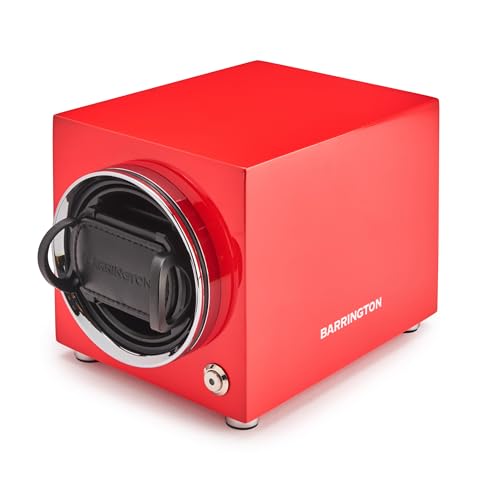
Barrington Single Watch Winder
- Five fixed speed settings clearly documented; the lowest setting of 650 turns directly matches the recommendation for calibres 8800, 8806 and 8900
- All three directions of rotation selectable, plus battery operation lasting weeks: the pragmatic solution for safe and cabinet without a power socket
- According to the manufacturer, designed for watches up to 50 millimetres and over 300 grams, so even a Planet Ocean on a steel bracelet sits securely
- Marketplace prices fluctuate noticeably depending on the colour variant, so it is worth comparing several colours before buying

WOLF Heritage Single
- The patented Lock-in Dynamic Cuff clicks into the drum and, according to the manufacturer, also carries large, heavy cases up to 52 millimetres, ideal for a Seamaster on a steel bracelet
- Preprogrammed interval rotation with pauses and rest phases, clockwise, anticlockwise or in both directions
- Storage compartment for a spare strap or second watch, glass cover against dust, and the included universal adapter covers the common plug types
- Fixed preset 900 turns instead of freely selectable settings; this is above the ideal Omega window and uncritical thanks to the slip clutch, but it cannot be finely adjusted
Turns per day for Omega calibres
This is where the wheat is separated from the chaff, because the right number of turns determines whether your watch really stays fully wound on the device. Omega's current Co-Axial Master Chronometer movements wind in both directions and are among the efficient designs, so they get by with comparatively few turns. We compiled the following values from our own calibre overview and from the winder manufacturers' settings databases, and cross-checked them against each other.
| Calibre | Typical models | Recommended turns per day | Rotation direction |
|---|---|---|---|
| Omega 8800 | Seamaster Diver 300M, Planet Ocean | 650 to 800 | bidirectional |
| Omega 8900 / 8901 | Aqua Terra, Planet Ocean 600M | 650 to 800 | bidirectional |
| Omega 8806 | Railmaster, Seamaster 300 | 650 | bidirectional |
| Omega 9900 | Speedmaster 57, Planet Ocean Chronograph | 650 to 800 | bidirectional |
| Omega 2500 | older Seamaster Diver 300M up to 2018 | 650 to 800 | sources inconsistent, bidirectional when in doubt |
| Omega 3861 | Speedmaster Moonwatch Professional | no winder needed | manual winding without rotor |
For context: Omega does not publish its own turn recommendations; the values come from the winder manufacturers' databases, which agree pleasingly well on the modern calibres. For the older calibre 2500, the sources contradict each other on the direction of rotation, and we would rather state that than claim a number. You will find the full calibre overview with ETA, Sellita, Miyota, Seiko and Rolex in our table of turns per day. How long your movement lasts without help is explained in the supplementary article on the power reserve.
Special case Speedmaster Moonwatch: calibre 3861 does not belong on the winder
Most guides leave this point out, yet it is the most important one for Omega collectors. The Speedmaster Moonwatch Professional runs on calibre 3861, and this movement is a pure manual-winding movement without a rotor. A watch winder will dutifully turn the case in circles, but it does not tension the mainspring at all, because there is simply no winding mass that could respond to movement.
In practice this means: you wind the Moonwatch via the crown, and it then carries around 48 hours of power reserve. Parking it on a winder gains nothing and only makes the motor and bearings work unnecessarily. A quiet spot in a watch box or in the safe makes more sense, where the watch lies dust-free and protected. The same applies to other manual-winding movements from the brand, while the automatic calibres in the table above do actually benefit from the winder.
What matters in a watch winder for Omega
The most important point is the direction of rotation. The modern Co-Axial movements wind in both directions, so a device should explicitly offer the bidirectional mode. Right after that comes the number of turns: at 650 to 800 turns per day, practically every current Omega calibre stays fully wound. Higher values do no harm thanks to the slip clutch in the mainspring barrel, but they use power or battery unnecessarily and make the motor work more than needed.
The holder is just as decisive, and this is often underestimated. A Seamaster Diver 300M or a Planet Ocean on a solid steel bracelet brings noticeable weight, and a loose cushion can slip underneath or let the watch tip. Devices with gripping cuffs such as the WOLF Heritage, or with robustly dimensioned holders such as the Barrington, are clearly at an advantage here. When in doubt, always check the manufacturer's specification for maximum case diameter and permissible weight.
The third point is where it will stand. For the bedroom, quietness matters most; there, direct drive and belt drive are superior to the classic gear drive, and you can find more in the comparison of quiet watch winders. For the safe you absolutely need a battery-powered device, because a cable feed-through drilled afterwards voids the safe's certification; suitable models are in the comparison of battery-powered watch winders and among the safes with watch winder. For an open shelf, it can finally also be a question of looks.
Which unit for whom
If you want to look after a single Omega as quietly and as long-term as possible, the Beco Technic Boxy Single is the first choice: the belt drive spares you the nightly whirr, and the Boxy system grows with you later. If the device is going in a safe, there is hardly a way around the battery-powered Swiss Kubik Velour Windsor, as it is designed for power-free operation from the start. Anyone who wants to dose the turns deliberately will reach for the botta Cube with its nine programmes or the Barrington, whose lowest setting of 650 turns hits the Omega recommendation precisely. Our watch winder buying guide gives an overall overview of all designs, and for the single slot specifically there is the comparison watch winders for 1 watch.
If you have a particularly heavy Seamaster or Planet Ocean on a steel bracelet, the holder is what matters, and then the WOLF Heritage Single with its patented cuff is the safest option in the field. If the device is meant to look impressive on an open shelf, the MODALO Ambiente MV4 in solid Makassar wood is the most beautiful solution. And if you are not yet sure whether your watch needs a winder at all, our basics article Does my watch need a watch winder? will clear that up. If you want to look after a Rolex, you will find the right values in the buying guide for Rolex, and for Japanese calibres it is worth looking at watch winders for Seiko.
Editorial verdict
A watch winder for Omega is quickly found if you keep three points in mind: bidirectional rotation, 650 to 800 turns per day and a holder that suits your case. The Beco Technic Boxy Single is our quiet reference, the Swiss Kubik the manufacture solution for the safe, the botta Cube the finely adjustable all-rounder and the Barrington the most flexible device at a sensible price. The MODALO scores with solid wood, the WOLF Heritage with the safest holder for heavy watches.
Two things to finish with, because transparency is part of our standard. First: none of these devices is made by Omega, licensed by Omega or certified by Omega; this is solely about technical suitability for Omega automatic watches. Second: if you wear your watch almost every day anyway, you strictly speaking do not need a winder at all, as your wrist handles winding reliably. How we classify devices and which data sheets lie behind it is shown in our data checks, and we present the manufacturers themselves in the brand overview, such as WOLF, Beco Technic, Swiss Kubik, MODALO and Barrington.
Buying guides for other watch brands
Co-axial movements tick differently from the rest of Switzerland, and the Speedmaster falls completely outside the pattern. Other brands have their own rules: Rolex, Tudor, Longines, Breitling, IWC, Panerai, TAG Heuer, Oris, Seiko, Cartier, Jaeger-LeCoultre, Zenith, Hamilton, Tissot, Certina, Mido, Grand Seiko, Bell und Ross, Sinn, Glashütte Original, Nomos, Rado, Maurice Lacroix, Frederique Constant, Junghans. Our table of turns per day collects all documented values for each calibre.
Suitable devices with fine programme selection are offered by Beco Technic and Swiss Kubik. The brand overview gives an overview of all manufacturers.
The text of this page was created with an AI language model and was reviewed and approved editorially before publication. Editorial responsibility lies with Seydhan Cakmak. The product images shown are not AI images but manufacturer and retailer photos from the Amazon catalogue, which we embed unchanged.
A limitation we disclose: Amazon and the retailers selling there now use generative tools in their listings themselves. Whether an individual catalogue image is affected, we cannot check from the outside, so we claim it neither one way nor the other. As soon as an image demonstrably comes from a generative model, we label it visibly on the image with the label AI image. More on this on the AI transparency page.