With Zenith, things are different from what many chronograph owners expect. Anyone who has so far wound a watch of the 7750 design knows the rule that a chronograph needs the winder to run purely clockwise. For a watch winder for Zenith this expressly does not apply, because the El Primero is not a modified third-party movement but a fully integrated in-house calibre with a bidirectionally winding rotor. We have ranked six units on this point and set alongside them which turn values are documented for Zenith.
The recommendations at a glance
| Model | Slots/type | Key feature | Price range | Rating |
|---|---|---|---|---|
| botta Cube | 1 position per module | 9 programmes from 600 to 1,800 turns | upper mid-range | 4,2/5 |
| Beco Technic Boxy Carbon Single 1 | 1 position, modular | Belt drive, 3 programmes, 3 directions | Mid-range | 4,4/5 |
| Barrington Single Watch Winder | 1 slot | Speed settings in numbers, 650 to 1,950 | Mid-range | 4,2/5 |
| WOLF Heritage Single Winder | 1 position plus storage compartment | Lock-in Cuff up to 52 mm, 3 directions | Premium class | 4,0/5 |
| Swiss Kubik Velour Windsor | 1 slot | certified noise values, battery operation only | Premium | 4,3/5 |
| ROTHWELL double watch winder | 2 slots | own direction and speed per slot | Mid-range | 4,2/5 |
The highest overall rating in the field goes to the Beco Technic Boxy, because drive, build quality and expandability fit together best in it. For Zenith we nevertheless put the botta Cube in first place, because it names its programmes in turns per day and lets you deliberately aim for the upper half of the range. With a movement of 36,000 half-oscillations per hour, that is the most useful property a winder can offer.
The devices in detail

botta Cube
- Nine programmes from 600 to 1,800 turns cover the range of 650 to 800 quoted for Zenith and let you deliberately go higher, and all three directions of rotation are selectable
- This fine grading is a real argument for the El Primero, because 5 hertz means a higher energy demand, and a setting that is too low shows up first in the power reserve
- The direct drive without gearing runs at around 14 decibels, almost inaudible, which suits a watch in a living space
- Operation via USB or battery with a running time of around four months makes it possible even in a closed safe
- Each additional module costs the full module price, so if you also want to look after a Defy, a double unit works out cheaper

Beco Technic Boxy Carbon Single 1 Classic
- The interval motor with belt drive manages without rattling gear trains and, according to specialist retailers, offers three fixed programmes and all three directions of rotation; for a Zenith you choose bidirectional operation
- Ready to use straight away and at the same time the starting point of a system: if a Defy joins the Chronomaster later, you stack another Boxy module with its own settings on top
- The plastic housing with acrylic glass dome stays under one kilogram, which makes it easier to move around on a shelf
- Beco Technic does not give the exact turns per programme as figures; if you want to deliberately set the upper half of the range, you are better served by the botta Cube
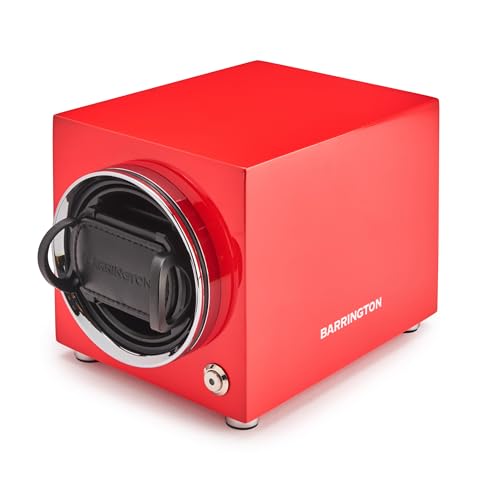
Barrington Single Watch Winder Crimson Red
- Five documented speed levels with 650, 750, 850, 1,000 and 1,950 turns per day, plus clockwise, anticlockwise and alternating rotation as separate settings instead of vague programme names
- For a Zenith you set alternating rotation and the 750 setting, with the 850 setting kept as a reserve upwards
- Runs on the power adapter or on two AA batteries; according to the manufacturer, one set lasts almost two months in intermittent operation
- The standard cushion holds common cases securely, but a clamping cuff like the one from WOLF would be the more robust solution on a steel bracelet

WOLF Heritage Single Winder with storage
- The patented lock-in holder clicks into the drum and, according to the manufacturer, carries cases up to 52 millimetres, so even a hefty chronograph body sits rock solid
- The direction of rotation is selectable: clockwise, anticlockwise and bidirectional; for Zenith calibres you set alternating rotation
- Operation on the supplied universal adapter or on AA batteries, plus a storage compartment for a spare strap or second watch and a glass cover against dust
- The speed is fixed at 900 turns per direction and lies above the quoted range; thanks to the slip clutch it is uncritical, but not adjustable

Swiss Kubik Velour Windsor for 1 automatic watch
- Swiss Kubik is the only brand in the niche to quote independently verified noise values, a real argument for the bedroom cupboard
- Battery-only operation makes the device safe-compatible, because a retrofitted power lead-through destroys the safe's certification
- The running cycles can be programmed, so you deliberately set the 650 to 800 turns quoted for Zenith, and bidirectionally
- Manufacture price for a single position; if you want to look after a Chronomaster and a Defy at the same time, you pay considerably more

ROTHWELL double watch winder
- Five speed settings and three directions of rotation can be set separately for each position, so an El Primero runs in alternating rotation on the left and a 7750 watch in pure clockwise rotation on the right
- This very separation is the practical core of this page, because a bidirectional manufacture movement and a chronograph that winds in one direction only cannot share a common setting
- The wooden frame with PU leather cover and the contrasting interior give an appearance above the plain plastic class
- There is no battery compartment; the device needs a permanent power socket and is therefore ruled out for a closed safe
Turns per day for Zenith calibres
Zenith does not publish its own turns figure for watch winders. Two sources are reliable: the settings databases of watch-winder.store and Barrington, and the documented winding direction of the rotor. Both databases give 650 turns per day bidirectional for Zenith, and 650 to 800 is considered the usual working range. These are database values, not a manufacturer specification.
| Calibre | Typical models | Recommended turns per day | Rotation direction |
|---|---|---|---|
| El Primero 400 and 400 B | Chronomaster chronographs of older series | 650 according to the database, practical 650 to 800 | bidirectional (rotor winds in both directions) |
| El Primero 3600 | current Chronomaster chronographs with tenth of a second | no own entry: 650 to 800 | bidirectional (skeletonised rotor) |
| Elite 670 | Defy Skyline 36, Defy Revival Diver | no own entry: 650 to 800 | bidirectional (ball-bearing rotor) |
| All other Zenith automatic movements | Models without a documented entry | 650 to 800 (rule of thumb) | bidirectional |
| For comparison: movements of the 7750 type | TAG Heuer Calibre 16, Longines L688, Oris 771 and 774 | 800 | clockwise only |
The El Primero 400 and the 400 B variant are fully integrated automatic chronographs with column wheel control, 31 jewels and 326 components, 30 millimetres in diameter and 6.60 millimetres high. They run at 36,000 half-oscillations per hour, that is 5 hertz, and offer over 50 hours of power reserve. The rotor is decisive: it transfers energy to the mainspring in both directions of rotation, which is why alternating rotation is the right setting.
The same principle applies to the newer El Primero 3600. The movement consists of 311 components, also beats at 5 hertz, measures tenths of a second, offers a seconds stop and reaches 60 hours of power reserve, with winding via a skeletonised rotor. The flat Elite 670 is the counterpart: 144 components, 28,800 half-oscillations per hour and around 50 hours of power reserve, with a ball-bearing rotor that likewise winds in both directions. It sits in more compact models such as the Defy Skyline 36 and the Defy Revival Diver.
For choosing the setting, the high frequency has a practical consequence that we do not want to dramatise, but also do not want to conceal. A movement at 5 hertz uses more energy than one at 4 hertz, because the balance wheel oscillates more often. If a winder permanently sits at the lower end of the range, an El Primero can therefore be more likely to approach the limit of its power reserve. We therefore recommend the upper half of 650 to 800, without inventing a figure that nobody has documented. Our table of turns per day collects all documented values per calibre, and Power reserve explained covers the basics.
What matters in a watch winder for Zenith
The most important point with a watch winder for Zenith is a contrast that we describe in the opposite direction on our other brand pages. Chronographs of the 7750 type, documented on our site for the TAG Heuer Calibre 16, the Longines L688 and the Oris calibres 771 and 774, transfer the rotor movement exclusively clockwise. The rule of pure clockwise rotation therefore applies to these watches. The El Primero does not follow it, because it is not a module on a third-party base movement, but an integrated automatic chronograph with a bidirectionally winding rotor.
For you this has a concrete consequence when switching. If you previously had a watch of the 7750 family on the winder and left it set to pure clockwise, you must change the device over for a Zenith. Otherwise the El Primero uses only one of its two winding directions, and only part of the set turns arrives as winding output. Conversely, a bidirectional programme on a 7750 watch wastes around half of the movements. If you own both watches, you therefore need two separately adjustable positions.
The second point concerns the holder. On a solid steel bracelet, a Chronomaster brings weight that acts as a lever on the mount with every rotation. A loose cushion can slip under this, whereas a clamping cuff like the one on the WOLF Heritage actively fixes the case. For the smaller Defy models with the Elite 670, a well-adjustable cushion is enough.
Finally, the location counts. A device on the bedside table should run quietly; for this we have an overview of the quiet watch winder. If the winder is to go in the safe, you need battery operation, because a drilled cable lead-through voids the safe's certification; suitable models are collected in the category battery-powered watch winders. And because an El Primero 3600 with 60 hours of power reserve survives a weekend, a device is pure convenience with daily wear, which the watch winder buying guide puts into context.
Which unit for whom
If you want to look after your Zenith as precisely as possible, the botta Cube is the first choice, because its nine programmes are named in turns per day. If you value separate switches for direction and turns, the Barrington Single is the equivalent alternative. Anyone looking for the most well-rounded device and wanting to expand later should go for the Beco Technic Boxy with the highest rating. The comparison Watch winders for 1 watch shows further single devices.
If your chronograph hangs on a solid steel bracelet, the WOLF Heritage with its locking cuff up to 52 millimetres is the most robust answer, even though its fixed 900 turns lie above the range. If the device is to stand in the bedroom or in the safe, the way leads to the Swiss Kubik Velour Windsor. If you own a watch of the 7750 type alongside the Zenith, the ROTHWELL Doppel with two separate positions does the right thing. If the collection grows, the comparison Watch winders for 2 to 4 watches is worthwhile.
If you are interested in a particular provider, you will find the ranges gathered in the brand overview, for example at Barrington, WOLF, Swiss Kubik or ROTHWELL. The full data sheets are in our overview of data checks. If you wear other brands alongside the Zenith, the sister page Watch winders for Rolex will help.
Editorial verdict
Zenith is the exception among chronograph brands, and the whole buying decision follows from that. The El Primero winds bidirectionally, so you set alternating rotation and not pure clockwise. The databases give 650 turns per day, 650 to 800 is usual, and because of the 5 hertz we feel more comfortable in the upper half. Our recommendation is the botta Cube for the finest dosing, the Beco Technic Boxy as the best-rated all-rounder, the Barrington Single for clear figures, the WOLF Heritage for heavy cases, the Swiss Kubik for bedroom and safe, and the ROTHWELL Doppel for mixed pairs.
You do not need to worry about too many turns, because the slip clutch in the barrel prevents the mainspring from being overwound. A setting that is too high only costs electricity, which is why the WOLF's 900 turns are harmless. Whether a device is worth it is covered in our basics article Does my watch need a watch winder?. And to be clear: none of the devices is recommended, licensed or approved by Zenith; we only assess technical suitability.
Buying guides for other watch brands
The El Primero is the rare chronograph that winds in both directions, while the common 7750 design only knows one direction. How the other brands fit in is explained here: TAG Heuer, Longines, Breitling, Rolex, Omega, Tudor, IWC, Panerai, Oris, Seiko, Cartier, Jaeger-LeCoultre, Hamilton, Tissot, Certina, Mido, Grand Seiko, Bell und Ross, Sinn, Glashütte Original, Nomos, Rado, Maurice Lacroix, Frederique Constant, Junghans. Our table of turns per day collects all documented values by calibre.
Because a 5 Hz movement demands more energy, devices with finely graduated programme selection from Designhütte and Beco Technic are worthwhile. The brand overview gives an overview of all manufacturers.
The text of this page was created with an AI language model and was reviewed and approved editorially before publication. Editorial responsibility lies with Seydhan Cakmak. The product images shown are not AI images but manufacturer and retailer photos from the Amazon catalogue, which we embed unchanged.
A limitation we disclose: Amazon and the retailers selling there now use generative tools in their listings themselves. Whether an individual catalogue image is affected, we cannot check from the outside, so we claim it neither one way nor the other. As soon as an image demonstrably comes from a generative model, we label it visibly on the image with the label AI image. More on this on the AI transparency page.